
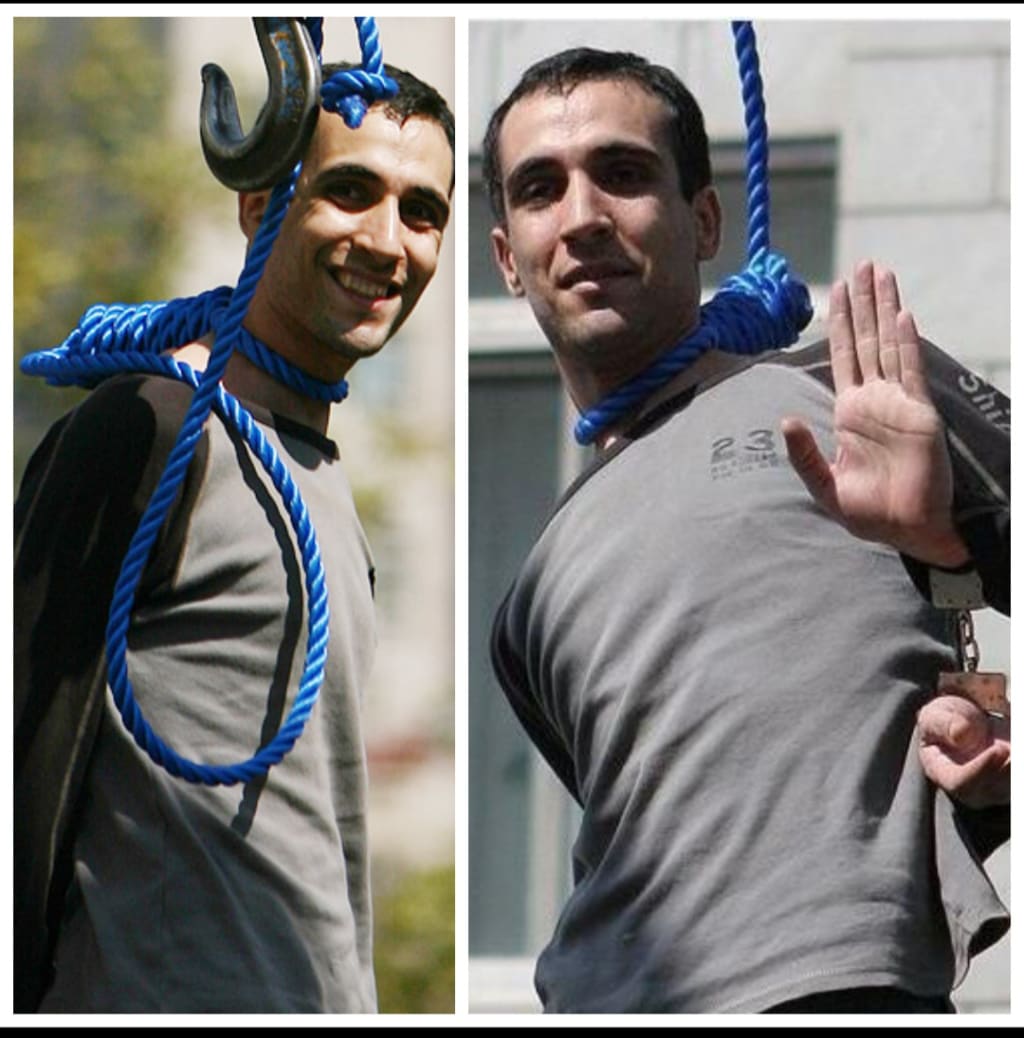
Majid Kavousifar: The Man Who Smiled Before the Noose
On August 2, 2007, the streets of Tehran bore witness to one of the most controversial public executions in modern Iranian history. Two men — Majid Kavousifar and his nephew Hossein Kavousifar — were hanged before a large crowd for the assassination of Judge Masoud Moghaddasi, a prominent figure in Iran’s Islamic Revolutionary Court. The case drew attention not just for the crime itself, but for what Majid said and how he faced his final moments — with defiance, calm, and a smile.
A Judge and a Controversial Legacy
To understand the depth of this story, one must first look at Masoud Moghaddasi, the man Majid targeted. Moghaddasi was no ordinary judge. He was part of the Islamic Revolutionary Court — an institution responsible for sentencing thousands of political prisoners after the Iranian Revolution.
During the 1988 mass executions of political prisoners, Moghaddasi was among several judges who collectively condemned between 2,800 and 3,800 detainees to death. Many of those prisoners were accused of being opponents of the regime, yet their trials were brief, often lasting only a few minutes. For decades, families of those executed have sought justice, labeling those days as one of the darkest chapters in Iran’s modern history.
To Majid Kavousifar, these memories were not distant history — they were a wound that had never healed.
The Assassination of Judge Moghaddasi
In August 2005, Masoud Moghaddasi was shot and killed in Tehran. The assassin fled the scene but was later identified as Majid Kavousifar, a man in his early thirties. Accompanying him was his nephew, Hossein, who allegedly helped plan and execute the attack. After the killing, the two fled to the United Arab Emirates, seeking asylum. However, they were arrested and extradited back to Iran — a country that rarely shows mercy to political crimes.
Their trial was swift. Both men were found guilty of murder and sentenced to public execution. For the Iranian government, this was meant to be a warning to anyone who dared to challenge its authority. But for Majid, it was a moment to speak — perhaps for the last time — against the injustice he believed had consumed his country.
A Smile Before Death
On the day of their execution, witnesses recalled that Majid appeared calm and composed. While many tremble in their final moments, he stood tall, his eyes steady, his demeanor unbroken. When asked if he had any last words, he delivered a statement that would echo across social media and human rights circles in the years to come.
“My name is Majid Kavousifar, I am Iranian.
I did not wait for someone in this world to give me my right.
I reached the point at which I decided to eradicate any injustice.
I smile because I know that a small smile at that moment will be a great message of hope for every oppressed human being on the face of the earth.”
Those who witnessed it said his final words silenced the crowd. For some, he was a criminal. For others, he became a symbol of resistance — a man who believed that standing against oppression was worth dying for.
Between Justice and Rebellion
The case of Majid Kavousifar remains deeply divisive. The Iranian government portrayed him as a murderer who took the law into his own hands. But among dissidents, his act was seen as a form of retribution against a regime responsible for decades of political repression and mass executions.
Human rights organizations have pointed out that the story reflects a cycle of violence fueled by injustice. When people lose faith in the system, they sometimes turn to acts of desperation — acts that, while morally complex, stem from a deep yearning for justice and dignity.
The Legacy of a Final Smile
Eighteen years later, Majid’s words continue to be shared online, often quoted by those who fight against tyranny and corruption. His smile — captured in photos moments before his execution — has become a haunting image of both defiance and tragedy.
Was Majid Kavousifar a hero or a misguided avenger? The answer depends on one’s perspective. But what cannot be denied is that his death left behind a question that still resonates: When justice is denied, what choices are left to the oppressed?
In the end, Majid’s final act — and his final smile — became more than an execution scene. It became a symbol of a man who, in his own words, “decided to eradicate injustice” — even if it meant giving his life for it.
About the Creator
Keep reading
More stories from Khan and writers in Confessions and other communities.
If a men sells his daughter for sex trafficking
Of Gold and Grit: When Wealth Met Justice in Two Unforgettable 2020 Stories The year 2020 was filled with chaos, change, and countless viral moments — but among them, two stories stood out for their emotional contrast. One told of unimaginable generosity from one of the world’s richest royal families, while the other revealed the desperate love of a father who took justice into his own hands. The first involved rapper Lil Wayne and a Saudi prince; the second, an ordinary American father named John Eisenman. Together, they showed how power and pain can both drive extraordinary human actions.
By Khan5 months ago in Confessions
The Piggy Project
I’ve had so many names in this life I lose track of which ones were ever really mine and which ones I wore because someone needed me to. Some were handed to me before I had words to refuse them, before I knew what they meant, before I knew I could say no. Most weren’t meant to hurt. That doesn’t mean they didn’t leave marks. Marks that told me who I belong to, who I am by way of who claims me, recognizes me in the good and bad, who walks beside me.
By Fatal Serendipity4 days ago in Confessions
Exploring Fantasies Between Couple To Strengthen Emotional Intimacy
Fantasies are an inseparable aspect of human fantasy and affective disclosure. Healthy partners should share fantasies to enhance each other and to build trust and to make partners communicate honestly. In a place where couples are free to talk about their wishes and thoughts, there will be an environment where there is honesty and vulnerability. The openness assists partners to know each other better, which enhances emotional closeness and respect.
By Robert Smith2 days ago in Confessions



Comments
There are no comments for this story
Be the first to respond and start the conversation.