
The Letter She Never Sent
A daughter's grief finds healing through the silent words of her late mother

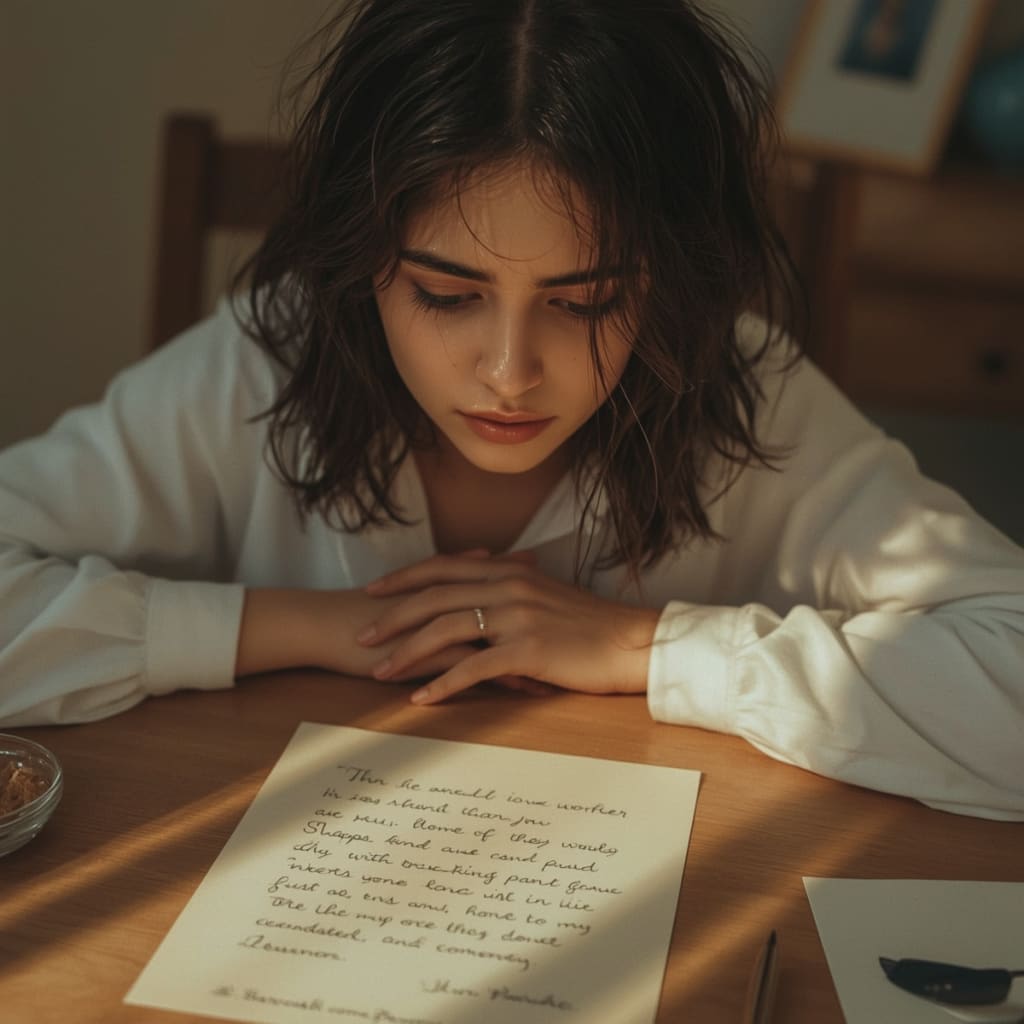
I found the letter three weeks after she passed. It was tucked inside the old shoebox she kept beneath her bed—the one I was never allowed to touch. It smelled faintly of rosewater and dust, the scent of my childhood.
The envelope was yellowed at the edges, unsealed, and addressed to me in her careful handwriting: "To my daughter, when the time is right."
The irony twisted like a knife. The time was never right, and now it never would be.
I sat on the carpet of her bedroom floor, legs numb, eyes raw. I traced each letter of my name with trembling fingers before pulling the paper out. Her words spilled into my hands.
---
“My dearest Maya,
If you're reading this, it means life has already done what life does best—move forward, whether we are ready or not.
There are things I could never say while I was alive. Not because I didn’t want to, but because I didn’t know how. I was always better with silence, wasn’t I?”
---
I paused. That line alone brought tears.
Yes. She had been better with silence. Conversations with my mother were often measured in nods and glances, not words. I spent most of my teenage years trying to crack her like a code, only to give up and assume she was simply cold. Detached.
But now, her voice on the page felt warmer than any memory I had of her.
---
“You always thought I didn’t understand you. Maybe I didn’t—at least not the way you wanted me to. But I watched. I watched you build a world out of stories when real life felt too sharp. I saw you stare out the window longer than a child should, searching for places your feet hadn’t been yet. I saw your pain, Maya, even when you tried to bury it behind books and sarcasm.”
---
There was a lump in my throat. I remembered those long, lonely summers — when I would lock myself in my room and write in cheap spiral notebooks until my hands cramped. I had always thought she never noticed. That she didn't care.
But she did.
---
“I never learned how to say ‘I’m proud of you’ without my throat tightening. I never learned how to tell you that I, too, used to write poems under my pillow. That I, too, once believed that if I vanished, no one would notice. We were more alike than I ever let on.”
---
I closed my eyes.
Maybe the silence between us wasn’t empty—it was heavy. Weighted with everything unsaid, everything we were afraid to say. I had resented her for not opening up, but perhaps she had always been trying, in her own quiet way.
---
“But motherhood isn’t a mirror. It’s a window. And sometimes I was too afraid to look in.”
---
Her handwriting began to waver slightly, like the tremble of an old voice. I imagined her writing this at night, maybe sitting at the kitchen table with a cup of tea gone cold. Did she cry while writing it? Did she hesitate before sealing it away?
I would never know.
---
“If I could ask you for anything now, it would be this: be kinder to yourself than I ever was to myself. Forgive more quickly. Let love surprise you. And write, Maya. Write even when it hurts. Especially then.”
“With all the love I didn’t know how to show,
Mom.”
---
That letter changed everything.
It didn’t bring her back. It didn’t undo years of distance or erase the silences between us. But it gave me something I never knew I needed—a door into her world. A bridge between her silence and my noise.
That night, I sat at my own kitchen table, the letter beside me, the shoebox still open. I picked up a pen after months—maybe years—and opened a fresh journal. I didn’t write a story. I wrote to her.
I told her about the funeral. About how her sister cried harder than I thought possible. How I’d stood still like a statue.
I told her about the yellow sweater I found in her closet, the one I remember wearing to school one day when I was sick.
I told her how I finally understood why she always cut the crusts off my sandwiches without asking.
I wrote for hours. Pages and pages. My handwriting messy, my eyes swollen, my heart somehow lighter.
When I finally stopped, I placed the original letter in a new envelope and wrote three words on it in my own handwriting:
"I forgive you."
Then I slid it into the shoebox, closed the lid, and whispered into the quiet room,
"I'm writing again, Mom."
And for the first time in a long time, I didn't feel alone.
About the Creator
Hazrat Bilal
"I write emotionally-driven stories that explore love, loyalty, and life’s silent battles. My words are for those who feel deeply and think quietly. Join me on a journey through the heart."
Keep reading
More stories from Hazrat Bilal and writers in Confessions and other communities.
A Shepherd and a Lion in the Forest
The forest was alive with whispers. The wind rattled the tall trees, carrying with it the sound of leaves brushing against each other, like countless voices telling old secrets. Somewhere at the edge of this vast green world, a young shepherd named Elias guided his small flock of sheep. He was no ordinary boy; though his life was simple, his heart was restless, always searching for meaning beyond the daily rhythm of grazing, feeding, and keeping his sheep safe.
By Hazrat Bilal5 months ago in Confessions
Word of the Day: ホチキス
I don't know the word for Staples. I remember I used to think that Hochikisu was an Onomatopoeia for a stapler rather than a brand name. I am pretty sure I already have this title as a theme, which is making me feel many sort of ways as Vocal is harassing me about payments currently.
By Kayla McIntosh19 days ago in Confessions
The Fear of Being Seen
Introduction The fear of being seen is something many of us carry quietly. It hides behind our smiles, our silence, and the carefully curated versions of ourselves we present to the world. We want connection, yet we dread exposure. We long to be understood, but we fear judgment. This inner conflict shapes our choices, our relationships, and even our dreams.
By Aiman Shahid3 days ago in Confessions



Comments
There are no comments for this story
Be the first to respond and start the conversation.