
The Hidden Cost of Always Being Available: Why Constant Connectivity Drains Our Joy
How Our Need to Stay Online 24/7 Erodes Peace, Productivity, and True Human Connection
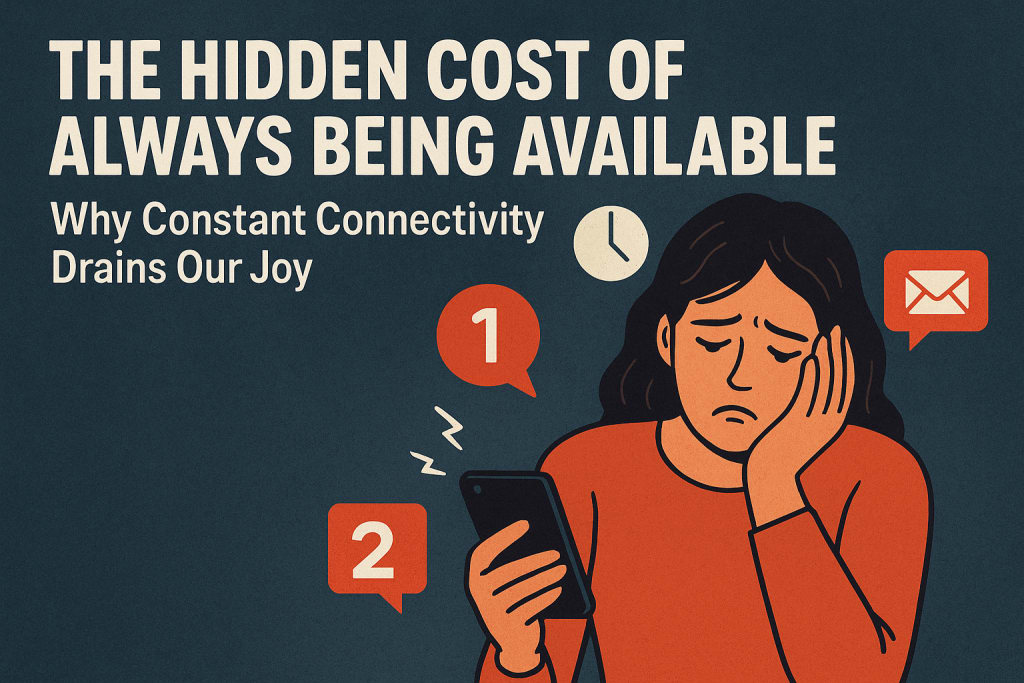
Introduction: The Pressure of Being “Always On”
In today’s hyperconnected world, the idea of being unreachable feels almost impossible. Our smartphones buzz, our inboxes flood, and notifications flash across multiple screens from dawn until late at night. We carry the internet in our pockets, giving people unlimited access to us anytime, anywhere. What was once a tool of convenience has quietly become a leash of expectation: the expectation to reply immediately, to always “check in,” and to never truly disconnect.
This constant accessibility promises efficiency, but it comes at a steep price. Beneath the illusion of productivity lies burnout, stress, and a growing sense of emptiness. Being “always available” doesn’t just drain our energy—it erodes our joy, peace of mind, and even the depth of our relationships.
The Illusion of Productivity
One of the biggest myths of modern connectivity is that being available 24/7 makes us more productive. In reality, constant interruptions chip away at focus and efficiency. Studies have shown that it can take up to 23 minutes to fully regain concentration after an interruption. That quick reply to a Slack message, email, or text might feel harmless, but it fragments attention in ways that reduce the quality of our work.
Instead of deep, meaningful progress, we end up in a perpetual state of “half-work”—answering emails while trying to finish projects, checking messages between meetings, or scrolling through notifications during dinner. The outcome? We’re busier than ever, but less fulfilled and less effective.
The Emotional Tax of Availability
Being available all the time isn’t just a practical issue—it’s an emotional one. Every ping, buzz, or vibration pulls us out of the present moment and creates a small spike of anxiety. The thought, “I should reply right now” becomes an internalized pressure. Over time, this builds into a chronic state of stress.
The real danger is subtle: we begin to measure our worth by our responsiveness. If we don’t reply fast enough, we feel guilty. If we miss a call, we fear disappointing someone. This emotional tax robs us of joy and replaces it with low-level tension that never fully leaves.
The Death of Downtime
In the past, leaving the office meant being done with work. Evenings and weekends offered rest, family time, or hobbies. Today, smartphones blur those boundaries. Work emails follow us to the dinner table, and social media DMs creep into late-night hours.
True downtime—moments of doing nothing, reflecting, or simply enjoying silence—has become a rare luxury. But downtime isn’t wasted time; it’s essential for creativity, problem-solving, and mental health. Without it, we run on empty, constantly exhausted but never fully recharged.
The Impact on Relationships
Constant availability doesn’t just affect us individually; it affects our connections with others. How many times have we sat across from a loved one while simultaneously scrolling through our phones, responding to texts, or checking notifications?
When we’re always “half-present,” relationships suffer. Genuine conversations require attention, but divided attention communicates disinterest. Friends and family might not voice their frustration, but they feel it—the sting of competing with a device for our time. Over months and years, this erodes intimacy and weakens bonds.
Ironically, the very tools that keep us “connected” often disconnect us from the people who matter most.
The Burnout Cycle
Being always available feeds directly into burnout—a state of emotional, physical, and mental exhaustion caused by chronic stress. Burnout thrives in environments with no boundaries, where every ping feels urgent and every silence feels like failure.
The cycle looks like this:
Constant alerts → Break focus and cause stress.
Guilt over delayed responses → Drive us to be more available.
Less downtime → Leads to exhaustion.
Exhaustion → Reduces productivity, creating pressure to “catch up” by being even more available.
It’s a vicious cycle, and unless we deliberately break it, burnout becomes inevitable.
Why We Struggle to Disconnect
If constant availability is so harmful, why do we cling to it? The answer lies in both social norms and personal fears.
Fear of Missing Out (FOMO): We worry that disconnecting means missing opportunities or important updates.
Fear of Disappointing Others: We want to be seen as reliable, responsive, and committed.
Cultural Expectations: In many workplaces, availability is equated with dedication, even if it undermines actual performance.
Addictive Design: Apps and platforms are engineered to keep us hooked, rewarding us with dopamine hits for every notification or message.
In other words, it’s not just weakness of will—it’s a system designed to keep us plugged in.
The Hidden Joy of Boundaries
The good news is that reclaiming joy doesn’t require abandoning technology altogether. It requires boundaries.
Set “Availability Hours”: Just like businesses have opening and closing times, we can set personal limits. No emails after 7 p.m., or no social media during meals.
Turn Off Non-Essential Notifications: Do we really need to know the moment someone likes a post? Probably not.
Practice “Single-Tasking”: Be fully present in one activity at a time—whether that’s working on a project, talking with a friend, or resting.
Take Digital Sabbaths: A day or even a few hours each week offline can reset our nervous systems.
Communicate Boundaries Clearly: Let colleagues and friends know your preferred response times so they respect your space.
Boundaries aren’t about shutting people out—they’re about showing up fully, with more energy and attention, when we are available.
Rediscovering Joy in Disconnection
When we step back from constant availability, something beautiful happens: we rediscover joy. We notice the quiet details of life—the warmth of sunlight, the comfort of silence, the laughter of a loved one. We find creativity flowing again, unblocked by endless pings. We remember what it feels like to be fully present in a moment without wondering who might be messaging us.
Disconnection creates space for reconnection—with ourselves, with nature, with loved ones, and with the activities that bring us true fulfillment.
Conclusion: Choosing Presence Over Availability
The hidden cost of always being available is that we lose the very things that make life meaningful: peace, focus, connection, and joy. Constant connectivity convinces us we’re being productive and connected, but in reality, it drains us and distances us from real fulfillment.
The truth is, we don’t need to be reachable at every moment to be valuable. In fact, our greatest contributions often come when we step back, recharge, and return with clarity and purpose.
Choosing presence over availability isn’t just self-care—it’s a radical act of reclaiming joy in a world that profits from our distraction. By setting boundaries and embracing disconnection, we can finally move from a life of endless pings to a life of deeper meaning.
About the Creator
Keep reading
More stories from Aiman Shahid and writers in Confessions and other communities.
The Silent Strength of Solitude: Why Time Alone Can Heal and Empower You
Introduction: Redefining Solitude In a world that glorifies constant connectivity, solitude often gets mistaken for loneliness. We live in an age where being “busy” is worn like a badge of honor, and silence is quickly filled with notifications, streaming videos, or endless scrolling. The very idea of being alone without distraction can feel uncomfortable—almost foreign. Yet solitude, when embraced intentionally, is far from a void. It is a source of restoration, growth, and empowerment.
By Aiman Shahid4 months ago in Confessions
Wild Card Weekend Recap: What Happens Now?
I think I figured out why I love Wild Card Weekend so much. It's because it's the first playoff anything of the calendar year. The NFL season starts in the fall, and once upon a time, the champion was crowned either on or slightly before New Year's. The evolution of the NFL schedule has resulted in the playoffs starting just into the New Year, and currently, the final week of the season falls on the first weekend of the New Year, with Wild Card Weekend coming a week after that. So yes, chronologically, the NFL's Wild Card Weekend serves as the first playoff anything of the calendar year.
By Clyde E. Dawkins5 days ago in Unbalanced




Comments
There are no comments for this story
Be the first to respond and start the conversation.