
The Empires That Vanished Overnight
How Powerful Civilizations Collapsed Faster Than Anyone Expected
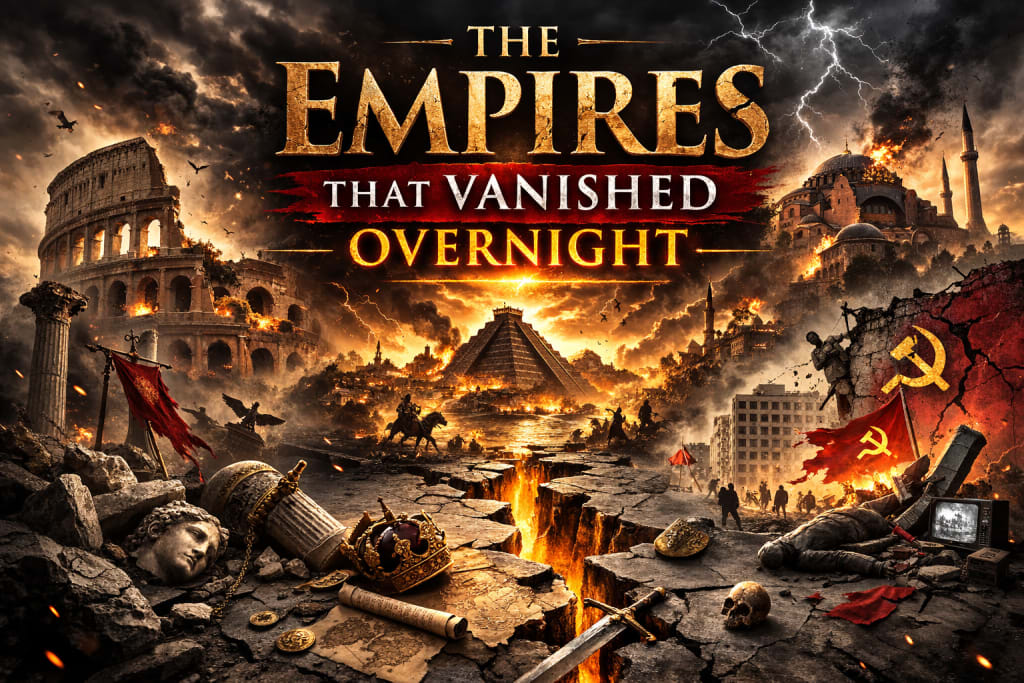
History often gives us the illusion that empires fall slowly — that decline is a long, visible process of weakening armies, failing economies, and crumbling institutions. Yet some of the most powerful civilizations in human history seemed to disappear almost overnight. In reality, their collapse was usually the result of years — sometimes centuries — of hidden instability, only revealed when a final shock shattered the illusion of permanence.
These sudden collapses remind us of one humbling truth: no empire, no matter how mighty, is immune to fragility.
The Fall of the Western Roman Empire (476 CE)
For centuries, the Western Roman Empire stood as the ultimate symbol of power. It dominated Europe, North Africa, and parts of the Middle East. Roman roads connected continents. Roman law shaped civilizations. Roman legions were feared across the known world.
Yet in 476 CE, it ended abruptly.
A Germanic chieftain named Odoacer deposed the young emperor Romulus Augustulus and declared himself ruler of Italy. No dramatic final battle. No massive last stand. Just a quiet transfer of power.
To many citizens, it may have felt sudden. But the empire had been hollowing out for decades — political corruption, economic strain, overextended borders, and repeated invasions had weakened its core. The sack of Rome in 410 by the Visigoths shocked the world, signaling that even the “eternal city” was vulnerable.
When the final blow came, there was little left to defend.
Rome didn’t collapse in a day — but it disappeared from the political map in one.
The Aztec Empire (1521)
In the early 16th century, the Aztec Empire ruled central Mexico from its magnificent capital, Tenochtitlan — a city built on a lake, filled with temples, markets, and canals.
It was one of the most impressive urban centers in the world.
Then, in 1521, it was gone.
Spanish conquistador Hernán Cortés arrived in 1519 with a few hundred men. Against an empire of millions, such a force should have been insignificant. But Cortés formed alliances with rival tribes resentful of Aztec dominance. Worse still, smallpox — a disease unknown in the Americas — spread rapidly, devastating the population.
Within two years, Tenochtitlan fell.
The empire that had ruled for nearly a century vanished with shocking speed. What seemed like a sudden collapse was actually the convergence of military strategy, internal resentment, and biological catastrophe.
Sometimes, the most powerful structures fall not just from enemies — but from invisible threats within.
The Mongol Empire’s Fragmentation (14th Century)
At its height, the Mongol Empire stretched from Eastern Europe to the Sea of Japan. It was the largest contiguous land empire in history.
Founded by Genghis Khan, the empire conquered vast territories with unmatched speed and military precision. Cities trembled at the sound of Mongol cavalry.
But after its peak in the 13th century, the empire fragmented rapidly
The death of strong leaders led to internal divisions. The empire split into khanates — the Golden Horde, the Ilkhanate, the Chagatai Khanate, and the Yuan Dynasty. While these states survived for decades, the unified empire vanished quickly.
From an unstoppable global superpower to fractured regional states — the shift happened within a generation.
It wasn’t a battlefield defeat that destroyed the Mongols. It was succession conflict, governance challenges, and the difficulty of ruling a vast multicultural empire.
The Byzantine Empire (1453)
The Byzantine Empire was the continuation of Rome in the East. For over a thousand years after Rome’s fall, Constantinople remained a center of culture, trade, and Christianity.
By the 15th century, however, it had shrunk dramatically. Surrounded by the rising Ottoman power, it clung to survival.
In 1453, Mehmed II launched a massive assault on Constantinople. Using enormous cannons to break through the ancient Theodosian Walls, Ottoman forces overwhelmed the defenders.
On May 29, the city fell.
In a single day, an empire that had lasted more than a millennium disappeared.
The fall of Constantinople shocked Europe and marked the end of the medieval era for many historians. It was both a military defeat and a symbolic turning point in global history.
The Soviet Union (1991)
Modern history offers its own example of a sudden imperial collapse: the Soviet Union.
For decades, it stood as one of two global superpowers, rivaling the United States during the Cold War. It possessed nuclear weapons, vast resources, and influence across Eastern Europe and Asia.
Yet in December 1991, it dissolved.
Economic stagnation, political reform under Mikhail Gorbachev, rising nationalism in republics, and the failed August coup all accelerated its decline. When leaders of Russia, Ukraine, and Belarus signed an agreement declaring the union dissolved, the world watched in disbelief.
One day it was a superpower. The next, it was fifteen independent nations.
For those living through it, the collapse felt almost instantaneous — even though its roots stretched back decades.
Why Do Empires Fall So Suddenly?
When we examine these examples, a pattern emerges:
Internal Weakness – Corruption, economic strain, or political instability.
External Pressure – Invasion, competition, or military defeat.
Technological or Biological Shock – Cannons, gunpowder, disease.
Leadership Crisis – Weak succession or reform gone wrong.
Empires rarely collapse purely because of one factor. Instead, they balance on a fragile edge. When enough pressure accumulates, the tipping point comes — and history records it as an “overnight” fall.
But the truth is deeper.
Collapse is often silent before it is visible.
The Illusion of Permanence
Every empire believes it will last forever. Rome called itself eternal. The Byzantines believed their city was divinely protected. The Soviet Union projected ideological certainty.
Power creates confidence. Confidence creates complacency.
The most dangerous moment for any empire may not be when it is weak — but when it believes it is invincible.
History shows that strength can hide fragility. Prosperity can conceal inequality. Military dominance can mask internal decay.
When the final moment arrives, it looks sudden only because we ignored the warning signs.
Lessons for the Modern World
Studying fallen empires isn’t just about the past. It is about understanding systems — political, economic, and social — that govern our present world.
Empires fall when:
Leaders ignore internal divisions.
Innovation outpaces adaptation.
Citizens lose faith in institutions.
External threats exploit internal weakness.
The story of vanished empires reminds us that stability is not guaranteed. It must be maintained.
No civilization is too advanced. No nation too powerful. No system too secure.
Conclusion: The Silence After Power
Perhaps the most haunting part of an empire’s collapse is not the battle, the invasion, or the political announcement.
It is the silence afterward.
The empty throne.
The lowered flag.
The city that once ruled the world — now just ruins and memory.
Empires rarely hear the moment they fall. But history does.
And history whispers a warning across centuries:
Power is temporary.
Glory is fragile.
Even the mightiest empires can vanish overnight.
About the Creator
Keep reading
More stories from Aiman Shahid and writers in Confessions and other communities.
The Silence Between Us
There are moments in every relationship when words fail—not because we don’t have them, but because we are afraid to use them. We convince ourselves that silence is safer. Less messy. Less confrontational. We tell ourselves we’re protecting the peace, when in reality, we’re protecting our pride, our fear, or our fragile hope that things will somehow fix themselves without us having to say anything at all.
By Aiman Shahida day ago in Confessions
I was in a Toxic Relationship, with my Workplace
“You got that?” My ex yelled. His hands were balled into fists at his side. At six foot three, he towered over me. A normal person would have been afraid, but I looked up a video of George Lopez repeatedly saying, “I got this,” and showed it to him. I had grown used to this treatment, so much so that I didn’t blink when he ripped the phone from my hand and threw it across the room.
By Jade M.2 days ago in Confessions
Word of the Day: 目に入れてもいたくない
Unfortunately, today is the start of the Mercury Retrograde. I should've sent some emails yesterday. I was too weak to do so yesterday, also since the appointment didn't happen.. Well, I can't use that as an excuse, I was weak so, whether the appointment happened or not, I wouldn't have had the strength to do anything afterwards either way.
By Kayla McIntosh2 days ago in Confessions




Comments
There are no comments for this story
Be the first to respond and start the conversation.