
The Day the Internet Died: A Town's Journey Back to Human Connection
When a global outage silenced the screens, one forgotten town discovered the forgotten magic of real life.

Chapter One: The Silence
It started like any ordinary Tuesday.
I got up, half-awake, stumbled to the kitchen, poured myself the usual bitter coffee from the machine I kept forgetting to clean. As I sat at my small breakfast table scrolling through emails and muted TikTok clips, the screen stuttered, then froze. My Wi-Fi symbol blinked out. My laptop gave me a spinning wheel. My phone, even on mobile data, refused to load anything.
No Internet Connection.
“Ugh. Again?” I muttered, thinking maybe it was just my router or the service provider acting up — again. But something felt… different.
Then the texts started coming in — or rather, the lack of them. My group chats stayed eerily silent. No memes. No GIFs. No passive-aggressive work messages. It wasn’t just me. My friend Sara called me — called, as in, voice-to-voice, something we hadn’t done in months.
“You offline too?” she asked, sounding breathless.
“Yeah. My Wi-Fi’s gone, but so is my mobile data.”
“Same here. My cousin in Islamabad says his internet’s dead too. And Twitter’s completely down.”
“Wait… even Twitter?”
That’s when I knew something serious had happened.
Chapter Two: The Collapse
By noon, it was official: a global cyberattack or system failure — no one knew for sure — had crashed the internet. Not just websites, but the core infrastructure of global communication.
Banks, airlines, schools, hospitals — all paralyzed. ATMs stopped spitting out cash. Online payments failed. Apps were frozen. Cloud systems crashed.
People poured into the streets, phones in hand like compasses without a North Star. Some looked angry. Others looked terrified. A few seemed… relieved?
The first casualty in our town was the coworking space. With no virtual meetings to attend, people simply walked out, shrugging. The owner, a guy named Rizwan, just locked the door and laughed nervously, “Guess it’s a holiday now.”
Shops couldn’t process transactions. Delivery apps were useless. Kids didn’t know what to do without YouTube. Older folks just sat on porches, watching the chaos unfold with an air of told-you-so.
No one knew when — or if — the internet would return.
Chapter Three: Offline Awkwardness
The next morning, I stepped outside for a walk. I didn’t even know why. Maybe it was habit. Maybe it was boredom. But when I got to the park, something odd happened.
People were talking.
Not on FaceTime. Not over WhatsApp. Real, face-to-face conversations. At first, it was awkward. You could see it in their body language. We were like prisoners of a strange social experiment. Eyes darted around nervously, trying to avoid contact — or maybe seeking it.
I ran into Samir, a software engineer who used to work remotely for a company in Dubai. Without internet, his job had evaporated overnight.
“No Zoom. No code. No clients,” he sighed, looking both amused and lost. “I haven’t sat in this park since college.”
He sat next to me. We talked for three straight hours.
Three hours.
I don’t think I had talked to anyone that long since 2018.
Chapter Four: A New Routine
By Day 3, things began to shift in town. And in us.
With no social media to compare our lives to, people started showing up — really showing up. The local farmer’s market became the hub. You couldn’t use PayPal or credit cards, but you could trade eggs for bread, or a carton of milk for a bag of rice.
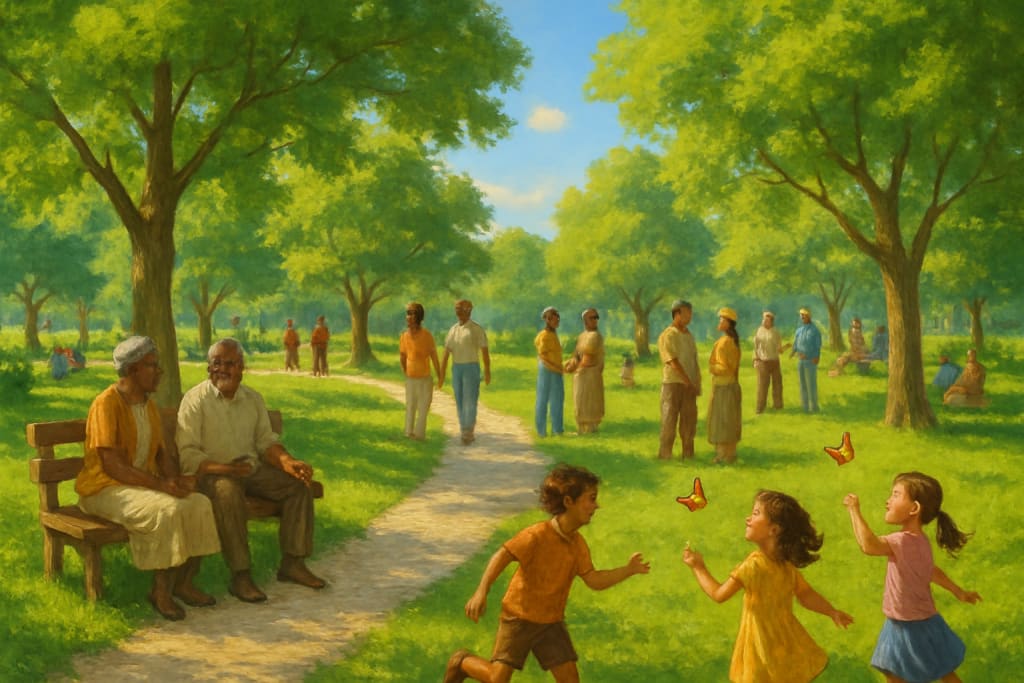
Children — real, human children — played tag in the fields. Without screens to distract them, they turned sticks into swords and rocks into kingdoms. I saw a boy drawing comics with colored pencils, selling them for candy.
The old bookstore, once on the brink of shutting down, became a meeting place. Not just for buying books — for sharing them. Swapping. Reading aloud. I even led a storytelling circle, something I never imagined I’d enjoy.
With the internet gone, we became each other's entertainment.
Chapter Five: The Forgotten Arts
By the end of Week 1, a wave of creativity swept through town.
Sana, a shy teenager who had once lived on Instagram stories, started painting murals — giant, beautiful depictions of life before smartphones. One showed a group of children racing bicycles under the sun, while another showed two elderly people playing chess in the park.
Local musicians emerged with dusty guitars and flutes. Jam sessions broke out on the corners of bakeries and barbershops. Someone found an old radio and broadcasted news the old-fashioned way — crackling voices reading paper reports like it was 1942.
Cooking classes popped up. Gardening groups formed. I joined a community workshop where we learned how to repair broken appliances — without YouTube tutorials.
And, perhaps most beautifully, letters made a comeback.
Real, handwritten letters, passed from door to door. Kids wrote to grandparents. Couples exchanged poetry. One young man proposed with a folded note slipped into a bouquet.
No emojis. Just ink and intention.
Chapter Six: The Elder Voices
Mr. Hamid was my neighbor. I’d lived next to him for six years and barely knew his name.
Turns out, he used to be a radio technician in the army. When the internet failed, he became our town’s unofficial “tech whisperer.” He fixed radios, taught kids how to build antennas, and ran classes on Morse code.
“I told you youngsters one day this cloud would burst,” he said with a smirk as he rewired a transistor. “Now you’ll learn to listen with your ears again.”
His words echoed through me for days.
Without distraction, I noticed things I’d missed: the way my mother hummed when cooking, the call of birds at sunrise, the smell of rain before it fell.
Time felt slower. And somehow, richer.
Chapter Seven: The Breakdown
But it wasn’t all idyllic.
By Week 2, tensions started to surface. The cash crisis grew worse. Without digital systems, some people hoarded food. A few tried to exploit others — offering to barter essentials for absurd demands.
There were rumors of blackouts coming. A few fights broke out in the queue for water. People worried about loved ones abroad. One woman cried on my shoulder, unable to reach her son in Canada.
And then came the Digital Withdrawal Syndrome — yes, that’s what the doctors called it. Anxiety, restlessness, irritability. Turns out, for some, the internet wasn’t just a habit. It was a coping mechanism. Their safety net. Their entire social world.
We held community circles to support one another. It wasn’t perfect, but it helped. Sometimes just being together made the panic ease.
Sometimes, human presence was enough.
Chapter Eight: The Return
It was a cold morning when the internet returned.
A quiet, almost eerie ping on my phone. Then another. Then a flood. Notifications from 21 days ago crashed in like a tsunami. Emails. News. Missed updates. Old memes. Messages from people I hadn’t thought about in weeks.
The world had come back online.
I expected people to cheer. Some did. Others looked… hesitant.
We stood there, in the park where we now met daily, staring at glowing screens like relics from a forgotten religion. It felt like coming back from a spiritual retreat only to be pulled into a noisy nightclub.
The silence we had embraced — the clarity — was gone.
Chapter Nine: Offline Hour
That Sunday, Samir had an idea.
“What if we kept one thing from the blackout?”
He proposed a weekly “Offline Hour” — no devices, no screens, just one hour of undistracted presence. Talking. Playing. Listening. Living.
To our surprise, dozens showed up.
We met at the park. We shared food. Sang songs. Read poetry. Told stories. No one checked their phones. No one filmed it. We were just… there.
Offline Hour became a tradition. Every Sunday since, we gathered. And slowly, other towns adopted the idea. It spread. Not through viral tweets — through letters, through travelers, through word of mouth.
In a world obsessed with connection, we had rediscovered presence.
Chapter Ten: The Legacy of Silence
It’s been a year now.
The world is back online. Faster than ever. Smart glasses. AI assistants. VR social rooms. The next phase of digital evolution is in full swing.
But every Sunday, at 4 PM sharp, we meet in the park.
Offline.
No one’s required to come. But most do. Even teenagers. Even the busiest moms. Even Samir, who now works for a tech company again.
Because we remember.
We remember that in the silence, we found our voices.
That behind every screen is a soul.
That connection isn’t measured in likes or bandwidth.
It’s in shared glances. Laughter. Letters. Silence.
Thanks for reading 😘:)
LIKE AND SUBSCRIBE FOR MORE INTERESTING STORIES
About the Creator
Muhammad Abbas khan
Writer....
Keep reading
More stories from Muhammad Abbas khan and writers in Confessions and other communities.
The Unseen Struggle Behind a Royal Media Empire
When someone steps away from the structured life of royalty, the spotlight does not dim—it shifts. For Meghan Markle and Prince Harry, the transition from palace halls to global media ventures has been anything but smooth. Behind the glamorous headlines lies a world of halted projects, stalled opportunities, and the subtle challenges of maintaining relevance outside royal duties.
By Norul Rahman6 days ago in Confessions




Comments
There are no comments for this story
Be the first to respond and start the conversation.