
The Confession Hidden in My Father’s Wallet
He passed away five years ago — but what I found inside changed everything I believed about him.
When my father died, I couldn’t throw away his things.
For months after the funeral, his jacket still hung by the door, his shoes lined neatly under the bench, as if he might walk in any moment.
Grief does that — it keeps you waiting for someone you know isn’t coming back.
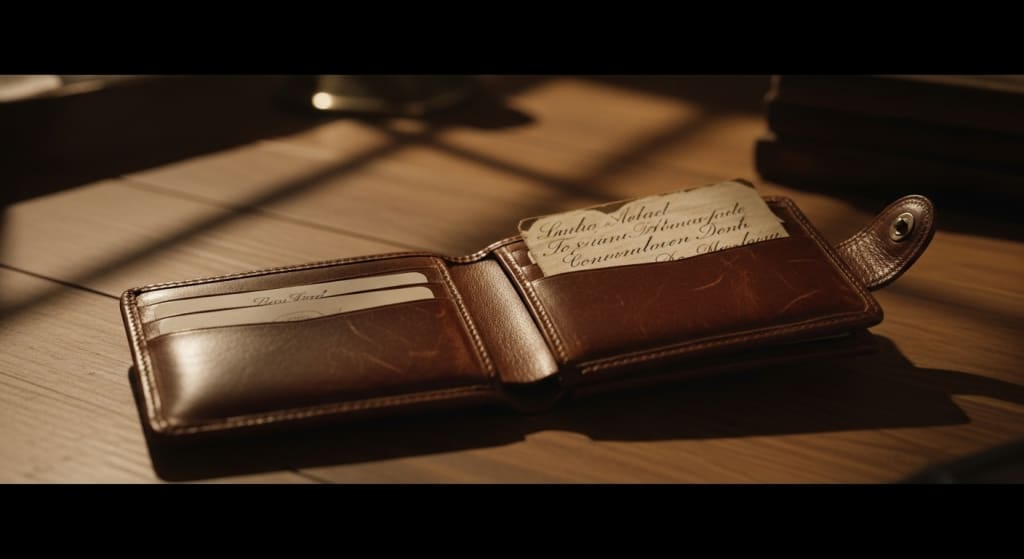
Among all his belongings, there was one thing I couldn’t bring myself to touch: his old leather wallet.
It was the one he’d carried everywhere, the corners worn smooth from years of use, the smell of faded tobacco still clinging to it.
I kept it in a drawer beside my bed. Every time I opened it, I’d glance at it — but I never dared to look inside. It felt sacred, like a small piece of him I wasn’t ready to disturb.
Five years passed before I finally did.
It was a Sunday afternoon, and I was cleaning the house when I came across the drawer again. The wallet was right where I left it, still closed, still whole. I sat on the bed, held it in my hands, and took a deep breath before opening it.
Inside were the usual things — his driver’s license, some old receipts, a couple of coins, and a small photo of me as a child, smiling with missing front teeth. I smiled at that.
Then I found it — a small folded piece of paper tucked behind a coffee receipt. It looked old, yellowed, the edges softened by time.
I unfolded it carefully. On the back, in his familiar handwriting, were six simple words:
“Tell her I never stopped waiting.”
At first, I thought it must’ve been meant for my mother. Maybe an old love note, something sentimental he forgot to throw away.
But then I noticed the date written at the top — 1985.
My parents didn’t meet until 1988.
I froze. My heart started racing.
“Tell her I never stopped waiting.”
Who was her?
That night, I couldn’t stop thinking about it. I tried to remember if my father had ever mentioned someone before my mother. But he never talked much about his past. He’d always been a man of few words — kind, patient, but private.
The next day, I started searching through the old box of his things I kept in the attic. I found letters, family photos, postcards from his work trips — and then something that made my breath catch.
Inside one of his old books, tucked between the pages, was a small postcard. It was from Paris.
On the front, the Eiffel Tower.
On the back, in delicate cursive handwriting:
“Wish you were here. — E.”
The postmark was from 1984.
I turned it over again and again, trying to make sense of it.
E. Who was E?
Was this the woman from the note?
The one he never stopped waiting for?
The more I tried to ignore it, the more it gnawed at me. That night, I finally asked my mother.
We were having tea when I mentioned it casually — or at least, tried to.
“Mom,” I said. “Did Dad ever… love someone before you?”
She didn’t answer right away. Her hands trembled just slightly as she set down her cup.
Then she sighed — that kind of sigh that carries years of quiet acceptance.
“Yes,” she said softly. “Her name was Eleanor.”
I stared at her. I hadn’t told her about the postcard, or the initial.
“How do you know that?” I asked.
She smiled faintly. “He told me once. Long before we married. He said she was someone he met when he worked abroad. They were serious, but her family didn’t approve. She had to leave suddenly, and he never heard from her again.”
Her eyes glistened. “He said she taught him how to love — and how to let go.”
I didn’t know whether to feel sad or angry or strangely touched.
It wasn’t betrayal — it was… humanity.
My father had loved deeply, lost painfully, and somehow carried that quiet ache into a new life — with us.
I showed my mother the note. She looked at it for a long moment, then smiled through tears.
“He must’ve written that for her. Maybe he hoped she’d see it one day.”
We sat together in silence. The kind of silence that says more than words ever could.
That night, I couldn’t sleep. I kept thinking about that note — those six words written decades ago, hidden in a wallet that never left his side.
It made me realize how little we sometimes know about the people we love most. How their pasts live quietly inside them, shaping who they become.
I thought about the love he gave my mother, the patience he showed me, the way he carried himself through life — calm, gentle, content. Maybe it wasn’t because he’d forgotten Eleanor. Maybe it was because he’d learned how to love better after losing her.
The next morning, I took the note and the postcard and placed them back in his wallet.
Some things, I decided, don’t need to be explained. They just need to be honored.
When I closed the drawer, I whispered,
“I hope she knew you never stopped waiting.”
And somehow, in that moment, I felt like he heard me.
Five years later, that wallet still sits in the same drawer.
Every now and then, when life feels heavy or love feels complicated, I open it again — not to read the note, but to remind myself that love isn’t about how it ends. It’s about how deeply we live it while it lasts.
Because maybe the greatest confessions aren’t spoken out loud.
Maybe they’re folded quietly into the corners of our lives, waiting to be found by someone who’s finally ready to understand.
About the Creator
Keep reading
More stories from Malaika Piolet and writers in Confessions and other communities.
Lifestyle Adjustments That Build Patience And Resilience In Love
Long-term romantic relationships need patience and a sense of resilience. Patience enables partners to react rationally instead of impulsively when conflicts arise whereas resilience enables the partners to overcome their losses, misunderstanding or disappointments caused by emotions. These attributes are not automatically developed; they can be developed by deliberate lifestyles. Learning to be patient and resilient is to make couples realize that everything they are facing is not a threat but a chance to develop. In trying to view problems as inherent in the cycle of relationships, the partners have a higher chance to do so with empathy, flexibility, and readiness to cooperate.
By Willian James4 days ago in Confessions

Comments
There are no comments for this story
Be the first to respond and start the conversation.