
The Bright and Dark Side of Social Media: What We Gain and What We Lose
It connects us, inspires us, and informs us—but at what hidden cost?
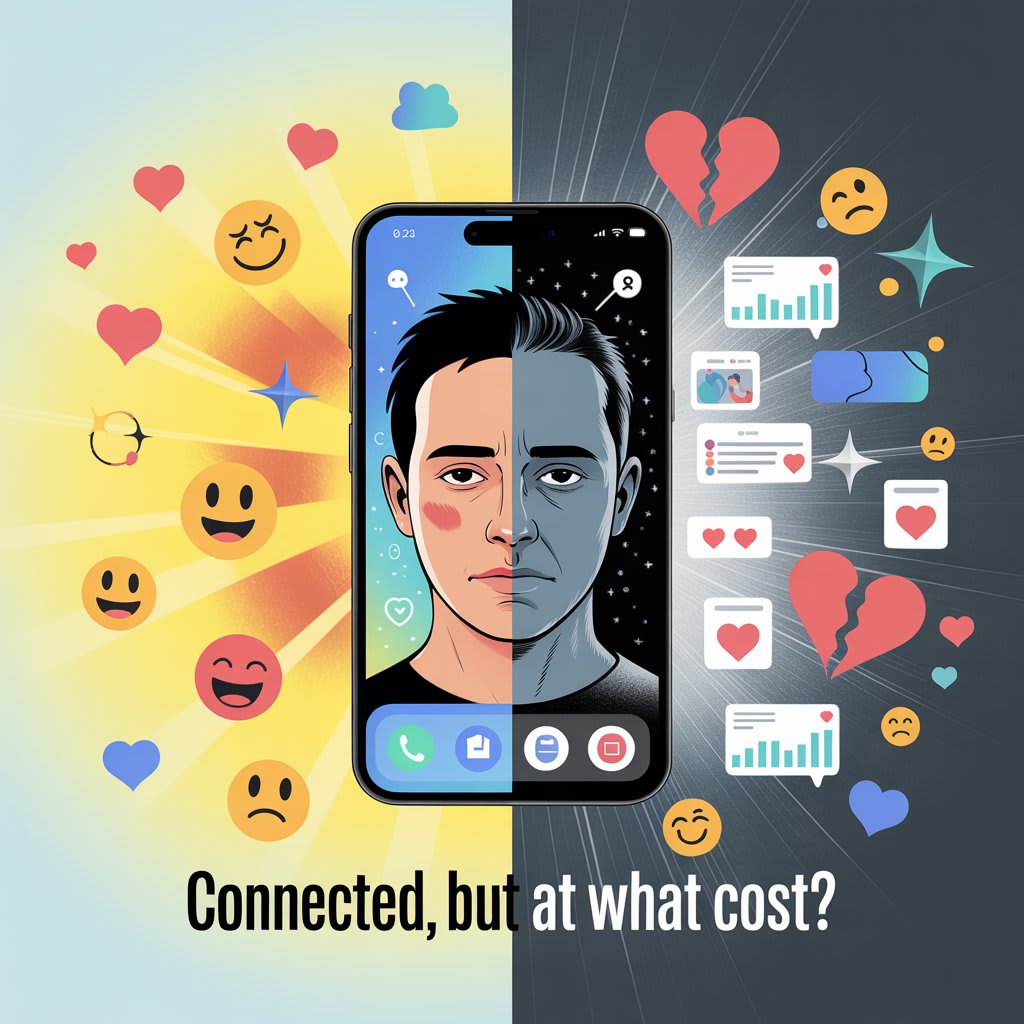
There’s no denying that social media has changed the way we live. In just over a decade, it has transformed from a fun way to share photos with friends into something that touches nearly every part of our lives. It’s where we get our news, connect with people, express ourselves, promote businesses, and even find love. But for everything we’ve gained, there are things we’ve quietly lost—and we rarely stop to notice.
Let’s start with the bright side. Social media gave us connection like never before. We can stay in touch with family across the world, share milestones instantly, and reconnect with childhood friends we thought we’d never see again. It bridges physical distance, and in many cases, emotional distance too.
It also gave people a platform to be heard. In the past, you needed money, influence, or media access to share your voice. Now, anyone with a phone can speak up—and sometimes that voice can change lives. Movements like #MeToo or #BlackLivesMatter gained global momentum because of social media. Silent stories found ears, and people who once felt invisible discovered they weren’t alone.
For creators, entrepreneurs, and small businesses, social media has been a game-changer. A handmade jewelry artist in a small town can now sell her designs to people across continents. A student with a talent for drawing can build an audience, share tutorials, and earn a living without ever leaving home.
But while the gains are real, so are the losses—and many of them are hidden beneath the surface.
We’ve lost a lot of real presence. Think about the last time you were with friends or family—how often were people looking at their phones instead of each other? We’ve grown used to documenting our lives instead of living them. Moments that could be memories get filtered, captioned, and posted before we even enjoy them.
We’ve also lost a sense of self-worth that comes from within. It’s easy to say that likes and followers don’t define us, but for many, they do. We measure our value based on virtual applause. A post with no likes can feel like a personal failure, even if it was just a harmless photo or honest thought.
And then there’s the constant comparison. Social media is a highlight reel. We rarely see the fights, the bad days, or the sleepless nights. Instead, we see perfect smiles, luxury vacations, career wins, and carefully curated lives. It’s not that people are lying—it’s just not the full truth. Still, it’s easy to look at these images and wonder, “Why isn’t my life like that?” This can quietly lead to anxiety, jealousy, and a sense of inadequacy.
Social media also encourages addiction to validation. We keep checking for notifications, replies, and shares. Our brains get hooked on the dopamine hit that comes from attention. The more we seek it, the more we depend on it.
Perhaps the most silent loss is peace of mind. Scrolling through endless content leaves our minds overstimulated. Our attention span shortens. We get used to noise, and quiet moments start to feel uncomfortable. We lose the ability to be still, to think deeply, and to truly rest.
So where does that leave us?
It leaves us with a choice. Social media isn’t inherently good or bad—it’s a tool. And like any tool, it can build or break. The key is to use it intentionally.
We can choose to follow people who inspire us instead of drain us. We can set boundaries around our screen time. We can learn to post without needing approval, and scroll without comparing.
We can remind ourselves that not everything needs to be shared to be meaningful. Some moments are meant to be lived, not posted.
Most importantly, we can return to real conversations, real emotions, and real connection. Social media can be a part of our lives—but it shouldn’t be the center of it.
In the end, social media gave us a louder voice, wider reach, and endless inspiration. But it also stole silence, authenticity, and the beauty of the unshared moment.
What we gain is choice. What we lose is up to us.
About the Creator
Keep reading
More stories from Mansoor khan and writers in Confessions and other communities.
Running My Own Race
I used to think I was behind in life. It didn’t matter what I had achieved, how far I’d come, or how many personal milestones I had quietly reached—there was always someone doing more, getting there faster, or doing it better. Social media made it worse. I’d scroll through images of friends traveling the world, launching businesses, getting engaged, buying homes, and chasing dreams I hadn’t even dared to speak out loud yet. With every scroll, I felt a quiet sting of inadequacy.
By Mansoor khan9 months ago in Confessions
Word of the Day: ホチキス
I don't know the word for Staples. I remember I used to think that Hochikisu was an Onomatopoeia for a stapler rather than a brand name. I am pretty sure I already have this title as a theme, which is making me feel many sort of ways as Vocal is harassing me about payments currently.
By Kayla McIntosh23 days ago in Confessions
I Was Almost Forgotten by Life, Until I Chose to Remember Myself
Story There was a time in my life when I felt invisible. Not the kind of invisible where people accidentally overlook you, but the kind where it feels like the world has already decided you don’t matter. I walked through my days quietly, carrying thoughts I never shared and dreams I didn’t dare to speak aloud.
By On that6 days ago in Confessions



Comments (1)
A good lesson