
The Borrowed Sorrow
She sold them grief she never owned—and now she's drowning in it.

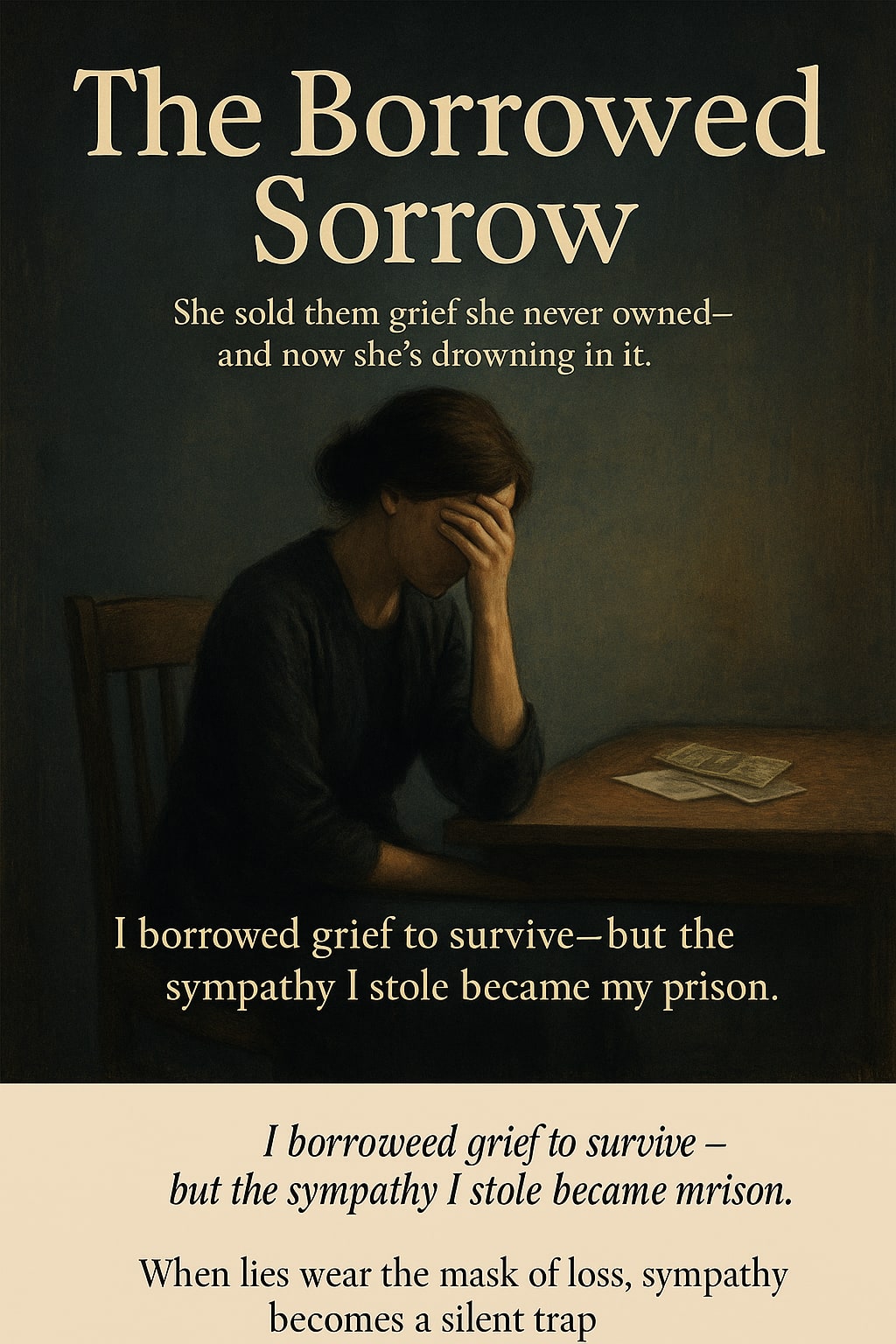
borrowed grief to survive—but the sympathy I stole became my prison.
The Borrowed Sorrow
I pretended to be someone else – a grieving widow, a shattered orphan – to gain sympathy and financial aid, and now I'm trapped in a web of borrowed sorrow. Every kind word, every compassionate glance, every dollar received, feels like another thread tightening around me, pulling me deeper into a lie that has become my terrifying reality. The fear of exposure is a cold, constant companion, far more real than any of the fabricated tragedies I peddle.
It started innocently enough, or so I convinced myself. I was adrift, barely making ends meet after a series of bad choices and worse luck. My small apartment was a suffocating box, my bank account a barren wasteland. Desperation gnawed at me. One evening, while scrolling through social media, I saw a crowdfunding campaign for a family who had lost everything in a house fire. The outpouring of support, the sheer volume of donations, struck me. Not with empathy, but with a cynical thought: If only I had a story like that.
The idea took root, ugly and insidious. Not a fire, no, too easily disproved. Something more personal, more tragic, something that tapped into the deepest wells of human compassion: grief.
My first foray was small. I created a fake profile on a lesser-known forum, claiming to be a young woman whose husband had just died suddenly in a tragic, freak accident. I spent hours reading real obituaries, researching the language of grief, learning to mimic the raw pain of loss. I posted a few carefully crafted updates, describing my "despair," my "loneliness," my "struggle to cope." I never explicitly asked for money, just for "prayers" and "support."
The response was overwhelming. Messages of sympathy poured in. People offered advice, comfort, and yes, small monetary donations, "just to help you get by during this difficult time." The ease of it was shocking. The warmth of their compassion, undeserved as it was, was intoxicating. It wasn't just the money; it was the attention, the validation, the feeling of being seen and cared for, even if it was for a fabricated persona.
The lie quickly escalated. The "young widow" became a more elaborate character. I crafted a fake backstory for my "late husband," giving him a noble, slightly heroic profession, ensuring maximum sympathy. I started posting on larger platforms, sharing tearful "memories" and heart-wrenching "photos" (stock images, carefully edited to look personal). The donations grew. It became a lucrative venture, a twisted game where the more profound my "grief," the greater the reward.
But the real power lay in the personal connections. People wanted to help. They offered me comfort over the phone, sent me care packages, even offered a place to stay. I had to learn to cry on demand, to lower my voice with a tremor of sorrow, to look perpetually on the verge of tears. It was exhausting, a constant performance, but the fear of returning to my previous life of poverty was a powerful motivator.
The "widow" narrative, however, had its limitations. It required too much emotional investment, too much upkeep. So, I diversified. I became a "struggling orphan," whose parents died in a car crash, leaving behind younger siblings I was trying to raise. Then, a "war veteran" suffering from severe PTSD, unable to work, his heroic past contrasting with his current destitution. I researched these roles meticulously, watching documentaries, reading testimonials, ensuring every detail of my fabricated suffering was convincing. I even shaved my head for the veteran role, claiming chemotherapy for a phantom war injury. The lengths I went to were extreme, but the pay-off was immense.
I lived a life of borrowed sorrow, flitting between identities, managing multiple online personas, always wary of contradictions. My real life became a mere shadow, a vessel for these fabricated selves. The money poured in, allowing me to move into a nicer apartment, wear better clothes, eat well. I had achieved financial stability, but at what cost?
The cost was my soul. The constant fear of exposure became a paralyzing dread. Every new donation, every sympathetic message, was a tightening of the noose. What if someone recognized a detail from a real tragedy I had plagiarized? What if a well-meaning benefactor decided to do some deeper digging? The internet never forgets. A single slip-up, a forgotten detail from one of my countless lies, could unravel everything.
Just last week, a woman, a genuinely kind soul who had sent me hundreds of dollars for my "orphan" persona, messaged me saying she was in my city and wanted to meet for coffee, to "offer some real comfort." Panic seized me. I concocted an elaborate excuse about a sudden family emergency out of town, feeling a fresh wave of disgust at my own cunning. The terror of facing the real, human beings I was deceiving, of seeing the hurt in their eyes when they discovered the truth, was unbearable.
I am trapped. The wealth I acquired is tainted, impossible to enjoy without the looming shadow of discovery. I’ve tried to stop, to break free from this insidious cycle. But the thought of going back to destitution, or worse, of facing the legal and social repercussions of my actions, paralyzes me. I'm no longer just pretending to be someone else; I am that lie. It has consumed my identity, twisted my conscience.
Every night, I lie awake, listening to the silence, imagining the angry faces, the disgusted whispers, the public humiliation. I stole their empathy, their kindness, their hard-earned money, all by selling them a sorrow that wasn't mine. And now, that borrowed sorrow is the only thing that feels real, a suffocating blanket woven from my own deceit, ensuring that I, the identity thief of empathy, live a life haunted by the very pain I once manufactured for profit. And the biggest confession?
I don't know how to stop, or if I even can.
About the Creator
Noman Afridi
I’m Noman Afridi — welcome, all friends! I write horror & thought-provoking stories: mysteries of the unseen, real reflections, and emotional truths. With sincerity in every word. InshaAllah.
Keep reading
More stories from Noman Afridi and writers in Confessions and other communities.
I was in a Toxic Relationship, with my Workplace
“You got that?” My ex yelled. His hands were balled into fists at his side. At six foot three, he towered over me. A normal person would have been afraid, but I looked up a video of George Lopez repeatedly saying, “I got this,” and showed it to him. I had grown used to this treatment, so much so that I didn’t blink when he ripped the phone from my hand and threw it across the room.
By Jade M.4 days ago in Confessions
CHRIS HANSEN CONFESSION Chris Hansen Admits He Tried To Catch Jeffrey Epstein But Couldn't Figure Out How To Make Money Off It
Chris Hansen made a name for himself especially with the series To Catch a Predator. His cool persona and clear projection of finding an older man (usually) with a minor in a precarious situation catapulted him into fame and superstardom. One thing he thinks about now, though, is if he could have caught Jeffrey Epstein years in advance.
By Skyler Saunders5 days ago in Confessions
When the Shelter Closes
Across the street from my house, a man slept under a tree, his dog by his side. My first, naive thought: he must be traveling through. But he kept coming back, often sleeping there during the day. Then it hit me—that person might not have a home.
By Bride of Sound5 days ago in Humans



Comments (1)
nice