


In the hushed stillness of his attic studio, bathed in the soft glow of a single oil lamp, Professor Armitage hunched over his workbench. The air was thick with the scent of linseed oil and graphite, a familiar comfort to a man who had dedicated his life to the pursuit of anatomical perfection. Before him lay a sheet of pristine vellum, its surface yearning for the touch of his skilled hand. His tools, a collection of finely sharpened pencils, lay beside him, each one a conduit for his artistic vision. Tonight, he sought to capture the very essence of life itself: the human heart.
He began with the broad strokes, the gentle curves that defined the organ's overall form. His hand moved with a practiced grace, each line a testament to years spent poring over textbooks and dissecting specimens. He knew the heart intimately, its every chamber and valve etched into his memory. But tonight, he wasn't merely replicating; he was creating. He sought to infuse his drawing with a sense of vitality, to capture the relentless rhythm that sustained human existence.
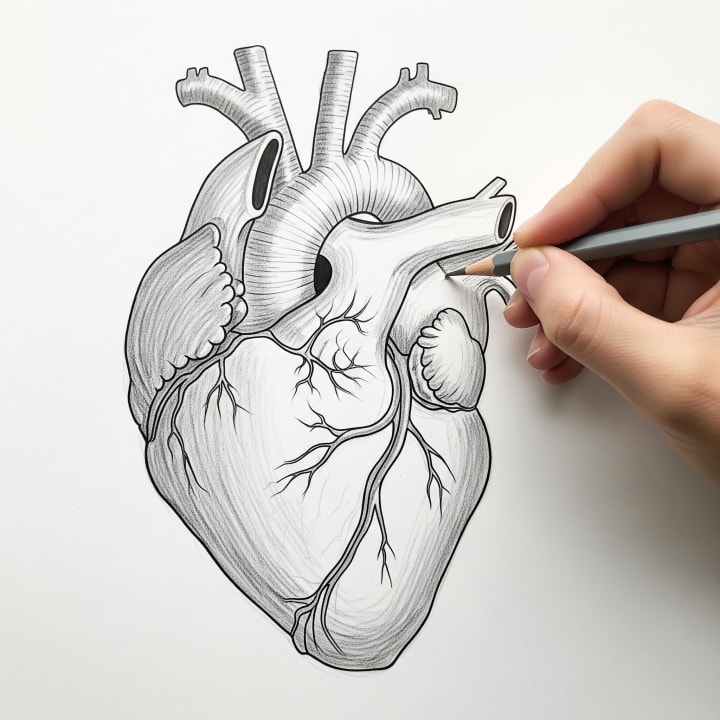
As the hours passed, the heart began to take shape on the vellum. The intricate network of arteries and veins emerged, branching out like the roots of an ancient tree. The delicate valves, the guardians of the circulatory system, were rendered with meticulous precision. Armitage worked with a feverish intensity, lost in the world of his creation. He felt a strange connection to the organ he was drawing, as if he were breathing life into it with every stroke of his pencil. It was more than just a drawing; it was a testament to the beauty and complexity of the human body.
The professor paused, his eyes scanning his work. He saw the heart not just as a biological pump, but as a symbol of love, courage, and resilience. It was the engine of human emotion, the source of our deepest passions. He wanted to capture that essence, to convey the profound significance of this vital organ. He added subtle shading, creating depth and dimension, making the heart seem to pulsate on the page.
He thought of his late wife, Eleanor, a woman whose heart had been as kind as it was strong. He remembered her laughter, her warmth, and the unwavering love that had sustained him through the darkest of times. He poured those memories into his drawing, imbuing it with a sense of tenderness and affection. This heart, he realized, was not just an anatomical representation; it was a tribute to her.
The night wore on, and the first rays of dawn began to creep through the attic window. Armitage, his eyes weary but his spirit invigorated, finally set down his pencil. He gazed at his creation, a masterpiece of anatomical art. The heart seemed to glow on the vellum, a testament to the power of human skill and the enduring mystery of life itself. He knew that this drawing would be more than just a scientific illustration; it would be a symbol of hope, a reminder of the preciousness of every beat. And in that quiet attic, amidst the scent of oil and graphite, the professor felt a profound sense of peace. The heart, both on the page and in his own chest, beat on.

About the Creator
Aima Charle
I am:
🙋🏽♀️ Aima Charle
📚 love Reader
📝 Reviewer and Commentator
🎓 Post-Grad Millennial (M.A)
***
I have:
📖 reads on Vocal
🫶🏼 Love for reading & research
***
🏡 Birmingham, UK
📍 Nottingham, UK
Status : Single
Keep reading
More stories from Aima Charle and writers in Confessions and other communities.
unbound
when i was in high school, i powerlifted and crude peers joked that my "tits would get hard." this didn't seem like a problem to me, but i knew what they intended to mean—small breasts, flat, more like pecs, defined and masculine. how derogatory of a woman. unfitting and disgusting. my irreverence toward gendered expectations bristled, challenged, and disturbed some. it excited others.
By Aima Charle10 months ago in Confessions
I was in a Toxic Relationship, with my Workplace
“You got that?” My ex yelled. His hands were balled into fists at his side. At six foot three, he towered over me. A normal person would have been afraid, but I looked up a video of George Lopez repeatedly saying, “I got this,” and showed it to him. I had grown used to this treatment, so much so that I didn’t blink when he ripped the phone from my hand and threw it across the room.
By Jade M.3 days ago in Confessions




Comments (1)
This description of Professor Armitage drawing the heart is really vivid. It makes me picture the attic studio clearly. I can relate to being so focused on a project that hours fly by. Have you ever been that immersed in creating something? I wonder how long it took him to finish this drawing. Also, the idea of seeing the heart as more than just an organ, but a symbol of so much, is really interesting. What do you think that says about the human connection to our own bodies?