
Tesla Stalls: Auto Revenue Plunges 20% Amid Brand Backlash and Falling Sales
Elon Musk’s political entanglements and declining vehicle deliveries weigh heavily on Tesla’s bottom line.

Tesla Stalls: Auto Revenue Plunges 20% Amid Brand Backlash and Falling Sales
Elon Musk’s political entanglements and declining vehicle deliveries weigh heavily on Tesla’s bottom line.
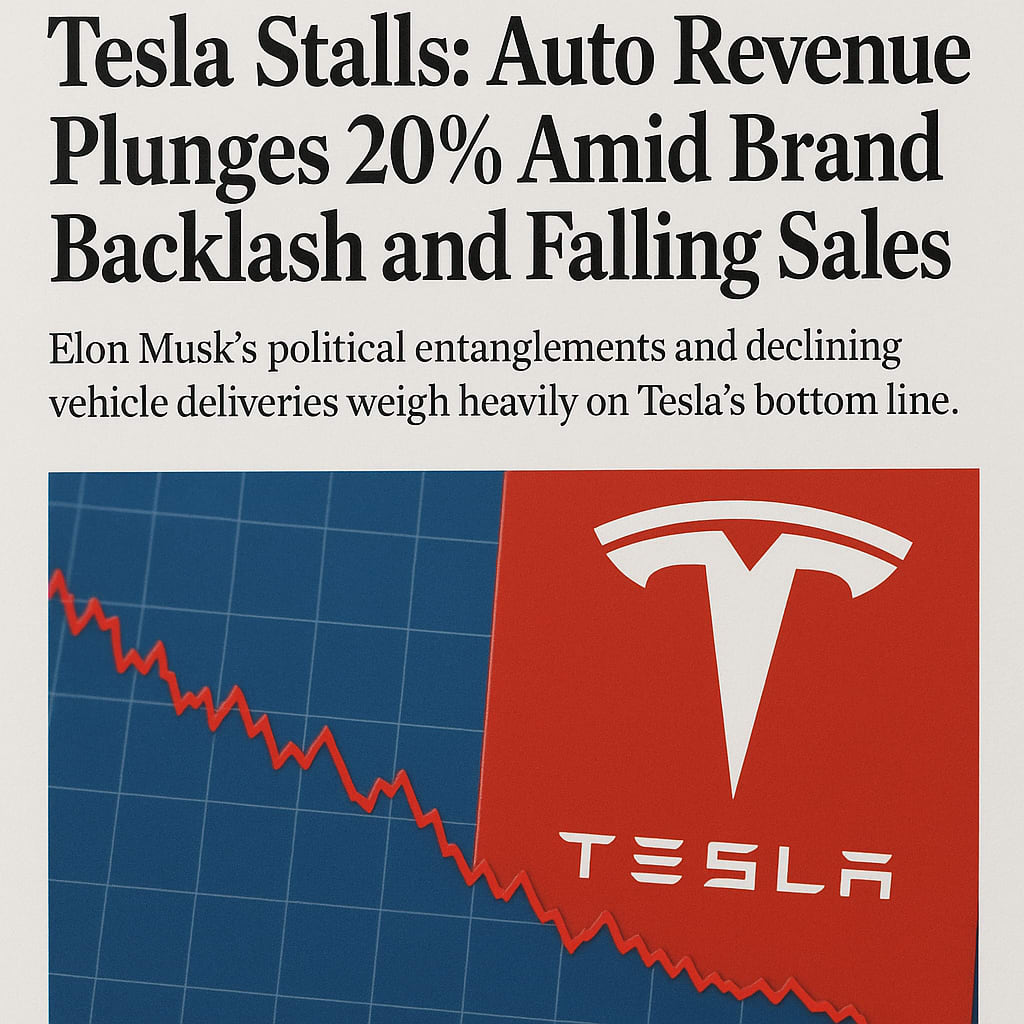
Tesla's road ahead is looking bumpier than expected. The electric vehicle pioneer released its first-quarter earnings this week, revealing a 20% drop in automotive revenue and a 71% plunge in profits—results that not only missed Wall Street expectations but also raised deeper questions about the company's brand, leadership, and future direction.
The company posted $19.3 billion in total revenue for Q1 2025, down from $23.3 billion in the same quarter last year. Automotive sales, Tesla’s core business, accounted for $13.9 billion of that—down significantly from $17.5 billion a year ago. Analysts had expected revenue closer to $21.45 billion, marking one of the biggest quarterly misses for Tesla in recent memory.
Steep Decline in Deliveries
Tesla delivered 336,681 vehicles in the first quarter, a 13% year-over-year drop. This marks the lowest quarterly delivery volume since 2022, breaking the company’s momentum from previous years of rapid expansion. The drop has been attributed to a combination of weakened demand, intensifying competition in the EV market, and recent recalls.
One of the more serious setbacks involved the recall of over 46,000 Cybertrucks, Tesla’s latest futuristic model. Issues with braking and unintended acceleration forced the company into damage control mode, further eroding consumer confidence just as it was ramping up deliveries.
Musk’s Political Ties Spark Backlash
But the numbers tell only part of the story. Many analysts believe Tesla is now grappling with an identity crisis—driven in part by CEO Elon Musk's increasingly controversial political presence.
Over the past year, Musk has taken on an advisory role in the Trump administration, while also expressing support for far-right European politicians. The move has sparked protests and organized boycotts, particularly in European and liberal U.S. markets that once formed Tesla’s most loyal customer base.
“Elon Musk has become a political lightning rod,” says Chris Reynolds, an auto industry analyst. “That’s increasingly making Tesla a political brand—and for a car company, that’s dangerous territory.”
The reputational fallout has been swift. Tesla was excluded from this year’s Vancouver International Auto Show, a symbolic yet pointed rejection that underscores its eroding status among industry peers. Online, hashtags calling for boycotts have trended in multiple regions, and public trust in Tesla appears to be slipping, even among tech-savvy early adopters.
Mounting Pressure from Global Rivals
While internal turmoil takes its toll, Tesla is also feeling the heat from the outside. Chinese EV maker BYD has been aggressively expanding in international markets, offering more affordable models that are capturing price-conscious consumers. In Europe, automakers like Volkswagen and Renault are gaining ground with increasingly competitive EV lineups.
Tesla once had a near-monopoly on attention in the electric vehicle space. But with more options on the road, the gap is closing—and fast.
Eyes on What’s Next
Despite a rough quarter, Tesla executives are urging investors not to panic. The company is expected to unveil a new generation of more affordable electric vehicles, and its much-anticipated autonomous ride-hailing service, dubbed “Cybercab,” is still on track for a 2026 launch.
However, Tesla notably withheld any forward-looking financial guidance for the next quarter. This could be a sign of caution—or a signal that the company expects further turbulence ahead.
Elon Musk, who has been serving in a government role since early this year, is set to return full-time to Tesla leadership by the end of May. Supporters hope his return will refocus attention on innovation and new product rollouts rather than politics.
A Defining Crossroads
Tesla has long thrived by defying expectations and rewriting the rules of the auto industry. But this quarter’s earnings suggest the company is at a crossroads—one where external controversy, internal challenges, and rising global competition are colliding in real time.
The big question now isn’t just whether Tesla can bounce back—but whether it can do so while maintaining the cultural edge and broad appeal that made it a market darling in the first place.
About the Creator
Hossain Uddin Ahamad
Web developer & graphic designer with experience in frontend design, WordPress, and T-shirt design. Skilled in Canva, Sublime Text & video editing. Always learning, always creating.
Keep reading
More stories from Hossain Uddin Ahamad and writers in Confessions and other communities.
The Hidden Health Benefits of Walking Just 30 Minutes a Day
When it comes to health and fitness, we often think of intense workouts, strict diets, and expensive gym memberships. But the truth is, one of the most powerful things you can do for your body and mind requires nothing more than a good pair of shoes — and about 30 minutes a day.
By Hossain Uddin Ahamad9 months ago in Lifehack
The Last Day of the Year
My New Year Countdown Clock indicates that I have just over five hours left before this year is over. I am stuck in the suburbs with my mother and stepfather, contemplating what I am going to eat and drink to celebrate this great change in our lives. The weather is cold, but I do not feel as though it has really affected my attitude about what the new year will bring...but I am not as happy with this moment as I usually feel.
By Kendall Defoe 19 days ago in Confessions
Two girls, one library, and a hunger for worlds beyond your own—Part 4 A
When i am thinking back, is difficult to imagine all that—no fear for exams, most of them not. All that being something normal the exam. All that confidence and light heart without the negative stressed care...hm...how i was even possible to be like that?
By C.M.about 8 hours ago in Confessions



Comments
There are no comments for this story
Be the first to respond and start the conversation.