
Tattoos for Tots
A Revolutionary Approach to Youth Expression and Educational Innovation

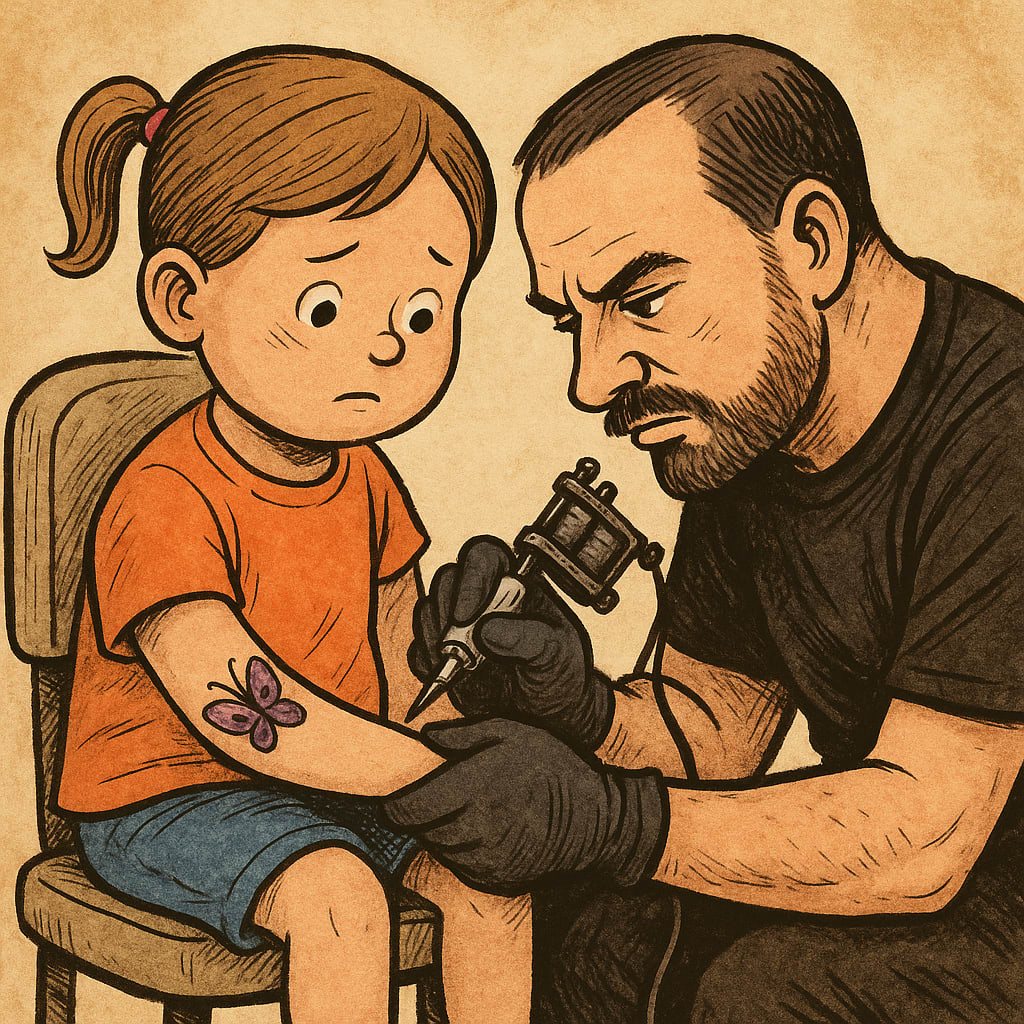
In the grand carnival of our perpetually progressing society, every day brings fresh opportunities to cast aside dusty traditions and dance wildly into the realm of innovation. Among the array of societal taboos ripe for reconsideration, one surprisingly persists—our arbitrary denial of tattoos to children. Yes, my good friends, the absurdity must cease; it's high time we acknowledge the autonomy and self-expression of our youngest citizens by letting them ink their hearts onto their sleeves—literally.
Why must tattoos, these vibrant narratives etched permanently upon one's skin, remain imprisoned behind a wall of chronological prejudice? Denying children the freedom to adorn their bodies with dragons, mermaids, or Fortnite avatars amounts to nothing short of aesthetic apartheid—a systematic suppression of their creative identity.
Some may balk, insisting, "But children lack the maturity for lifelong decisions!" Precisely, dear naysayers, which is why we have teachers—those tireless stewards of youthful intellect—to guide our children's aesthetic journey. Picture, if you will, Mrs. Henderson's third-grade classroom transformed into a consultation suite, complete with flash sheets of age-appropriate designs pinned beside the multiplication tables. Educators already spend countless hours cultivating young minds; surely approving little Timmy's request for a Spider-Man chest piece is simply continuing education by other means.
Indeed, we could establish Scholastic Tattoo Parlors alongside cafeterias and gymnasiums, creating the interdisciplinary learning opportunities our education system desperately needs. Naturally, we would implement an age-appropriate progression curriculum. Kindergarten students would begin with washable practice tattoos, allowing them to explore their artistic identities while mastering basic motor skills. First grade would introduce semi-permanent ink—still removable but requiring slightly more commitment, teaching valuable lessons about consequences. By second grade, students would earn their first permanent tattoos upon demonstrating reading proficiency, with full sleeve privileges reserved for those exceptional third-graders who master cursive writing.
Art teachers could seamlessly transition to tattoo artistry—imagine the pedagogical possibilities! Geography lessons would culminate in world map sleeves, while mastery of multiplication tables might earn students their choice of numerical ink. Parent-teacher conferences would achieve new heights of engagement: "Your daughter excels at reading, struggles with fractions, and has submitted a compelling proposal for a unicorn tramp stamp."
This revolutionary approach would finally address our inconsistent attitudes toward childhood autonomy. We celebrate a child's freedom to choose breakfast cereals or select Halloween costumes, yet recoil in horror at permanent body modification. This selective permission is akin to serving cake but denying the icing—a cruel tease that mocks childhood itself.
Meanwhile, America shamefully lags behind more enlightened nations in pediatric body art initiatives. Scandinavian countries have reportedly established "Youth Expression Centers" where children as young as five can receive their first tattoos alongside their first library cards. The Netherlands has integrated tattoo artistry into their famously progressive education system, with students graduating not just with diplomas but with comprehensive biographical murals covering their torsos. We must ask ourselves: how long will we allow our children to remain competitively disadvantaged in this global ink economy?
Of course, implementing such progressive policies requires proper educator preparation. Teachers would need certification in Pediatric Aesthetic Counseling, requiring 40 hours of continuing education in child psychology, color theory, and basic needle safety. Summer workshops could offer intensive training in "Interpreting Childhood Dreams Through Permanent Art." The Teachers' Union could negotiate tattoo insurance benefits, ensuring our educators receive the same professional protections as traditional healthcare providers.
Predictably, a vocal minority of regressive parents will resist this evolution, clinging desperately to antiquated notions of "childhood innocence" and "bodily autonomy." These backwards-thinking guardians, organized under banners like "Parents Against Permanent Expression" and "Coalition for Clean Kids," would likely protest outside schools with signs reading "Hands Off Our Children's Skin!" Their irrational fears about pain, infection, and lifelong commitment reveal a troubling lack of faith in their own offspring's decision-making capabilities.
These same hypocritical parents readily allow ear piercing for their daughters yet recoil at the thought of a tasteful butterfly adorning their son's shoulder blade. They permit temporary tattoos at birthday parties but somehow draw arbitrary lines at permanence. Such selective permissiveness demonstrates the inconsistent thinking that has long plagued American parenting—celebrating surface-level choices while suppressing deeper expressions of identity.
The economic opportunities alone should convince any skeptic. The pediatric tattoo industry could rival theme parks in revenue generation, transforming birthday parties from mundane cake-and-games affairs into memorable inking ceremonies. School fundraisers could abandon tedious car washes in favor of "Ink for Books" campaigns, where local artists donate their services to raise money for new textbooks while simultaneously addressing our education funding crisis.
When inevitable regret strikes—as it surely will when thirteen-year-old Madison outgrows her Twilight vampire bite tattoo—modern laser removal technology stands ready to transform yesterday's poor choices into tomorrow's learning experiences. Dr. Peterson's removal clinic could partner with guidance counselors to offer "Mistake Erasure Therapy," turning remorse into revenue.
Beyond mere decoration lies a world of practical applications. Children's emergency contact information, tattooed discretely behind ears, would eliminate lost ID bracelets forever. Medical alerts could replace those playground-snagging bracelets with elegant script across collar bones. Even Social Security numbers, permanently inked on foot soles, would spare our citizens the horror of forgotten credentials during tax season.
Therefore, dear friends, let us bravely march toward this inky dawn, where elementary schools boast both honor rolls and tattoo portfolios, where show-and-tell features fresh artwork on actual arms rather than construction paper, and where the only tears shed in classrooms come from the sweet sting of needle meeting skin in service of self-expression.
The tattooing of children, of course, transcends mere aesthetics. It signals an essential evolution—a broader societal awakening that finally recognizes what forward-thinking educators have long known: children are perfectly capable of making permanent decisions about their bodies, provided they can spell their own names and demonstrate basic needle safety.
So, fellow citizens, let us boldly ink forward. Together, we shall witness the dazzling sight of kindergarteners comparing fresh tattoos during snack time, third-graders trading designs like Pokemon cards, and high school graduations where diplomas seem almost redundant beside the magnificent full-body murals our students have cultivated throughout their academic careers.
After all, a society that respects a child's right to permanent body modification is surely a society that has achieved the pinnacle of enlightened parenting. The future belongs not to those who blindly preserve unmarked skin, but to those daring enough to let children ink their own paths—no matter how small their canvases.
***
NOTE: A different version of the article was previously published by Conrad Hannon on The Cogitating Ceviché in 2023.
***
Want more commentary like this, minus the filters and institutional disclaimers?
Follow The Cogitating Ceviché — Conrad’s quiet corner for loud ideas.
About the Creator
Conrad Hannon
Conrad Hannon, a pseudonym, is a satirist, humorist, and commentator. He's stricken with a peculiar malady, a dual infection of technophilia and bibliophilia. To add to this, he harbors an unsettling fondness for history and civics.
Keep reading
More stories from Conrad Hannon and writers in Confessions and other communities.
The Last Counterculture Reads the Bill of Rights
Once upon a time — say, around 1789 — civic literacy was the expectation. Politicians quoted Cicero without footnotes. Farmers could debate the finer points of separation of powers while milking cows. The average newspaper reader knew the difference between a republic and a democracy, and more importantly, why it mattered.
By Conrad Hannon9 months ago in The Swamp
I was in a Toxic Relationship, with my Workplace
“You got that?” My ex yelled. His hands were balled into fists at his side. At six foot three, he towered over me. A normal person would have been afraid, but I looked up a video of George Lopez repeatedly saying, “I got this,” and showed it to him. I had grown used to this treatment, so much so that I didn’t blink when he ripped the phone from my hand and threw it across the room.
By Jade M.2 days ago in Confessions
Letters to the Grave
Have you ever felt the pull of the past—that quiet ache to return to the crossroads where words were left unsaid? Not to chase the echoes of the dead, but to face the living ghosts we carry—the ones who walked out of our days, or slipped from our minds, or were cut away like threads no longer meant to weave our story. These are the conversations that haunt the quiet moments, letters addressed to absences, sent to the spaces where people once stood before time, distance, or choice turned them into shadows.
By Jackie Fazekas5 days ago in Confessions



Comments
There are no comments for this story
Be the first to respond and start the conversation.