
Rebels with a Cause
The Truth-Tellers Who Refused to Stay Quiet
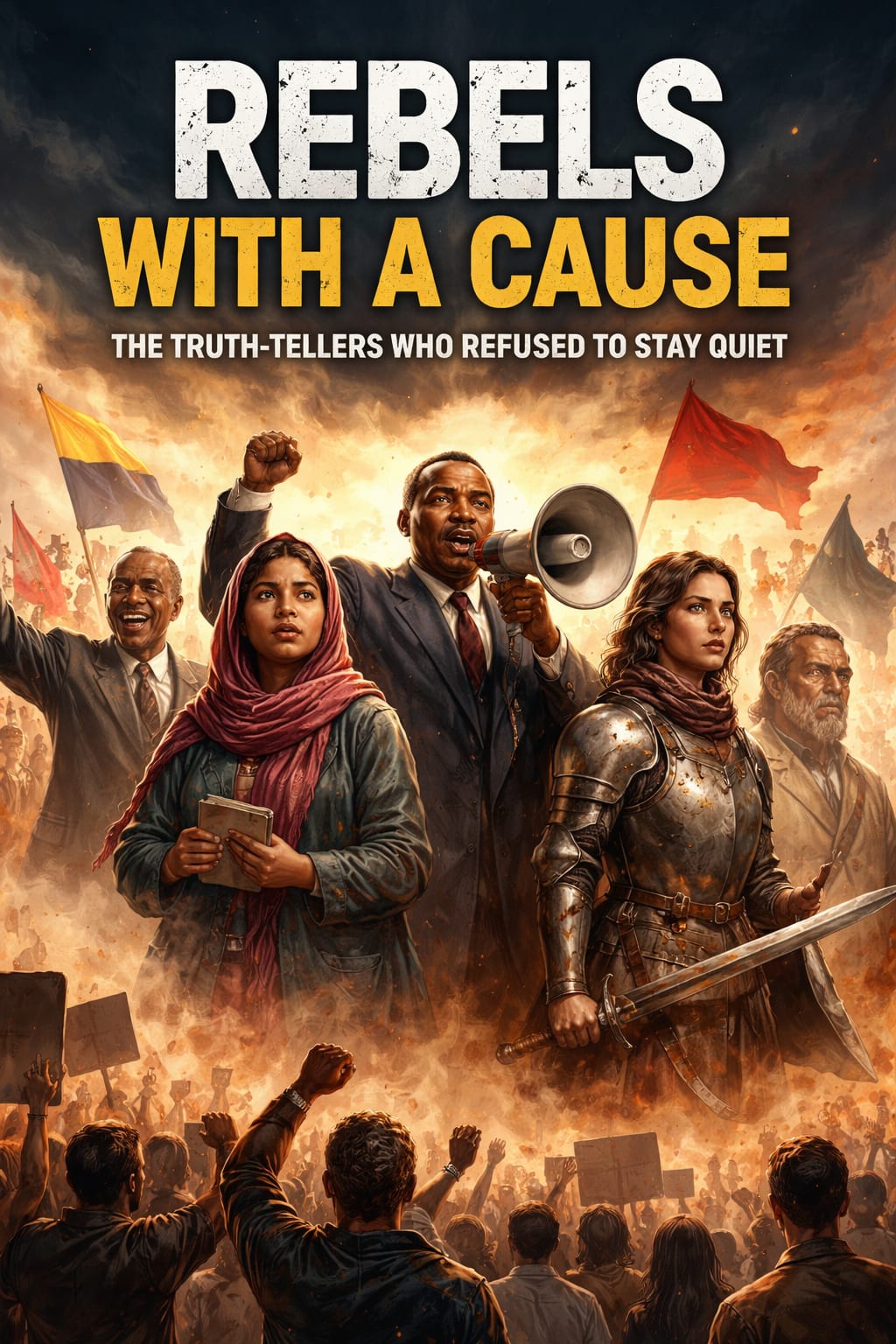
Throughout history, progress has never come easily. Every right we enjoy, every freedom we celebrate, and every injustice we condemn today was once defended by brave individuals who dared to speak up when silence felt safer. These were not rebels for chaos — they were rebels with a cause. Their voices cut through fear, challenged authority, and reshaped the world. While many faced punishment, exile, or even death, they proved one timeless truth: real change begins when someone refuses to stay quiet.
The Meaning of Being a Rebel
The word rebel often carries negative connotations — troublemaker, rule-breaker, agitator. But history tells a different story. A rebel with a cause is someone who stands up against injustice, not for personal gain, but for the greater good. These individuals are driven by conscience, courage, and a belief that the world can be better.
They don’t rebel because they enjoy conflict. They rebel because they cannot accept oppression, inequality, or silence. They speak when it is dangerous. They act when it is unpopular. They continue even when the cost is high.
Socrates: The Original Truth-Seeker
One of history’s earliest rebels was Socrates, the Greek philosopher who challenged Athenian society with questions that made people uncomfortable. Instead of accepting traditional beliefs, he encouraged people to think critically about morality, politics, and truth.
His relentless questioning angered powerful leaders. Accused of corrupting youth and disrespecting the gods, Socrates was sentenced to death. He could have escaped — but he chose to drink poison and accept his fate. Why? Because he believed in standing by his principles, even at the cost of his life.
Socrates proved that ideas are powerful — and dangerous to those who fear them.
Joan of Arc: A Teenager Who Changed a Nation
At just 17 years old, Joan of Arc led French troops during the Hundred Years’ War. In a male-dominated society, she defied every expectation. She claimed to hear divine voices guiding her to save France — and she did exactly that.
Her courage inspired soldiers and turned the tide of battle. But her success made enemies. She was captured, accused of heresy, and burned at the stake.
Years later, she was declared innocent and canonized as a saint. Joan showed the world that age, gender, and status cannot silence destiny.
Martin Luther King Jr.: Dreaming in a Divided World
In the 1950s and 60s, the United States was deeply divided by race. Black Americans faced discrimination, violence, and segregation. Then rose Martin Luther King Jr., a preacher who believed in peaceful resistance.
Through speeches, protests, and marches, he demanded equal rights. His famous “I Have a Dream” speech inspired millions. But his activism made him a target. He was arrested, threatened, and eventually assassinated.
Still, his legacy lives on. He taught us that nonviolent rebellion can move mountains.
Malala Yousafzai: A Modern-Day Rebel
In 2012, a young Pakistani girl named Malala Yousafzai was shot by the Taliban for speaking up about girls’ education. Most people would have retreated into silence after such trauma — but Malala became louder.
She addressed the United Nations, traveled the world, and became the youngest Nobel Peace Prize winner. Her message was simple: every child deserves education.
Malala represents today’s rebels — ordinary people using their voices to fight injustice in extraordinary ways.
Nelson Mandela: From Prisoner to President
Nelson Mandela spent 27 years in prison for fighting apartheid in South Africa. Instead of turning bitter, he emerged with forgiveness and vision.
He helped dismantle a racist system and became South Africa’s first Black president. His leadership showed that rebellion isn’t just about resisting — it’s about rebuilding.
Mandela once said,
"It always seems impossible until it’s done."
And he proved it.
Why Rebels Are Feared
Rebels challenge comfort. They force society to confront ugly truths. That makes them dangerous — not because they use violence, but because they use truth.
Governments, institutions, and powerful groups often suppress rebels because:
They expose corruption
They unite people
They demand accountability
They threaten control
Silencing rebels is a way to maintain power. But history shows that truth cannot stay buried forever.
The Cost of Speaking Up
Being a rebel comes with consequences:
Arrest
Exile
Loss of reputation
Physical harm
Death
Yet rebels choose to speak anyway. Why?
Because silence hurts more.
Because injustice feels unbearable.
Because they know future generations deserve better.
Ordinary People, Extraordinary Impact
Not all rebels are famous. Many are everyday people:
A teacher defending a bullied student
A worker exposing corruption
A journalist uncovering truth
A woman refusing forced silence
These quiet rebels shape society just as powerfully. History isn’t only written by leaders — it’s written by brave individuals who refuse to comply with wrong.
The Power of One Voice
One voice can spark:
A movement
A revolution
A law
A global conversation
Rosa Parks refused to give up her seat.
One woman. One moment.
It ignited a civil rights movement.
Never underestimate your voice.
Rebels in the Digital Age
Today, rebellion looks different:
Social media activism
Online petitions
Viral videos
Digital journalism
People can speak to millions with one post. But this power also brings risk — censorship, harassment, and threats.
Still, modern rebels continue.
They speak for:
Climate justice
Human rights
Gender equality
Free speech
The battlefield has changed — but the fight remains.
Why the World Needs Rebels
Without rebels:
Slavery might still exist
Women might not vote
Segregation might continue
Dictators might rule unchallenged
Rebels push humanity forward. They question norms. They break chains. They demand better.
Progress depends on discomfort.
Are You a Rebel?
You don’t need to march in protests or speak to crowds. Being a rebel can mean:
Standing up for someone
Speaking truth at work
Challenging stereotypes
Refusing to accept injustice
Courage begins in small moments.
Final Thoughts
History remembers rebels differently than their own time did. While alive, they are mocked, feared, and punished. After death, they are honored.
Why?
Because time reveals truth.
Rebels with a cause are not troublemakers.
They are builders of a better world.
So the next time you feel scared to speak — remember:
Every great change started with someone who refused to stay quiet.
Your voice matters.
Your courage matters.
Be the rebel history will thank.
About the Creator
Keep reading
More stories from Aiman Shahid and writers in Confessions and other communities.
Your Story Deserves a Voice
Every person carries a story inside them. Some stories are loud, filled with triumphs and victories. Others are quiet, shaped by struggle, loss, and resilience. Yet no matter how big or small they seem, every story matters. Your experiences, thoughts, and emotions are unique, and they deserve to be heard. In a world that often encourages conformity and silence, choosing to speak your truth is an act of courage. Your story deserves a voice because it holds power—not just for you, but for everyone who hears it.
By Aiman Shahid2 months ago in Confessions
Is He Fun to Be Around, or Am I Fun and He’s Just Around?
We often mistake silence for peace and presence for connection. We spend months, sometimes years, decorating a relationship with our own laughter, our own energy, and our own vibrant spirit, only to wake up one morning and realize we’ve been throwing a party for two where only one person brought the music. The question isn't just a clever play on words; it is a mirror held up to the tired soul: Is he actually fun to be around, or am I the fun, and he is simply standing in the glow of my light?
By Alex Sterling 6 days ago in Confessions


Comments
There are no comments for this story
Be the first to respond and start the conversation.