
President Biden Pardons Hunter Biden: A Controversial Move Amid Political Tensions
A Father’s Love or Political Strategy?

President Biden Pardons Hunter Biden: A Controversial Move Amid Political Tensions
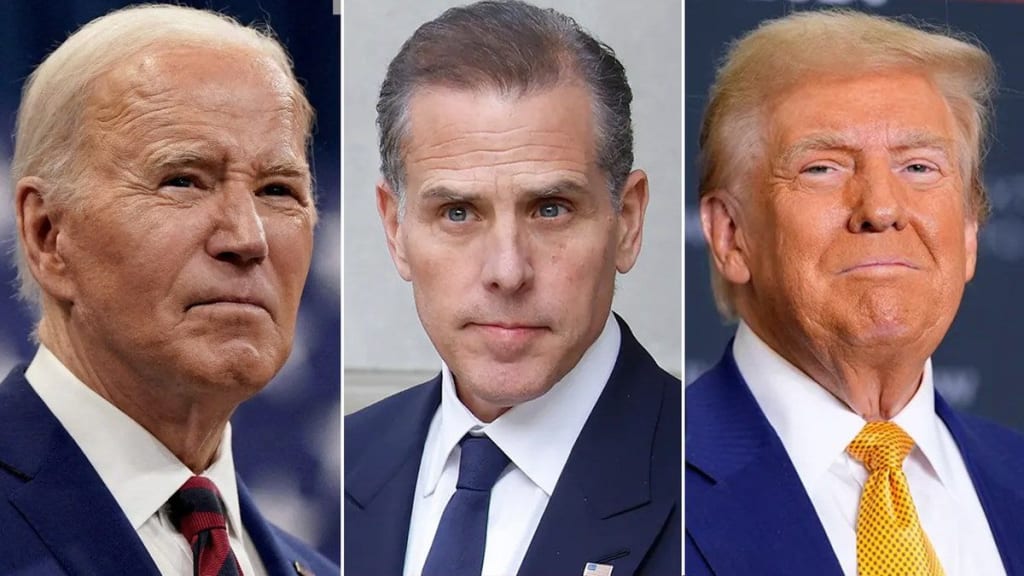
This morning, President Joe Biden embarked on a trip to Angola after spending the holiday weekend with his family in Nantucket. Before heading overseas, Biden made a brief stop in Washington, where he announced a significant and polarizing decision: pardoning his son, Hunter Biden.
Hunter Biden has faced legal challenges on multiple fronts. He was convicted of lying about his drug use on a federal form while purchasing a firearm. In a separate case, he agreed to plead guilty to charges related to unpaid taxes. The pardon, which extends beyond these specific charges, covers any offenses Hunter may have committed against the United States between January 1, 2014, and December 1, 2024.
President Biden defended his decision, attributing the charges against Hunter to political motivations. “Several of my political opponents in Congress instigated these charges to attack me and oppose my election,” Biden stated.
A Reversal of Position
The pardon marks a sharp departure from Biden’s earlier stance. For months, the president firmly denied considering a pardon for his son, stating unequivocally, "Yes," when asked if he ruled it out. This shift has drawn sharp criticism from both sides of the political spectrum.
Republican Representative James Comer, chairman of the House Oversight Committee, accused Biden of bypassing accountability. Similarly, Democratic Representative Greg Stanton of Arizona expressed disapproval, emphasizing that Hunter’s felonies were determined by a jury of his peers.
Historical Context of Presidential Pardons
Presidential pardons are not without precedent, especially as leaders near the end of their terms. Former President Bill Clinton issued a controversial pardon for his half-brother, Roger Clinton, and a former business partner. Likewise, President Donald Trump pardoned Charles Kushner, the father of his son-in-law, Jared Kushner.
Trump, however, did not hold back his criticism of Biden’s decision. Taking to social media, Trump questioned, “Does the pardon given by Joe to Hunter include the January 6th hostages?” This statement underscores the escalating tension between the two political figures, particularly as Trump has promised to target his perceived political adversaries if re-elected.
The Emotional Weight of a Father's Decision
For Biden, the pardon may have been as much a personal decision as a political one. Legal experts point out that Hunter Biden faced the possibility of significant prison time. “Placing his son in the Bureau of Prisons under the control of a political rival like Donald Trump is something any father would want to prevent,” noted one analyst.
Hunter Biden himself has expressed gratitude for the pardon, acknowledging the second chance it provides. In a statement, he vowed to use his life in sobriety to assist others struggling with addiction, saying, “I will not take this decision for granted.”
The Fallout
Biden’s decision has ignited heated debate about the use of presidential pardon powers. Critics argue that such actions undermine the justice system, while supporters contend that presidents must sometimes make decisions grounded in compassion and the unique pressures of political life.
As Biden continues his diplomatic trip in Angola, the controversy surrounding the pardon will likely remain a focal point in Washington. With the 2024 election looming, the decision to pardon Hunter Biden could have far-reaching implications for Biden’s presidency and the political landscape as a whole.
The question now is whether this controversial choice will resonate with empathy or criticism among voters—and what it means for the future of presidential pardons in the United States.
About the Creator
Keep reading
More stories from Cherub Kane and writers in Confessions and other communities.
The Terrifying Brilliance of Humanity: Why We Are the Universe’s Greatest Paradox
The Terrifying Brilliance of Humanity: Why We Are the Universe’s Greatest Paradox At a glance, humans may not seem like the most intimidating species on Earth. We aren’t the fastest, strongest, or largest creatures. Yet, throughout history, humanity has cemented its place as one of the most relentless and fearsome forces ever to exist. What makes us so terrifying isn’t just our intelligence or technology—it’s the unique combination of persistence, ingenuity, and an insatiable curiosity that has driven us to conquer challenges and ourselves.
By Cherub Kaneabout a year ago in Futurism
Word of the Day: 火病
It is kind of funny, because I was going on about having fire sickness myself without realizing this was an actual thing. It actually sounds accurate to what I was experiencing, but luckily I don't live in a culture/area that is overtly suppressive to where it would aggravate this sort of condition.
By Kayla McIntosh4 days ago in Confessions


Comments
There are no comments for this story
Be the first to respond and start the conversation.