
My Grandma’s Secret Life as a Cold War Spy
I thought she was a Kansas farm girl. I was wrong—dangerously wrong

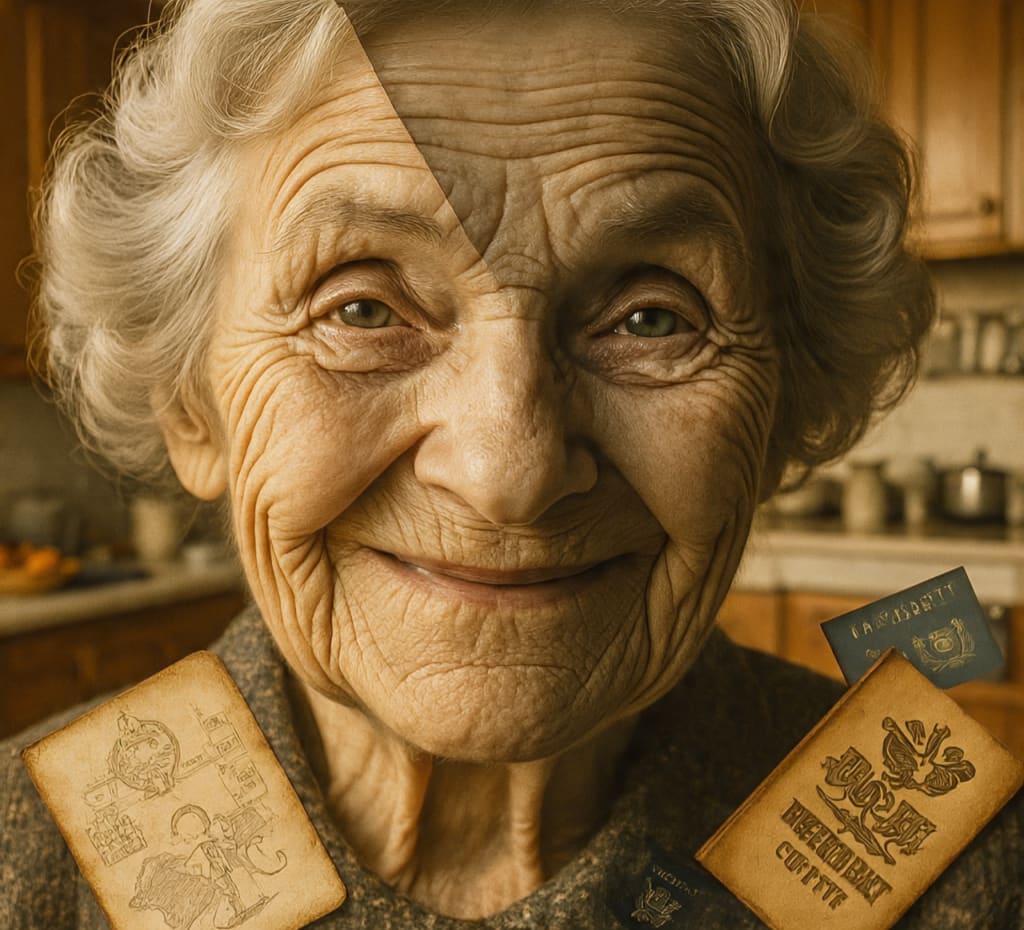
The Grandma I Thought I Knew
Growing up, my grandmother was my anchor.
Her little kitchen smelled like cinnamon and safety. Light streamed through lace curtains, catching dust motes in midair like tiny floating stars. Her hugs weren’t just embraces—they were shields, the kind that could melt away a bad day before I could even explain what had happened.
She spun stories as easily as she kneaded dough—about growing up on a Kansas farm, about the apple pie recipe she swore was older than she was, about the night she met my grandfather at a wartime dance, when the world felt both fragile and full of promise.
She was gentle, warm, pure love.
Or so I believed.
Because the truth?
Everything I knew about her was a lie.
The Lockbox
It began the day she died.
After the funeral, the family gathered in her cottage to sort through her things. The house felt different without her in it—quiet in a way that wasn’t peaceful.
I volunteered to clean out her bedroom closet, mostly because it was where she kept old photos and letters. I told myself I was looking for her recipe book, but deep down, I think I was searching for a piece of her to hold on to.
That’s when I found it.
Tucked behind a row of winter coats was a small, metal lockbox. It was heavy, cold to the touch, and out of place in a closet filled with sweaters and scarves.
My mother looked at it and shook her head. “Never seen it before.”
We pried it open with a screwdriver.
The moment the lid creaked back, the air in the room seemed to shift.
What lay inside didn’t belong to the life of a pie-baking grandmother.
Multiple Lives
Inside were passports—lots of them.
Each bore a different name, a different birth date, a different country of origin.
American. Russian. German. Argentinian.
The photos were all of her… yet each was slightly altered. In one, her hair was a fiery red. In another, deep brown. In one, she had striking blue eyes; in another, a soft hazel. Age shifted too—sometimes she looked twenty years younger, sometimes older.
There were letters written in languages I couldn’t understand—Cyrillic script, German, something that looked like Spanish but older.
Then I saw the Soviet-era military ID. The paper was brittle, the ink faded, but her photograph was unmistakable. Next to it was a black-and-white photo of her standing with strangers in front of a building marked with an unfamiliar insignia. The air seemed colder as I stared at it.
The realization hit hard.
The woman who taught me how to knit had lived a life in shadows.
A Chilling Confirmation
My uncle, the quiet one who had spent most of his life working in government security, came to see what we’d found. He picked up the Soviet ID, studied it for a long moment, and went pale.
“I always suspected,” he whispered. “She knew how to disappear.”
Within days, he started calling in favors from people I didn’t know he knew. He spoke in hushed tones on the phone, his face drawn and serious. Weeks later, he gave us the truth.
Our grandmother wasn’t born in Kansas. She was born in Eastern Europe in the 1930s.
During the Cold War, she had been recruited by a Soviet intelligence agency. She operated under multiple identities across Europe and the Americas, gathering information, infiltrating networks, and—according to one file—helping defectors escape.
Then, in the 1970s, she disappeared from her own country. Rumor suggested she’d defected with the help of Western allies. That was when she became the woman we knew—a quiet American widow in a small town.
Two Women, One Life
I thought about all the little things that now made sense.
How she could vanish into a crowd in seconds during a busy fair. How she always positioned herself so she could see the door. How she could remember the faces of people she’d met once, years ago.
She was a gentle soul who cried during musicals… and a trained operative who had probably stared down danger more times than we could imagine.
Had she run from something—or toward something?
Had she been trying to escape her past, or to protect us from it?
One winter evening, when I was twelve, we sat by the kitchen window with mugs of cocoa, watching snow fall. Out of nowhere, she asked, “Do you think people can truly leave behind who they were?”
I shrugged, not understanding. She gave me a small smile, but her eyes lingered on the snow as if she were somewhere far away.
Now I understand.
We Kept Her Secret
We could have told the world. Written a book. Sold the rights to Netflix.
But we didn’t. This was her secret to keep, even in death. She had chosen her silence, and we chose to honor it.
Within our family, though, the truth changed everything. It made us question the past, the stories we’d been told, and the fragile threads of identity.
It also gave us pride. Maybe she had protected more than just us. Maybe, in her own quiet way, she had saved lives.
My grandmother wasn’t just the woman who raised us.
She was a survivor.
A fighter.
And maybe, just maybe, she was the kind of hero who never wanted to be known as one.
About the Creator
LUNA EDITH
Writer, storyteller, and lifelong learner. I share thoughts on life, creativity, and everything in between. Here to connect, inspire, and grow — one story at a time.
Keep reading
More stories from LUNA EDITH and writers in Confessions and other communities.
Secret Garden of Dreams
The path was hidden behind ivy and moss at the edge of a forgotten village. Most people passed it without seeing. But one morning as the sun cut through the mist Mira noticed something glimmering between the vines. She pushed aside the curtain of green and stepped into the unknown.
By LUNA EDITH7 months ago in Confessions
Problem-Solving Tips For Couples Experiencing Conflicts About Time Management
Time management issues are also usual in relationships due to the way each partner has varying duties, time, and priorities. The work, family, social obligations, and personal lives may all vie with attention. Couples can be frustrated when they feel that the time they spend together is either limited or unequal. Such conflicts do not always concern schedules; they are often indicative of much deeper concerns regarding the sense of being appreciated, supported, or included into the life of a partner.
By Robert Smith7 days ago in Confessions




Comments
There are no comments for this story
Be the first to respond and start the conversation.