
Immigrant Spaghetti
Story by Farhan Mustafa | Illustrations by Kristen Solecki
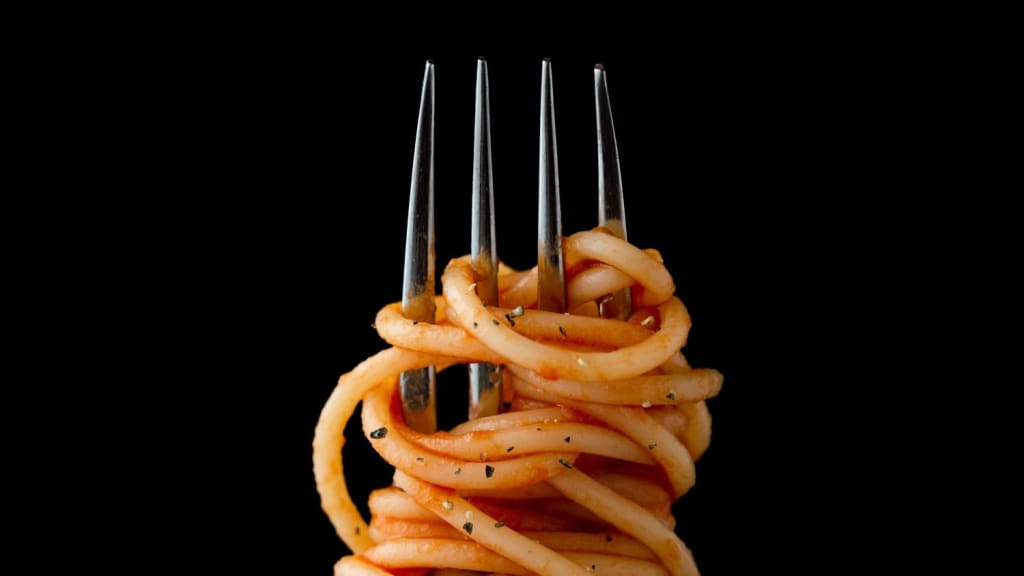
I’ll never forget the first time I had a taste of Ethiopian spaghetti. It was a balmy, late-spring night in Chapel Hill, North Carolina, in 2011, at the now-closed restaurant Queen of Sheba. Nearing closing time, the crew started dishing out its nightly staff meal. Owner Frieshgenet Dabei sat down at my table with a plate of spaghetti, and I caught a scent of tomato and berbere. I may have actually floated out of my seat like a cartoon character on a carpet of aromatics into the seat across from her. Without my having to ask, she explained that spaghetti is as popular as injera in Ethiopia, and sometimes they’ll even eat spaghetti on top of injera. She taught me how spaghetti was introduced by the Italians, who have a long history of violence in Ethiopia, during and following Italy's invasion and occupation of East Africa in the late 1930s and early ’40s. That influence now sat on Dabei’s plate, noodles swathed in a homemade tomato sauce with onions, garlic, berbere spice, ground beef, and green peppers. She’d incorporated the last ingredient when she moved to the South.
For the rest of the evening, my life in immigrant spaghettis flashed before my eyes. We loved having “Italian night” growing up. On those evenings, my mom, or Ammi as we called her, jacked up store bought Ragu or Prego with Indian spices like coriander, cumin, and a little turmeric, along with fried onions and garlic, green peppers, ground beef and denture-friendly soft noodles. We’d triumphantly carry a massive foil-wrapped loaf of garlic bread from Walmart or Kroger back home and pop it into the oven. Sometimes we’d also toss together an American salad with lettuce and baby carrots and bleu cheese dressing. I say American because otherwise our “salads” were either slices of cucumber, radishes, and carrots served separately like crudites; or just onions, tomatoes, cilantro, and a few sliced green chiles mixed together. While the garlic bread and bleu cheese-dressed salad sides never changed, my mom made the spaghetti different every time.
At Friday-night mosque potlucks in my hometown of Greenville, North Carolina, there would be even more versions of spaghetti. Our Egyptian friends, who lived down the street, made a dry version with vermicelli noodles redolent with more cinnamon, cardamom, and allspice, as well as finer ground beef, and the noodles way more al dente. Our Palestinian pals made a simple version with tomato puree, tomato paste, sweated onion and garlic, black pepper, parsley, and, of course, ground beef. I’d barely make it back to the tarps spread out on the floor with my sectioned Styrofoam plate (this was 1989) heaving with these international takes, along with rice dishes, curries, and salads, all crashing into each other and obliterating the plate’s false borders, the bright red and orange oils soaking through it onto my white kurta. Later, I’d see my Filipino friend slice hot dogs into noodles cloaked in a ketchup-based sauce with a little Maggi Seasoning. Our Nigerian friends’ jollof spaghetti might have been the most intense — woody and spicy. And the Southern spaghetti bake made by my best friend’s mom broke down to about 30 percent noodle and 70 percent ricotta cheese and sausage.
I’ve been in Seattle for the last two years, where my little brother Nanu, his wife, and my two amazing nieces live. As we talk about the community experiences my nieces are having, we find ourselves reminiscing about how much we loved those mosque potlucks. For a small college town in the rural South, it felt like a weekly international food festival. Modern community get-togethers these days tend to be catered by local businesses, food trucks, or pop-ups, which makes me feel like they’re missing out on tasting as many home kitchens as possible. Inevitably, we always bring it back to the different spaghettis we ate, which we now fondly call “immigrant spaghetti” — one name with infinite expressions. For me, immigrant spaghetti is a celebration of what makes all American tastes so personal and unique, immigrants or not.
About the Creator
Keep reading
More stories from Kristen Orkoshneli and writers in Confessions and other communities.
Exploring Fantasies Between Couple To Strengthen Emotional Intimacy
Fantasies are an inseparable aspect of human fantasy and affective disclosure. Healthy partners should share fantasies to enhance each other and to build trust and to make partners communicate honestly. In a place where couples are free to talk about their wishes and thoughts, there will be an environment where there is honesty and vulnerability. The openness assists partners to know each other better, which enhances emotional closeness and respect.
By Robert Smith3 days ago in Confessions



Comments
There are no comments for this story
Be the first to respond and start the conversation.