
Icons: Between Belief and Doubt-Part 6
A conversation on icon theology between belief and hesitation;

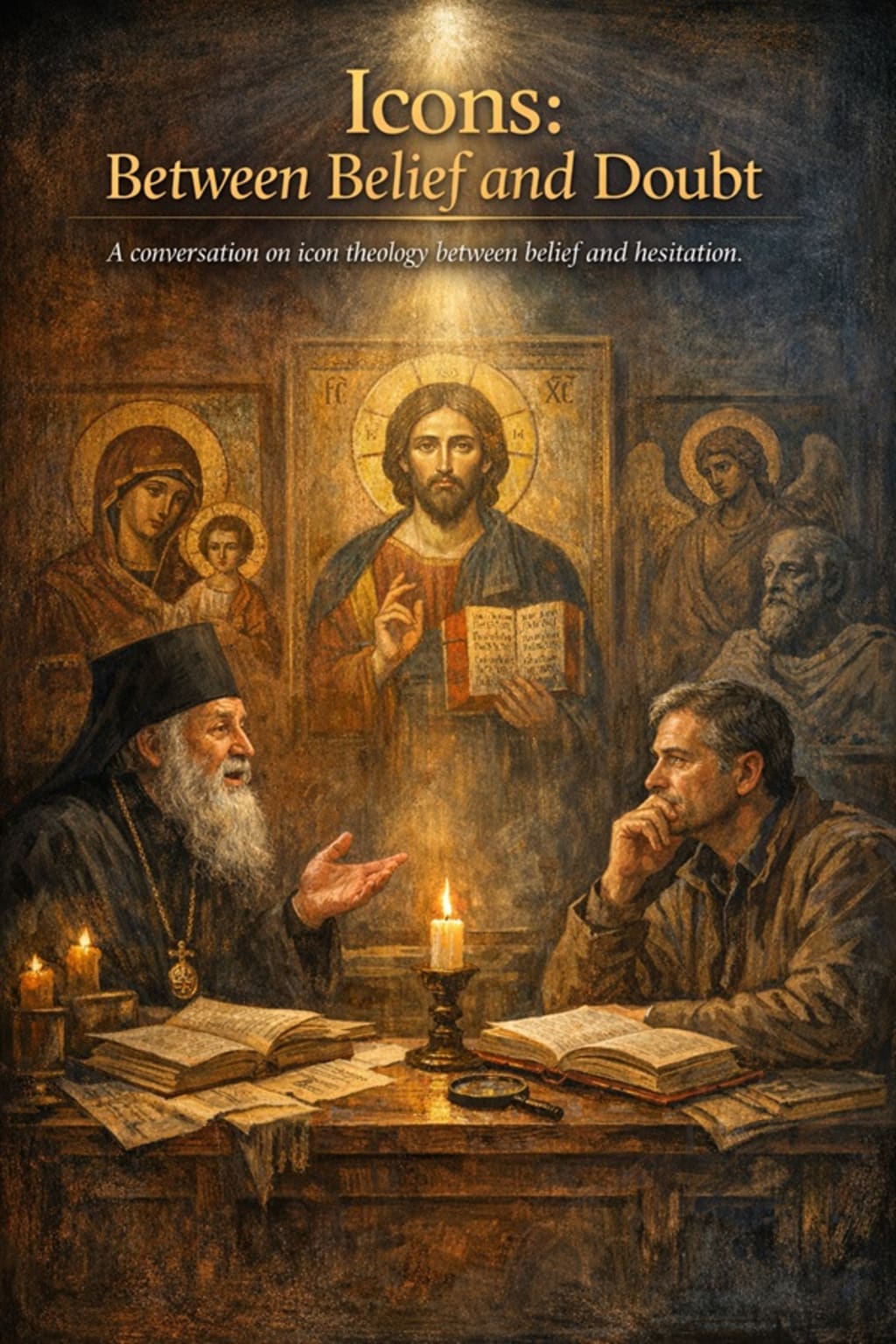
During the Liturgy, the bread and wine are consecrated and become, in the Orthodox and Catholic faith, the Body and Blood of Christ — not symbolically, but really, mystically. What does the Eucharist signify? It is the bloodless sacrifice of Christ, repeated liturgically but unique in essence. It is the nourishment of the soul, which unites us with Christ and with the other members of the Church — His mystical Body. It is the source and summit of spiritual life: all the other Mysteries lead toward the Eucharist.
“The Eucharist is the pledge of eternal life: ‘Whoever eats My body and drinks My blood has eternal life’ (John 6:54). It transforms us inwardly, unites us with Christ, and gives us strength to live in grace. It is the center of the Liturgy and of the life of the Church — without it, there is no full communion.
I was describing the Liturgy as the service at the church……
Exactly — and you are completely right. The Liturgy is the central service in the Church, often the most solemn one, the one in which the community gathers to listen to the Word of God and to partake of the Body and Blood of Christ. The term ‘Liturgy’ comes, as I was saying, from the Greek ‘leitourgia’, meaning ‘public work’ — therefore it is a service in which not only the priest, but also the faithful people participate actively: through chants, listening, prayer, confession, and communion. But it is much more than a simple ‘religious service’: What makes it unique compared to other service
The other services (Vespers, Matins, the Akathist) are important, but the Liturgy is the only one in which the Eucharist is celebrated. It is the center of the liturgical cycle — without the Liturgy, spiritual life would be deprived of real nourishment. Through the Liturgy, the Church defines itself not as a building, but as the living Body of Christ. If you describe it as ‘the service at the church’, it is absolutely correct — and you have captured the essence. Only that, beneath this simple expression, a huge mystery is hidden: God descends in the midst of people, and people ascend through grace toward God. What do we know about how the apostles understood it?
In the early Church, the apostles understood the Liturgy as a living continuation of the Last Supper, a form of real communion with Christ, in which the sacrifice is made present and grace is shared.
Although they did not have a fixed liturgical structure like we have today, the ‘breaking of the bread’ was the center of Christian gatherings. Let’s see what we know from Scripture and from tradition. In the New Testament, Acts of the Apostles 2:42: ‘They persevered in the teaching of the apostles, in communion, in the breaking of the bread, and in prayers.’ Acts 20:7: ‘On the first day of the week, when we were gathered to break the bread…’
1 Corinthians 11:23–26: Saint Paul directly transmits what he received from the Lord about the Eucharist — a sign that the Liturgy was already a living practice in the communities. What did the apostles understand by ‘the breaking of the bread’? It was not a simple meal, but a mystery: Christ present in their midst, offering Himself as nourishment. It was the central act of communion — not only between people, but between man and God. It was done with prayer, word, and chant, in a sacred setting, even if simple.
For the apostles, the Liturgy was not a formal ritual but a living experience of the presence of Christ. It was a sacrifice, a communion, a confession — and above all, an anticipation of the Kingdom. They did not ‘go to church’, but gathered as the Body of Christ, and the Liturgy was the breath of this new life.
Okay, how did this practice transform into the Liturgy of Saint John Chrysostom?
The Liturgy of Saint John Chrysostom is the result of a liturgical maturation of the apostolic practice of the ‘breaking of the bread’, becoming a structured, profound, and sacramental form of Eucharistic worship in the Orthodox Church.
Why then is the cross not uniformly recognised?
The theology of suffering versus resurrection is the main orientation: Catholics and Orthodox emphasise the sacrifice of Christ, so the cross is seen as a symbol of salvation through suffering. Protestants emphasise the resurrection and grace, so they prefer an empty cross, without a corpus. Fear of idolatry: some Protestant groups (for example, Calvinists and Anabaptists) avoided any visual symbol so as not to distract from the Word of God.
Historical and cultural context speaking: in periods of persecution, the cross was avoided or encoded (for example, the fish symbol — ichthys). In other eras, the cross was politicized (for example, the Crusades), which led to reluctance in some environments. Yet what unites them? All Christian confessions recognise the death of Christ on the cross as the central moment of salvation. Even if the symbol is treated differently, the meaning remains profound: love, sacrifice, victory.
Extra-biblical tradition is like the living memory of the Church — a form through which faith is expressed, adapted, and transmitted. It can be a source of wisdom, but also of disagreement between confessions.
©Ca De Luce> MINDFUL MIND Medium Blog 2025. All rights reserved.
©Ca De Luce> MINDFUL MIND Medium Blog 2025. No part of this publication may be copied or reproduced without permission.
©Ca De Luce> MINDFUL MIND Medium Blog 2025. Content protected — copying prohibited.
©Ca De Luce> MINDFUL MIND Medium Blog 2025. Unauthorized use of text or media is not allowed. All images and photo are fulfilling the copyrights regulations. Much obliged to you all!
About the Creator
CA'DE LUCE
I speak of spirit, soul, and flame,
Of humanity’s quest, our endless aim.
Religion, memory, stories untold,
Poetry woven with truths, oh! so bold.
Evolution’s path, the heart’s deep call,
Media’s noise, I’ll sift it all.
.
Keep reading
More stories from CA'DE LUCE and writers in Confessions and other communities.
Appaloosa
I couldn't stand this girl. For no reason at all. She had atomic orange curls springing in every direction, fully loaded chipmunk cheeks, and a different shirt with the same horse on it every stinkin' day. Her freckles looked so out of place on her sickly white skin. It was a month into 7th grade when I finally learned her name. Tracy. It was as bland as her personality. I didn’t understand her in the slightest; every time she spoke, her monotone voice would send my mind running for the hills. When the bell would ring, she would always be the last one to leave the classroom, but somehow scatter to be the first one to arrive at the next. I guess karma put her in just about every one of my classes and it drove me crazy that I could spend days studying for a test and never make the same grade as her in any of them. Why did she bother me so much?
By Kales5 days ago in Confessions
TUS NUA - ch 53
TUS NUA – ch 53 New Beginnings – Mia and Midnight (*)(*)(*) Finola knew Ali’s brother-in-law needed to put his mind at rest. She fed her arm through his and led him outside. “We’ll sit here. If you like, I can put a block around us so our conversation will be private.”
By Margaret Brennan2 days ago in Fiction


Comments
There are no comments for this story
Be the first to respond and start the conversation.