

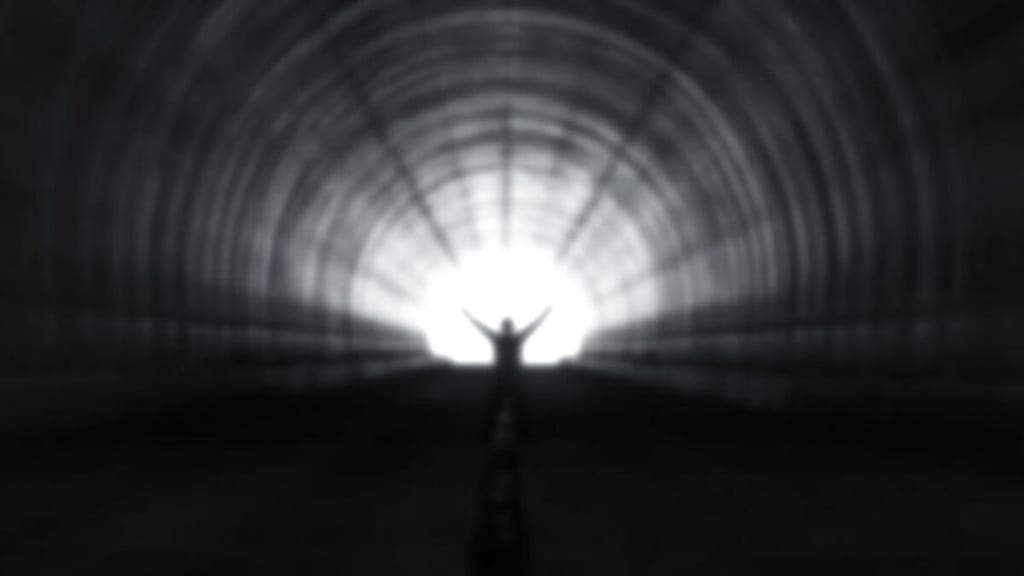
I opened my eyes. She leaned in. “You had a heart attack”
Staring, unable to speak, I looked at my wife blankly. I realized I heard words, I realized who she was. I recognized each word, but I could not comprehend the sentence, or for that matter, the situation. What seemed like an eternity later, my mind had hung on the last word: heart attack. It was a dreamy consciousness.
I closed my eyes and fell into a deep, deep sleep.
The next days were confusing. As I slept, occasionally, a person of importance would touch my arm while standing in my view. They always seemed to tell me something important but what that was I’ll never know. Day by day, I was more conscious.
Visiting frequently: one day my wife told me the story.
“You woke on 3 November 2014 with a ‘really more than just painful’ upper back. You were getting ready for work and school for the kids was at play. You Googled your symptoms and asked Carter to call 999. - To be clear, thrice I told him to call and not call. Carter was just 14 years old having celebrated his birthday in late October. She went on, “The last attempt was uninterrupted by you and answered with questions - through Carter - back to you. The ambulance was dispatched to our Stranmillis, South Belfast home.”
“As they walked in, you died. You had a cardiac arrest. For 18 minutes they ‘worked’ on you. CPR, rhythm, defib, loss of rhythm, repeat.”
At this point, the whole house is up, but the living room belongs to me and the paramedics. A casualty of the day: my favorite New Orleans Saints football shirt. You see, when you are hooked up to a defibrillator and heart monitor, they cut off your shirt.
Just before the 20-minute call, I found my way back to life and we were off to the hospital, my wife at my side in the ambulance.
When this happens, to be clear, the professionals – those in uniform, will try to save you but, the odds of survival are extremely low in these situations. 10% of those who have a cardiac arrest outside of a hospital make it to the hospital alive: of those, 10% go on to live. Sitting alone in the hospital relatives’ room, the duty nurse, reassuringly announces on a few more occasions, “He is back in cardiac arrest. But her face gave the gravity of the situation away.
Now I know what you are thinking: what did you see, did you see God, is there a heaven? What happens when you die – well, more on that later.
Back at the hospital, I am woken with the touch, of a good-looking youngish man. A Greys Anatomy McDreamy for sure – he was wearing a surgery cap, standing over me. Knowledgeable looking, serious, intent, he told me his name and announced that he was my cardiac surgeon. “Hi Keven, how are you today?” I looked at him, taking a minute to comprehend the situation. “OK,” I said. “You had three cardiac ‘events’” he said, staring at me in wonderment. You see, I had become the miraculous Lazarus patient of the cardiac ward. “I put two stents in your arteries, they were blocked 95%. There is another artery about 60% blocked but we left that one alone.” Me, struggling with words: “Why not do that one too?” “Well, it’s all about risk,” the surgeon said.
Now I don’t know a lot about the risk of stent implants, but being one who is recently educated in the risk of blocked arteries, I thought about what he said, “Let’s do another?”
Shaking his head from side to side he went on, “Can we do a few things?” I nodded, “Ok, follow my finger” My head moved to and fro. “How many fingers am I showing?” “Ahh...three.” “Do you know what year this is?” Is it 2014? Delighted, he asked, “What’s your name?” “Keven,” I said. Then, “Do you know where you are?” “In a Belfast hospital?” I asked “Yes, well, you are one lucky man. We put you into a coma for a week, you woke up yesterday. We were not sure if you had a brain injury, you know, from lack of oxygen.”
He squeezed my arm, smiled saying, “Others will be in touch, good luck.” I never saw him again.
In the next days, I drifted in and out. I was living the life of a person who wanders about in a blacked-out state. I learned later I had made many calls to the house espousing proper gibberish, woke up once asking about Nazis very worried, and generally made an ass of myself for the troubled nursing staff and my family.
Finally, I was home. Home seemed different, new, confusing, something to learn.
Now, it’s important here to stop and point out the knife-edge existence that we were living.
In 2012 we applied to the New York UK embassy for what’s called Ancestry VISA’s. To be clear, we needed five: My wife’s, mine, my two sons, and of course the wee daughter. It was a simple affair: $500, proof of heritage, and boom: five years of living in another country. Initially, we wanted to emigrate to Ireland, but that door was closed: the Irish ancestors were greats...too distant to qualify. With a UK VISA, we could still live in Ireland....in the north of Ireland.
As a director for a Canadian multinational, I stayed behind until I could find any kind of a job in the north. An interview was nailed, and I came across the pond one year later. The job was atrocious and the pay substandard. I took on a dysfunctional branch owned by a French company that just wanted to offload the thing. The line manager who had managed the depot delivered to me her entire incompetence. For certain, this was a temporary position.
In 2014, the job came to an end, and I found myself free-lancing in a business community I did not understand. Sectarian, tribal-based, the prospects were slim yet I managed to find a role as a sole proprietor salesman promoting a new anaerobic digestion plant. The money was scant, but it paid the bills. The event of November, the cardiac arrest, paved the way for the heartless decision to let me go. Funny thing that. The plant was owned by a hedge fund manager from Canada. I swear if he was Irish, I would still have been there.
So, there we were: on the knifes edge.
The last interesting fact about an Ancestry VISA is that you are not allowed to receive any state aid other than medical. This exclusion includes all government programs from housing to school lunches. If you take anything, you doom any idea of gaining indefinite leave to remain.
OK, back to the story.
My homecoming parade is tempered by my jobless ‘state of affairs.’ The money is tight, and our financial shelf life had a definite ‘must get a job by this due date’ future. Christmas was looming and the pressure there was to create the ‘everything is normal facade’ for the children.
Short-term memory is a problem. Adorning the fridge, phone, bulletin board, and other strategic areas, sticky notes remind me of where things were, remind me of who I talked to, remind me of job applications, remind me of anything to do with anything that falls into the short-term memory loss category. This, the memory thing is quite a problem.
TV watching is a problem too. First, it’s surreal. Too much information to quantify and compartmentalize. I just stare at it. Second, it takes up all the brain’s bandwidth. “Dad?” says my eldest son, “Dad?” I never heard him. New sticky note idea: Don’t try two things at once.
The surgeon said others would be in touch with me. Entering my life was a psychologist at the Brain Injury Clinic, a Neurologist housed in the hospital, and two wonderful cardiac nurses who had a gym in the Divis area and gave me back my confidence through physical therapy. Driving to physical therapy was both interesting and frightening. The sheer terror of all the things the brain must take into consideration while driving is a new and interesting sensation.
Who knew it was so complicated?
Now to the brain. A tricky thing this organ. The only time you know how it works is when it’s hurt, and you have that cognitive realization that thinking used to be different. The short-term memory loss is one thing, the discovery that my ‘event’ impinged on my ability to write, and spell is another, and of course, doing two things at once: highly complicated.
Many psychological tests later and an MRI, both the psychologist and neurologist said I was normal. Protesting the opposite, I complained about the two things at once, the ‘memory’ and, and.... and they offered this: ‘that their normal was most likely not my normal’.
“You test well on the spectrum,” the psychologist told me after weeks of games and puzzles. See, here are your scores, and here is where the population is. You are right in the middle. It probably was not where you were, but I don’t see any real brain injury here.”
“Wow, I am so happy to become average,” I said. By now, the dire financial situation is upon us.
The exchange rate between the Canadian dollar and the British pound sees two Canadian loonies making up one British pound. Result: savings are being depleted at twice the rate. To put things into perspective, Belfast rent in Canadian dollar terms was $2k, utilities $600, food $1k..... monthly.
The action plan required three things: get help, fend off the wolves and it’s time to ‘graft.’
I lifted the phone and called Sinn Féin – my local MLA’s party. I had met Máirtín Ó Muilleoir earlier when he was Lord Mayor of Belfast at the Ardoyne Fleadh. A lovely person, a humanitarian, smart, and well respected, Máirtín Ó Muilleoir ordered his staff to meet me right away. Fantastic I thought, we are saved. They couldn’t help us though- only because the helpline they managed was for acquiring and expediting the receipt of state aid. This I could not accept. They did however give me a number, a valuable number, a number that saved my family. The voice on the other end listened to my story and was sympathetic and helpful. She was a problem solver and well connected. She provided me with more contacts and numbers with the offer to help stick handle the situation. I had help! The first call was to the Red Cross. She knew the timing would be perfect since the Executive Office of Martin McGuinness in the North had just – the day before - provided them with a large grant to help immigrants. This delivered £400 per month. The second call was to a local food bank. Patricia, a person of the Protestant faith, middle class, non-judgemental showed up a day later with food...a lot of food. She would come back with more monthly. Finally, the last call, to St Vincent De Paul at St Bridges Catholic Church: our church.
Now, it took all my might to make those calls and accept the charity. Ashamed, embarrassed, emasculated, I did it gulping back my last breath of self-esteem.
Two men came from St Vincent de Paul: one short, one tall both, mid 60’s, dressed in their Sunday best. Most likely members of the Knights of Columbus. The short man was the one in charge. “So, Keven, I’m Peadar and this is Brenden.” “Please come in, please have a seat, would you like tea?” I said with a brave face while my insides churned. I told them my story laying out the financial train wreck that my life had become. Then silence, the kind of silence that breaks you, the kind of silence where you are scared of what’s next.
“So, Keven, what’s your plan here?” said Peadar. “Stave off the wolves and find work wherever possible while looking for a proper job” I replied. “Well,” Peadar starts, “Let us discuss your rent. Are you behind, have you spoken to your landlord?” “Two months arrears and No,” I offered, “I wanted to know first what may happen here, what are our rights if we can’t pay on time, is there a grace period?”
“You will have to vacate the property; you will be evicted,” Brendan said sternly. “You must negotiate.” He said to me, a guy who could barely string a sentence together.
Then, that awful silence filled the air again. I felt like vomiting, I could feel and hear my heart pumping, my fingers felt tight.
Peadar calmly spoke, “Call and see if you can make an arrangement and see if you can pay what you have – see about a payback plan over a period of time, let us know the outcome”
“I’ve never been late,” I said meekly. “Well, that should be in your favor then. Have you any money right now?”
I had never been without a penny in my pocket, had a bank account that was at the end of its’ overdraft, or looked in my wallet at a useless - maxed-out credit card.
“No, we have no money at all.” Brendan reached inside his blazer jacket and out of the inside left breast pocket he found a white envelope.
“It’s forty pounds. Buy some gas so you can cook and use the other twenty for some food.” We will go back to our committee and come and see you in a few days. Since you have no car, we will go to the food bank too and bring you food on our return. Do you have much food?”
The saying, ‘It’s the small things in life that make you happy’ could never have been truer. I was over the moon, forty pounds and help! The generosity and goodwill of the people of Belfast, no matter the tribe, warmed my heart to a city and Ireland: I felt I was home.
Holding back an emotional scene, I said thank you twenty times.
The next day, as promised, Peadar and Brenden arrived with more food. We sat together in the living room as the wife filled the kitchen cabinets. “Keven” Brenden looked at me. “Keven, the committee of St Vincent De Paul met last night, and we are prepared to offer you £400 per month for five months while you rehabilitate and find work. What did your landlord have to say?” “She agreed to a phased payback with no more accumulated arrears,” I stated. “Perfect then,” said Peadar, Maith Thú. Now, what about work?”
Graft.
Collins Dictionary:
Graft means hard work. [British, informal]
His career has been one of hard graft. Synonyms: labor, work, industry, effort
Living in America taught me one thing. It’s all about you, your world is what you make of it: I knew it was time to graft.
In my life, I created a career that provided for the family. When job security waned, - like the time I lost my job in America and came back to Canada – I grafted to keep the family afloat while I looked for a proper job: executive jobs take six months to find. In my college days, I grafted as a painter and for a while after had a small painting company.
Step one, print out flyers and door knock the neighborhood. Nothing. The second step, go on the internet and harass painting companies: surely someone would need a worker.
Jim is a lovely man. I walked the forty minutes into town to the arranged spot. “Do you have whites?” he first asked. He gave me whites, and off we went to paint. I was never sure if he needed me or was just interested in hiring a Canadian. It was cash on the nose and every Friday I could expect £350.00.
Into his van, door shut, he did a small interview. The painting experience started the conversation, and then, the conversation drifted into a series of questions designed to suss me out. So, your children, he asked. “Where do they go to school?”
Now, for those not in the know, this is the way your tribe is outed in the north of Ireland. The school question is important because, in the north, the predominant grammar and elementary schools are either Protestant or Catholic. If this fails the interrogator, they prod and ask about your neighborhood, and then sports. They might ask: So, are you a Celtic fan, or what do you think of hurling? While outlawed, discrimination is still alive in the north of Ireland and emanates more from the Loyalist-Protestant side.
I looked at Jim and said, “My youngest goes to Stranmillis Primary”
Stranmillis belongs to neither tribe...I was safe. “On the phone, you said you had another son?” My heart sunk. “He goes to Aquinas” I offered. Awaiting a response, I looked forward to the road ahead, the seconds felt like an hour. I was thinking, there’s the corner where he will let me out. Thanks for meeting me he would say as he drove off.
Jim smiled. I am from West Belfast he said, my brother, is a Councillor for Sinn Féin. I burst out laughing in a weird hysterical laugh acknowledging my good fortune. I had found work with my tribe!
“I named my company after a street in a mixed area to get work from both communities,” he said.
The job was in the heart of an upper-class Unionist-Protestant neighborhood a stone’s throw away from Stormont: the so-called ‘capital’ building of the north. There were no sign of British flags, or UVF flags festooned on lamp standards, or the tell-tale loyalist red, white and blue painted curbstones. Seems that clutter was relegated to the underclass neighborhoods of Loyalist-Protestant Belfast.
While the tribe was the right one, the ‘can you do the job thing’ loomed largely. Remember when I protested over the two things at once issue?
To properly paint you need a few skills: excellent eyesight, body coordination, experience, use a brush, and most importantly have perfect hand-eye coordination.
Jim introduced me to the men in his crew. They sized me up and we got on with our work. My first task – really a test, was to prep and paint a drainpipe. The top connected to an eve that was about 30 feet high.
The anxiety took away my breath.
I gathered my thoughts. Ok, Keven, think THINK! I’ll need a scraper, some sandpaper, and a wire brush to start. I breathed a small sigh of relief, the memory for prepping – and the one, two threes were coming back.
Next, a drop cloth under the working area to catch the falling debris. Now, I don’t know if any of you have lifted or moved a ladder of any kind, but what I can tell you is that it requires a lug of a person with good feet and strong coordinated arms to manage the feat. The larger the ladder, the more dangerous the maneuverer.
I stood, staring at the ladders: there were six. I could feel the burn of onlookers on the back of my neck. With all my might, adducing the feat, I picked the 30-foot ladder. Whew.
Centered, I carried the ladder to the drainpipe. Now, this drainpipe was in between a series of large rectangular windows. They cascaded from the top to the bottom floor of the house. In between a good 12 inches. One bad decision and SMASH, the window and the job were broken. On its feet the ladder wobbled, it had to gently land on the house wall. Gently I leaned the ladder into place. Extending further, the ladder found its way to the top and rested perfectly on the bottom of the top windowsill.
So, remember that time I had to graft when I came back to Canada from America? That’s the time, working on a house project of my own, I came down a ladder, missed the fourth rung from the bottom, landing on my right foot. 13 screws, a plate or three, and a few other pieces of hardware later, I could now feel my ankle pulse as I approached the ladder. Primer can, wire brush, scraper, paintbrush sandpaper. Up I went one rung at a time.
The drainpipe was finished at the end of the day. Jim approached me as the crew looked on. I was worried. Did I take too long, was I about to be fired? “Maith Thú” he said smiling, “Well done. I can tell you have painted before, the prep is good, that’s what’s important to me.”
Coincidence has always been a part of my life. A few weeks in, comfortable, I told my new workmates about the event. Jim listened intently. The others were skeptical and ‘took the piss out of me’ laughing and teasing. “My brother works for the ambulance service,” Jim said. You could hear a pin drop; all eyes were on Jim. “You are boxed in now” the crew offered. “It was at 5 Lagan Manor, - 3 November,” I said. The very next lunch, sitting together at the picnic table in the rear yard, with the crew looking on thinking I was a fibber, Jim looked at me, “Keven, I checked you out last night.” The crew waited breathlessly for the statement of fact. “It was my brother who attended you, he and his partner thought you would not make it – he says you are very lucky.... a miracle”
Jim kept me busy for four months even when his business mind told him not to, but in the end, his declining workload saw me searching out new companies.
He was a vulgar man. Steroid large and unpredictable, he wore Loyalist paramilitary tattoos on large forearms. He was possibly dangerous, and my new boss. The only upside, £90, paid at the end of every day. His steroid-using sidekick, 45yrs or so, is a proven womanizer. “How was Benedict’s? Did you buck someone?” says the boss. “Ha, ha, I found one, late 40’s I bucked her all night then threw her out in the morning.” They both laughed and laughed. In my head: what the fuck am I doing? All the way to the job site, it was bucking stories and talk about ‘working out’ with the steroid benefit. “Look, see that high-rise? It's full of hookers. My favorite is on the 16th floor.” Says the boss man.
They dropped me off at a job site, one project to do by myself all day. I had never experienced such relief. The days going forward were filled with the bucking womanizing let's work out and do steroids banter. On one occasion, the sidekick came to work with a broken nose. “Her brothers came after me, I need help” One UVF – Ulster loyalist paramilitary group call later, his problem disappeared.
Now, I grew up in Vancouver, and a major influence for me was the 1970’s birth of Greenpeace in Vancouver’s hippie-laden west side. I had the eco bug, I had the save the planet mantra planted deep within my soul. It manifested into an enduring moral belief.
I was picked up from a small job a week later, I had finished mid-day. Both the boss and sidekick were enjoying ogling and flirting with the single mother who, loving the attention, had dressed appropriately in a slinky housecoat. We stayed for a lunch break and drove off. Steroid rage comes from a strange place. There is no knowing the triggers for the rage, no knowing the when and where. Its’ as predictable as the Irish weather.
Driving to the next job, I was handed a pile of rubbish. Takeaway cups, a bag of accumulated trash, half-eaten food, and an old painting rag or two. Three abreast in the cab, I sat in the window seat.
“Throw it out!” I looked at the boss thinking, what? What? Again, “Throw it out!” Ummm....hesitating, comprehending the situation, the sidekick added, “Do it now, throw it out! “Right now, right now!” screamed the boss. I froze. After the cardiac arrest, high emotional situations always froze me. My brain would shut down. While shutting down, I knew a few things that moment: first, I was not doing what I was ordered to do, second, the double dose of unpredictable rage was at a crescendo, and third, - I needed the money and had to manage that awful tummy feeling my grandmother warned me about. I wanted to flee, but I couldn’t let the family down and with all my emotional might, I threw out the trash. Immediately they changed their demeanor to ‘happy,’ but: I had failed the test and was never fully trusted again. This still haunts me today.
With the money from the Red Cross, the money from St Vincent DePaul, and my meager wages, I was able to provide for the children and start repaying the one-month rent arrears. One day, - six months in, the phone rang: it was Andy from Scotland. It was an odd call; I was told my application for Operations Manager was incorrectly disqualified. “Can we have a discussion right now Keven?” We talked for 30 minutes. Delighted, Andy told me to expect a phone call. It’s a possible job in Scotland I announced to my anxious family onlookers. It amazes me to this day how news of this kind changes that ‘you can cut the tension in the air with a knife feeling,’ to a feeling of hope.
In Ireland, there is a historical figure of a man who, depending on your persuasion, is loved or hated. A real typical Irish problem. The figure I speak of is Michael Collins. The first leader of the Free State, he took a broken and fragmented Ireland out of the clutches of the British army leaving the north for another day.
My plane landed in Manchester England. I managed a bus and found my way to the corporate headquarters. It was my first real job interview: everything hung on the outcome. Sitting on the third floor, outside the huge office of the President, I rehearsed my lines. I rehearsed my STAR answers. One of the outcomes of the cardiac arrest was the way my brain shuts down if I am put under emotional stress. As I sat there waiting, my rehearsed answers were leaving me in droves.
“Keven come in.” The man ushered me into his office. My name is Michael Collins. What? I thought. I was being interviewed by Michael Collins. What are the odds? I noticed above him a signed picture of a hockey player. It was at this time I realized this, ‘Michael Collins’ had no accent. The blood rushed into my head. “I see you’re a Canadian,” he said. I smiled, “Yes, and you? I am from Toronto; I am here for a year or two managing the UK business.” This was not on the website...OMG I thought, I am interviewing at a Canadian multinational with a guy called Michael Collins.
Head down, he pulled out my CV. “Lots of experience, mainly operational experience, that’s good.” What do you know about security, ours is the business of securely destroying documents.” I thought and thought as time slowed down to a trickle and where the quiet gives way to a wall clock’s booming ticking sound. I knew nothing about the destruction of confidential documents. The last rehearsed answers still left in my brain were of no use here. This is over, I was about to blow this one-off. Then, out of nowhere, my brain offered: “Whether or not we are managing security or operational issues it’s all about the process. In my CV, as you can see, I have an incredible background for managing processes.”
“What are you looking for?” Boldly, firmly, I said: “£55,000 per year, a car and a pension.” Michael wrote it down, on my CV and circled the 55K.
When was the last time you were in Canada? I asked. “Not long ago, I was there for the election. I think young Trudeau will be good for the country” was the reply.
So, that was it. The conversation shifted to Canadian politics, then to hockey, and then laughter. When I left, I knew I had the job, what I didn’t know, was that this job would transform me, taking me to the killing fields of Derby. On the plane trip back, looking out the window of my beloved Ireland, I said to myself, I think that was too easy.
I couldn’t remember dying for a long time. In the depth of the pandemic, alone with my thoughts, with no people distractions, I became overwhelmed with the memory. When I died, I saw black. A black like no other darkness I had ever seen. This blackness, this place, this blackness was an inward observation given my closed eyes. Unconsciously and outside of my mind, I observed the blackness objectively and without thought. I do not recall feeling scared and my memory told me I felt OK, I felt comfortable. Suddenly, the comfort of the darkness was broken by an overwhelming flash of pure light, it bounced around every micrometer of my brain. I had come back; I opened my eyes; I was alive again.
About the Creator
Arthur Brain
North American ex-pat who emigrated to Belfast in the north of Ireland. Its people and history are my muse. I find inspiration in the streets and villages.
Keep reading
More stories from Arthur Brain and writers in Confessions and other communities.
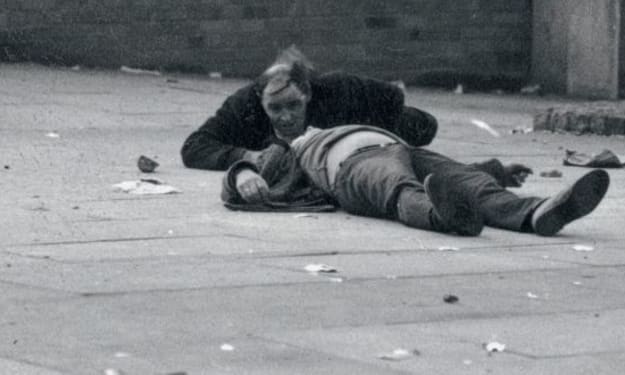
Sunday Bloody Sunday
They came from far and wide. Many walking, many sharing cars, others just finding a way forward. Mothers, sons, daughters, fathers, grandparents all. The outrage, the witnessed horror, the wounding and excruciating pain to the national soul on display. They marched to a place to mourn for their nation, to mourn for the fallen, they marched to Marrion Square Dublin. They were not alone, the outrage and anger everywhere: Cork, Galway, Sligo, Dundalk, Letterkenny, and over forty cities and towns large and small. The Irish soul was wounded that day, the love of a nation, the love of the fallen would be heard through an outpouring of love, anger, and patriotism.
By Arthur Brain4 years ago in Journal
The Last Day of the Year
My New Year Countdown Clock indicates that I have just over five hours left before this year is over. I am stuck in the suburbs with my mother and stepfather, contemplating what I am going to eat and drink to celebrate this great change in our lives. The weather is cold, but I do not feel as though it has really affected my attitude about what the new year will bring...but I am not as happy with this moment as I usually feel.
By Kendall Defoe 16 days ago in Confessions



Comments
There are no comments for this story
Be the first to respond and start the conversation.