
I Walked Out Without Saying Goodbye. Here's Why.
Sometimes, silence says what words never could.


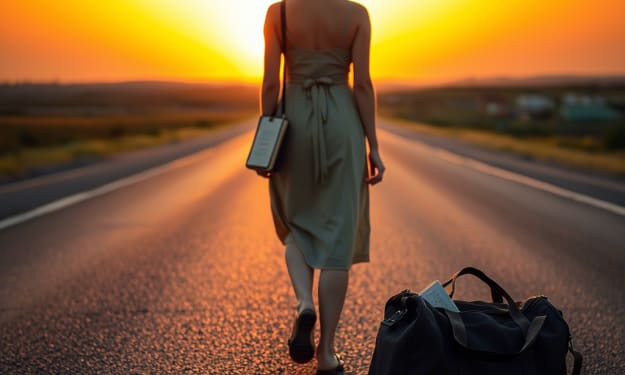
I walked out without saying goodbye. No final glance, no tearful hugs, no apologies whispered through trembling lips. I just left.
To the outside world, that makes me the villain. I’m okay with that now.
But here's why I did it—and why I had to.
---
I was twenty-six, living in a city that felt more like a cage than a home. I had a job I didn’t love, a partner who had long stopped listening, and friends who didn’t notice when I disappeared for weeks. I had built a life that looked good on Instagram, but inside, I was unraveling.
Every morning I would wake up with a weight on my chest—a heaviness I couldn’t explain. I told myself it was just stress. Just burnout. Just life. But the truth was much simpler: I was suffocating under the expectations of others and the lies I told myself to stay afloat.
It wasn’t one dramatic moment that broke me. It was the thousand little ones that stacked like bricks until the wall around me was too high to see over.
Like how my partner, Alex, would scroll on their phone while I spoke about my dreams. Or how my mother’s voice would harden every time I mentioned wanting to travel alone. Or how my boss told me I was “too emotional” when I cried after working 80 hours in a week.
So I did what I had never done before.
I stopped explaining myself.
---
The idea came suddenly, like a whisper from somewhere deep inside me: Leave. Just leave.
At first, I laughed it off. I’m not that kind of person. I don’t just vanish. But then I imagined it. I imagined waking up in a different city, with no one expecting me to be anything but a stranger. I imagined silence—not the kind filled with guilt or loneliness, but the kind that feels like peace.
I started planning in secret. A one-way ticket to Lisbon. A sublet arranged under a different name. A letter to my landlord. I packed a single suitcase, sold what I could, and donated the rest.
The night before I left, I stood in the doorway of the apartment I shared with Alex. They were asleep, mouth slightly open, the soft rhythm of their breathing filling the room. I watched for a while, wondering if I should wake them. Tell them. Say goodbye.
But I didn’t.
Because it wouldn’t be goodbye. It would be another argument. Another manipulation disguised as concern. Another round of “You’re being selfish,” and “What about me?”
So I walked out. Quietly. Keys on the counter. Phone wiped clean. No note.
---
The first few weeks were terrifying. I second-guessed everything. I felt guilty. I missed people—until I remembered how little they had really seen me. I kept waiting for the anger, the messages, the backlash.
But here’s the strange part: It never came.
Not a single person called.
I realized I had spent years building relationships based on obligation, not love. Presence, not connection. And when I left, it was like I had erased a ghost version of myself. One that had been haunting her own life.
In Lisbon, I started over. I worked in a bookstore where no one knew my name. I took long walks near the water. I dyed my hair. I wrote again. I didn’t recognize myself, but for the first time, that was a good thing.
---
A year has passed now.
Sometimes, when I sip my morning coffee on the small balcony of my rented apartment, I think about that night I left. About how a single decision—one that took me less than five minutes to make—changed everything.
Was it selfish? Maybe.
But was it necessary? Absolutely.
---
I’m not suggesting everyone walk away without saying goodbye. But if you're reading this and feel something stir inside you, something aching for permission—maybe this is it.
You don’t have to explain your pain to people who refuse to see it.
You don’t have to shrink to fit into lives that no longer have room for your growth.
You don’t owe anyone a goodbye that costs you your peace.
---
So yes, I walked out.
And no, I didn’t say goodbye.
But for the first time in my life, I finally said hello—to myself.
About the Creator
Keep reading
More stories from Azmat Roman ✨ and writers in Confessions and other communities.
The Day I Packed a Bag and Never Looked Back
The Day Everything Changed It was a Tuesday. Tuesdays are rarely revolutionary. They’re the sleepy cousins of Mondays—unremarkable, predictable. But that one? It was the day I stopped pretending everything was okay. The day I zipped up a single bag, walked out the door barefoot, and didn’t look back.
By Azmat Roman ✨8 months ago in Confessions
The Piggy Project
I’ve had so many names in this life I lose track of which ones were ever really mine and which ones I wore because someone needed me to. Some were handed to me before I had words to refuse them, before I knew what they meant, before I knew I could say no. Most weren’t meant to hurt. That doesn’t mean they didn’t leave marks. Marks that told me who I belong to, who I am by way of who claims me, recognizes me in the good and bad, who walks beside me.
By Fatal Serendipitya day ago in Confessions
Women History Month Celebrates: Ashley Bookashy
Nearly five years ago I started working at my current job and in the mornings when I first got there a girl in a red Kia parked next to me every morning. As this went on the first few months on the job we started interacting and joking about how we kept parking next to each other, but in time this great woman would end up being my best friend.
By Joe Patterson2 days ago in Confessions
REEEEEEEEE!
I'm on a low road right now. There are a literal million things to do and not one of them worth my time. I would rather sit in place and burn but the orbit takes me on its inevitable route 'round the center; and I a center in my own right, around which others orbit, and so on and so forth, ad infinitum, ad nauseum.
By C. Rommial Butler3 days ago in Poets


Comments
There are no comments for this story
Be the first to respond and start the conversation.