
I think it's a Weasel…
We all do it but how do we recognise Confirmation bias

The world we now live in has changed beyond all recognition since I grew up in the 1970s. Technology and computing power have allowed breathtaking scientific discoveries but even though we have immense technology at our fingertips able to search and find out about virtually anything within seconds, we also live in an era of quack cures, fake news, and conspiracy theories.
When we experience a string of bad events, we think that we are jinxed.
We look for patterns in our lives and try to make sense of them, so we think bad events come in three's or happen to us because we're born under a bad star sign or even that God is punishing us for a past transgression.
What we often fail to appreciate is that a random process can often generate non-random-looking data, indeed it's almost guaranteed to do this over a relatively short period because we forget how many ways there are for coincidences to occur.
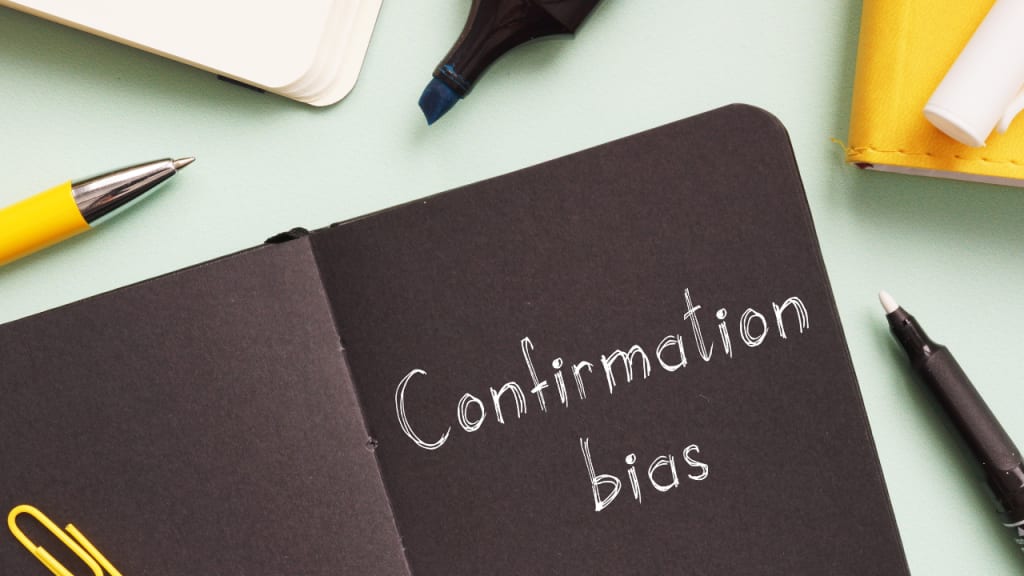
Much of what we see in the world around us needs to fit with what we already believe or suspect to be true. This is known as Confirmation Bias; it applies in relationships in an unconscious manner. Studies have shown we select the person most 'like us in terms of thinking, physical appearance, and social outlook as our life partner, like-minded people being attracted to each other isn't surprising or necessarily a bad thing as compatibility often equals stability.
Many people are now turning to find a partner online through the myriad of dating websites that exist but are often disappointed when they finally meet the person because their brain builds a perfect image and lifestyle around the person whose data and image they see. This creates an expectation, when that expectation isn't met, disappointment follows but this 'low' is quickly followed by moving on to the next person to validate that their expectation was correct.
A more realistic approach would be better to include an expectation around the likelihood that the person is not perfect and will have faults as all of us have, but our brains are not wired in this way.
Outside of relationships, cognitive bias can be seriously damaging to one's financial situation. One of the most infamous examples of cognitive bias is the 'Gamblers Fallacy' A gambler expects after a long run of reds at the roulette wheel that the ball is bound to run onto black. When it doesn't cognitive bias drives the gambler to think it's more likely to end up on black on the next spin, when it doesn't his cognitive bias fuelled by endorphins (pleasurable enzymes) in the brain further drives him to raise his bet to recover his losses from previous spins, thus he is in a spiral convinced because the previous runs have been red, the next must be black and he must win the next play.
What the gambler doesn't realise is that each spin of a roulette wheel is an independent and random event, and it can easily be seen how the gambler can be deluded into thinking it isn't.
Confirmation bias shows up in a wide variety of areas –business, politics, and social thinking.
In the Stock Market, I have been a victim, especially in my earlier years as an investor I thought that a large drop in a share price due to a market correction offered an opportunity to buy a stock at a low price, and it did, but NOT ALL Stocks offered the same opportunity there were some on reflection I should have avoided, and because I rushed in and purchased some stocks without doing the required 'due diligence, this resulted in losses, that's not to say I wouldn't have made losses but the promise would have been fewer if I had stopped my 'irrational brain' from driving my decision making process.
Inflation at the start of the year was about 2%, and the bank of England in March forecast a maximum rate of Inflation of 4%. Then in May this figure was updated to 7%, in June Inflation was revised again to peak at 9%, as I write the bank of England is now expecting Inflation to peak at 11% and some Economists think it could rise to 15% by the end of the year.
Economics unlike Mathematics and the Sciences isn't an exact science.
So, Economists often disagree about how to curb rising Inflation, whether interest rates should be raised to restrict spending which fuels rising prices and hence inflation, or to cut taxes to encourage people and businesses to spend to fuel growth and pull the economy out of recession.
This is the debate that is currently going on not only among the candidates applying to be Prime Minister but among mainstream economists, the majority of Economists seem to favour getting inflation under control first before cutting taxes -this was the approach the government in the 1980s took, and it seemed to work.
Whichever path is taken in the attempt to curb inflation and how successful that is will affect all of us, and only time will tell which approach was the right one.
Whether it's in relationships or looking at past financial events in making decisions that affect us personally or as a country, we all need to make better decisions that will make us both happier and hopefully lead to better financial security.
Copyright Suresh Thadani
An Independent Financial Advisor.
See more with @SureshThadaniFinancialAcademy
About the Creator
Suresh Thandani Financial Academy
EVERYONE wants to be debt-free, have a future secure. and Retire Early.
I have found a way to help you achieve FINANCIAL FREEDOM by Prioritorising at an Early Age Essential v Non Essential Spends.
Reader insights
Outstanding
Excellent work. Looking forward to reading more!
Top insights
Compelling and original writing
Creative use of language & vocab
Easy to read and follow
Well-structured & engaging content
Excellent storytelling
Original narrative & well developed characters
Expert insights and opinions
Arguments were carefully researched and presented
Eye opening
Niche topic & fresh perspectives
Heartfelt and relatable
The story invoked strong personal emotions
Masterful proofreading
Zero grammar & spelling mistakes
On-point and relevant
Writing reflected the title & theme
Keep reading
More stories from Suresh Thandani Financial Academy and writers in Confessions and other communities.
Repair, Reuse & Recycle
Before Global warming, before Climate Change, and even before the Wombles of Wimbledon, there was the second world war which inspired Britain’s post-war generation through the necessity to reduce waste, by saving Repairing, Reusing & Recycling.
By Suresh Thandani Financial Academy4 years ago in Lifehack
The Hollywood Dream That Didn’t Go as Planned
For years, the world has been fascinated by the lives of Prince Harry and his wife, Meghan Markle. Their departure from the royal family once felt like the beginning of a powerful new chapter—one filled with freedom, creativity, and global influence. But in the unpredictable world of entertainment and media, even the most promising partnerships can face unexpected setbacks.
By CelebCast Centrala day ago in Confessions
Bomb Scare
It was 2027, and the world never thought it would happen. A missle hit the United States, but it wasn't where they had anticipated. A little town in the northeast was hit by a missile strike, they didn't know why, and they didn't know exactly where it hit, but they did know it was a coastal community, somewhere between Maine and Delaware.
By Gregory Payton5 days ago in Fiction



Comments (1)
Excellent piece I loved it. Thank you for being an author online thru vocal.media!!