
Gaslighting Took Me
How I Lost Myself in a Relationship Built on Illusion—and Found My Way Back


It didn’t happen all at once.
There wasn’t a loud explosion, a screaming match, or a dramatic exit. No, the unraveling of who I was happened quietly, like a thread pulled from the hem of my identity. I didn’t see it then, but now I know the name for it—gaslighting. And it took me. Slowly, surely, and almost completely.
It started like every seemingly perfect relationship does: with charm. He was everything I thought I needed—funny, intelligent, attentive. He remembered the smallest details about my life and made me feel like I was the only person who existed. Our texts were long and thoughtful. Our dates were magical. When he looked at me, it felt like I was home.
But as with every illusion, the cracks began to show. I just didn’t want to see them.
Phase One: Doubt
The first red flag didn’t come in the form of abuse or control. It came wrapped in something much more subtle—correction.
“You never told me that,” he’d say, even though I was sure I had. Or, “You’re just being sensitive,” when something hurt my feelings.
At first, I brushed it off. Maybe I was forgetful. Maybe I was too sensitive. I started to second-guess myself—not just in conversations with him, but in everything. I began to keep notes, writing down things I was sure I had said or done, so I could go back and prove I wasn’t losing my mind. But when I showed him the notes, he laughed.
“You’re keeping notes on me now?” he said with a smirk. “That’s kind of crazy.”
That was the moment I stopped trusting my memory. But worse, I stopped trusting me.
Phase Two: Isolation
Once the seed of doubt was planted, isolation grew like weeds. He didn’t forbid me from seeing friends or talking to family. He didn’t have to. He simply made me feel guilty for it.
“I just feel like I don’t get to see you enough,” he’d say, his eyes sad, his voice soft. “But if your friends are more important, I get it.”
So I canceled plans. I skipped birthdays. I ignored phone calls. Every decision I made was through the lens of how it would affect him, how it might make him feel.
Eventually, my world became small. Just him—and the version of me that he approved of.
Phase Three: Erasure
Once I was isolated, the real damage began. My thoughts, my opinions, my voice—he slowly erased them, one by one.
When I shared something I was passionate about—writing, books, feminism—he’d mock it. Not overtly, just enough to plant the seed of shame.
“You still read that stuff?”
“You know no one takes that seriously, right?”
“I’m just saying, it’s not that deep.”
When I cried, he rolled his eyes. When I was excited, he brought me down. When I was angry, he twisted it back on me.
“You’re always trying to start a fight.”
“You love drama.”
“I can’t even talk to you without it becoming a problem.”
I stopped sharing. I stopped shining. I became silent in my own story.
The Turning Point
The funny thing about silence is that, eventually, you start to hear yourself again.
It was a random Tuesday. He had left in a hurry, annoyed over something small—I had bought the wrong brand of coffee. I sat alone, staring at the bag in my hands, and a question struck me like lightning:
When did I stop choosing things for myself?
I looked around our apartment—his posters, his books, his choices. Nothing looked like me. Nothing felt like mine.
That night, I dug out my old journal. I flipped through pages I hadn’t touched in years. And in those scribbled, forgotten entries, I found pieces of myself—raw, unfiltered, alive.
Rebuilding Me
Leaving wasn’t a straight line. It never is.
There were days I believed I had misunderstood everything—that maybe it wasn’t gaslighting, maybe I was the problem. But every time I tried to shrink myself back into the box he had made for me, I felt it: the suffocation.
I started seeing a therapist. I reached out to friends I had ghosted. Some responded with warmth, others with justified distance. Rebuilding those relationships took time. But each conversation was like a mirror, showing me a version of myself I thought I had lost forever.
The hardest part wasn’t escaping him. It was escaping the version of me I had become with him.
What I Know Now
Gaslighting is not just about lies. It’s about power. It’s about making someone doubt their reality so deeply that they cling to you for validation. And the worst part? You often don’t realize it’s happening until the damage is already done.
But here’s the good news: reality is resilient. Truth may get buried under manipulation, but it doesn’t die.
I found my truth again.
I write now—not just for me, but for others who might be reading this and thinking, “Wait... this feels familiar.”
If you’re doubting your reality, if you feel like you’ve lost your voice, your light, your sense of you—listen closely.
Gaslighting took me.
But I took me back.
About the Creator
Hamad Haider
I write stories that spark inspiration, stir emotion, and leave a lasting impact. If you're looking for words that uplift and empower, you’re in the right place. Let’s journey through meaningful moments—one story at a time.
Keep reading
More stories from Hamad Haider and writers in Confessions and other communities.
This Is What I Do When People Throw Rocks At Me
Rocks have been thrown at me for a greater part of my life. Some have been small and missed hitting me. When people don't get a reaction from me, they throw bigger rocks with a better aim. Many have been hurled at me with precision over the years. For a long time, I thought my only options were to dodge them or be crushed by them.
By Margaret Minnicks4 days ago in Confessions
Cold Coffee and Red Ink
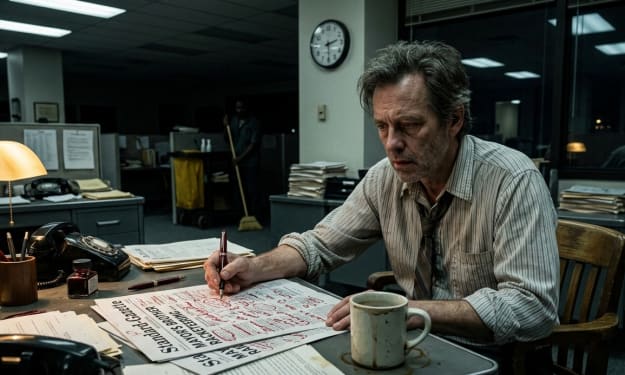
The clock on the wall of the Standard-Gazette newsroom didn’t tick; it thudded, a heavy, rhythmic reminder that Arthur Penhaligon was officially out of time.It was 3:14 AM. The fluorescent lights overhead hummed with a sick, flickering yellow energy that made the bags under Arthur’s eyes feel like lead weights. On his desk sat a ceramic mug—once white, now stained with a permanent ring of tannin. He took a sip. The coffee was stone cold, a bitter oily film coating his tongue. It tasted like failure and long division.Beside the mug lay the galley proofs for the morning edition. They were hemorrhaging.Arthur held a fountain pen gripped so tightly his knuckles were white. The ink was a shade of crimson called "Oxblood," and he had used it to eviscerate the lead story. Great sweeping strikes crossed out adjectives; jagged circles trapped grammatical errors like flies in amber. But the red ink wasn't just for style tonight. It was for survival."You’re bleeding it dry, Artie," a voice rasped from the shadows of the cubicle row.Arthur didn’t look up. He knew the scent of cheap cigars and peppermint anywhere. It was Elias, the night janitor, a man who had seen more scandals swept into dustpans than Arthur had ever printed."The truth is messy, Elias," Arthur muttered, his pen hovering over a paragraph that implicated the Mayor’s brother in a construction racketeering scheme. "It needs to be precise. If I miss one comma, the lawyers will have us for breakfast. If I miss one fact, I’ll be looking for a job at a greeting card company by noon.""You’ve been 'precise' for twelve hours," Elias said, leaning on his broom. "At some point, you're just stabbing the paper."Arthur finally looked up. His reflection in the dark window across the room looked like a ghost—gaunt, grey-skinned, and haunted. "I found a discrepancy."He pointed his red pen at the ledger notes he’d been cross-referencing. The ink there was different. It wasn't his. Someone had been in his office while he was at dinner, and they had made their own "corrections." Someone had tried to sanitize the blood out of the story, and they had used a red pen that matched his exactly."Look at this," Arthur whispered, his voice cracking. "The numbers in the second paragraph. They’ve been shifted by a single decimal point. It looks like a typo. It should be a typo. But $1.2$ million becoming $12$ million changes this from a local bribe to a federal conspiracy."Elias stopped leaning and stepped closer, his eyes narrowing. "And you didn't change it back?""I can't," Arthur said, gesturing to the cold coffee. "The editor-in-chief signed off on this version five minutes before he bolted out the door. If I change it back to the truth, I’m 'sabotaging' the paper. If I leave it, I’m publishing a lie that will ignite a firestorm the city can't put out."The silence of the newsroom felt heavy, like the air before a lightning strike. Arthur looked at the red ink on his fingers. It looked remarkably like the real thing. He realized then that the "Red Ink" of the title wasn't just about editing—it was about debt. The debt of the truth.He looked at the cold coffee, then at the clock. $3:22$ AM. The press started rolling at $4:00$."You know," Elias said softly, "sometimes the only way to fix a mess is to knock the whole bottle over. "Arthur looked at the bottle of Oxblood ink sitting precariously near the edge of the desk. He looked at the galley proofs. He thought about the years he’d spent chasing the perfect sentence, only to realize that the most powerful thing he could do wasn't to write—it was to erase.He didn't pick up the pen. Instead, he picked up the mug. He swirled the cold, dreg-filled liquid one last time."I'm not an editor anymore, Elias," Arthur said, a grim smile finally touching his lips. "I'm a witness."He stood up, grabbed the red ink, and headed toward the elevator that led down to the printing press. The coffee stayed behind, a cold monument to a career that was about to end in a very loud, very public explosion of ink and paper.
By aadam khan3 days ago in Confessions
Review of 'Man on the Run'
My wife and I saw Man on the Run, a nearly 2-hour documentary on Amazon Prime, about Wings, Paul McCartney's group that flew around the world from shortly after The Beatles broke up in early 1970 to shortly after John Lennon was murdered at the end of 1980, making a Beatles reunion forever impossible.
By Paul Levinsona day ago in Beat



Comments
There are no comments for this story
Be the first to respond and start the conversation.