
Do Compatibility Quizzes on Dating Apps Actually Work?
Do Compatibility Quizzes on Dating Apps Actually Work?


Online dating apps love to promote their compatibility quizzes. I’ve taken dozens of them—sometimes out of curiosity, sometimes out of hope that a set of clever questions could really point me to “the one.” But here’s the question I kept asking myself: do these quizzes actually work, or are they just another shiny feature to keep us swiping?
After spending years experimenting with different dating apps, reading the research behind matching algorithms, and reflecting on my own dating experiences, I’ve come to some interesting conclusions. In this article, I’ll share what I’ve discovered about compatibility quizzes—how they’re designed, what they get right, where they fall short, and whether they can actually help us find lasting connections.
Why Dating Apps Use Compatibility Quizzes
Most dating apps these days throw in some sort of quiz or questionnaire. They range from the classic “What’s your love language?” style questions to deeper psychological surveys designed to measure personality traits and values.
From my perspective, the main reasons dating apps include quizzes are:
User engagement – Quizzes are fun. They keep people on the app longer, which increases activity.
Conversation starters – Sharing results or seeing compatibility scores can spark interaction.
Data-driven matching – Apps can use quiz answers to feed their algorithms, theoretically increasing the chances of a successful match.
Brand differentiation – Let’s face it: swiping left or right can get boring. Quizzes make the app feel more sophisticated and purposeful.
In theory, compatibility quizzes should help filter out matches who don’t align with your lifestyle or personality. But in practice, it’s not always that straightforward.
My Experience With Compatibility Quizzes
I remember one app asking me 200+ questions about everything from politics to favorite vacation styles. I thought, Wow, if someone matches me after all this, we’re basically soulmates already.
Here’s what happened:
The matches I got did share some surface-level similarities with me.
But when we met in person, sometimes the “compatible” matches felt awkward or flat.
Conversely, people the app labeled as “low compatibility” sometimes ended up being fun, exciting, and even relationship-worthy.
This experience taught me an important lesson: while quizzes can highlight potential areas of alignment, real chemistry can’t be predicted on paper.
How Compatibility Quizzes Are Built
To understand whether quizzes work, I dug into the psychology behind them. Many apps base their compatibility systems on:
The Big Five personality traits (OCEAN): Openness, Conscientiousness, Extraversion, Agreeableness, and Neuroticism.
Attachment theory: Whether someone has a secure, anxious, or avoidant attachment style.
Values alignment: Things like politics, religion, lifestyle habits, and family goals.
Behavioral psychology: Tracking not just what you say, but how you swipe and interact.
Some apps claim to use scientific models—like the Myers-Briggs personality framework or even AI-based prediction tools—to calculate compatibility scores.
The challenge? These models are only as good as the data provided, and human behavior doesn’t always fit neatly into categories.
Do They Actually Work?
The short answer: sometimes, but not always.
Here’s how I break it down based on my experience and what research shows:
Where They Help
Filter dealbreakers early – If smoking, politics, or kids are non-negotiables, quizzes can save time.
Highlight shared interests – Knowing someone values travel or is career-driven can be useful.
Boost initial confidence – Seeing a “92% match” can make it easier to start a conversation.
Where They Fail
Overreliance on similarity – Sometimes opposites attract, but quizzes tend to push sameness.
Chemistry blind spots – You can’t measure body language, humor, or energy through a quiz.
Self-presentation bias – People often answer based on how they wish they were, not who they truly are.
In other words, quizzes can give you a head start—but they’re not a guaranteed shortcut to love.
The Psychology of Why We Like Quizzes
I’ve noticed that part of the appeal is psychological. Humans love labels and categories because they make a messy world feel more manageable. Seeing a “compatibility score” gives us the illusion of control over something as unpredictable as dating.
Quizzes also tap into our curiosity:
- We want to know what type we are.
- We want to know if someone is right for us before risking rejection.
- We like gamified experiences where dating feels less intimidating.
The danger is mistaking those scores for destiny.
How I Personally Use Compatibility Quizzes
After all this trial and error, I’ve come up with my own rules for making the most of dating app quizzes without being misled.
My Rules:
- Treat quizzes as conversation tools, not predictions.
- Notice patterns, but don’t obsess over scores.
- Use them to reveal values—not to define compatibility.
- Always test connections offline.
When I follow these rules, quizzes add a layer of fun to dating rather than becoming a source of disappointment.
So… Do They Work?
If by “work” we mean perfectly predict long-term compatibility, then no—they don’t work. Human relationships are too complex to reduce to a percentage.
But if by “work” we mean help filter, spark conversations, and highlight potential areas of alignment, then yes—they can be useful.
In my dating life, I’ve stopped treating quizzes like a magic formula and started seeing them as tools in the toolbox—helpful, but not the whole picture.
Final Thoughts
When I look back on my most meaningful relationships, none of them started with a compatibility score. They started with curiosity, conversation, and real-life connection.
That said, quizzes did sometimes play a role in getting me to notice someone I might have overlooked. They worked best when I treated them as icebreakers, not as fate.
So my conclusion is this: compatibility quizzes are fun and can add value, but they’re not a substitute for genuine human interaction. The real test of compatibility will always happen face-to-face, in those unpredictable moments where chemistry, timing, and authenticity collide.
Please note that this article may contain affiliate links, and the opinions shared are based on my personal experiences and perspectives.
About the Creator
Tracy Larson
A relationship and communication coach dedicated to supporting people in building meaningful connections online and offline.
Keep reading
More stories from Tracy Larson and writers in Confessions and other communities.
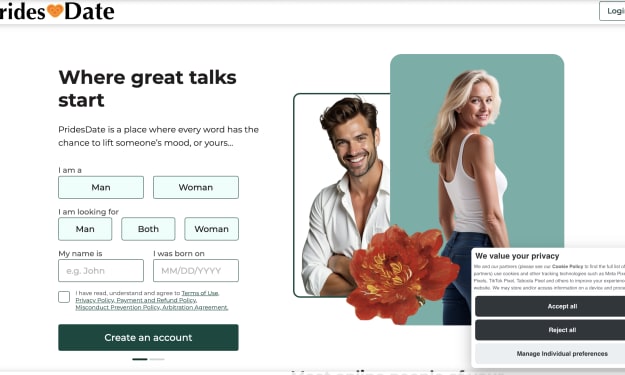
How to Use PridesDate to Connect People Online Without Wasting Time
If you’ve ever felt that dating apps are a maze of endless swipes and superficial interactions, you might appreciate a platform that focuses on thoughtful conversations and personal stories. I recently explored PridesDate, an LGBTQ+ dating platform, and wanted to share my experience. This review will guide you through how PridesDate works, its features, and why it can help you seek meaningful interactions without wasting time.
By Tracy Larson6 months ago in Confessions
The Piggy Project
I’ve had so many names in this life I lose track of which ones were ever really mine and which ones I wore because someone needed me to. Some were handed to me before I had words to refuse them, before I knew what they meant, before I knew I could say no. Most weren’t meant to hurt. That doesn’t mean they didn’t leave marks. Marks that told me who I belong to, who I am by way of who claims me, recognizes me in the good and bad, who walks beside me.
By Fatal Serendipity3 days ago in Confessions


Comments