
Confessions from Windsor: How Silence Spoke Louder Than Words for Prince Harry
When Donald Trump praised King Charles and Prince William but left Harry out, a quiet message about power, loyalty, and fading influence became impossible to ignore.

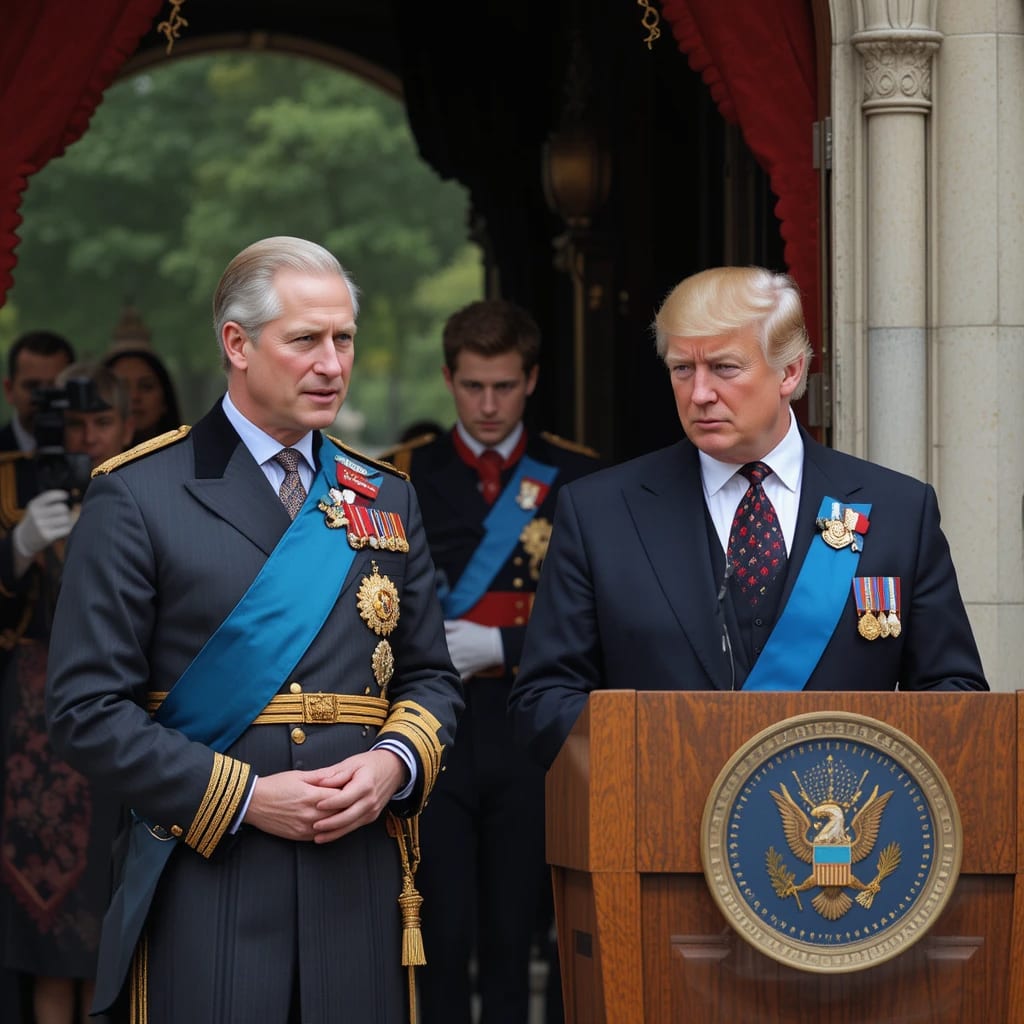
I have a confession: sometimes silence tells the sharpest story.
That’s exactly what happened when former U.S. President Donald Trump appeared at Windsor Castle and offered glowing praise for King Charles III and Prince William—while leaving Prince Harry completely out of the script. No slip of the tongue, no oversight. Just deliberate quiet.
For the world watching, it was more than a diplomatic moment. It was an eclipse.
Trump, never known for subtlety, carefully chose words that elevated Charles as a statesman and William as the future of the monarchy. But when it came to Harry, there was nothing. Not a mention, not even a polite nod. In the arena of global politics, absence can speak louder than insults. This one felt intentional.
Imagine standing in that setting—royalty beside you, cameras rolling, the world listening—and realizing that your name has been erased from the script. For Harry, who once commanded the world’s sympathy and attention, the silence must have cut deeper than any headline or late-night joke.
This wasn’t just about Windsor. Across the Atlantic, Harry’s image has been steadily eroding. In the United States, the country he now calls home, the admiration that once surrounded him has shifted. Media that once portrayed him as the brave outsider now cast him as uncertain, unfocused, even irrelevant. Corporate partners, from streaming executives to charities, seem increasingly hesitant to link their brands with his. One telling example: his personal ideas for Netflix projects have stalled, while Meghan’s ventures—though also struggling—at least remain on the table.
It all adds to a picture of a man caught between identities. In the United Kingdom, his departure from royal duties still sparks debate and criticism. In America, the country that was supposed to give him a fresh start, his star power seems to be dimming. When even late-night comedy turns someone into a recurring punchline, it signals a shift in public perception that’s hard to reverse.
The Windsor moment put that decline in stark relief. Trump’s praise for William wasn’t just personal—it was symbolic. It placed William firmly in the spotlight as heir, future, and continuity. Harry, by contrast, was left standing in the shadows, a reminder of how far his public standing has fallen.
Observers even noted King Charles’s reaction during the speech. He seemed calm, almost pleased, as though the omission of Harry was not an insult but a quiet validation. After years of seeing his younger son share family struggles in interviews, memoirs, and documentaries, perhaps Charles welcomed a moment where the hierarchy was silently but firmly reinforced.
For Harry, that must have been painful. Once, he represented modernity, rebellion, and a new voice in the monarchy. Invictus, his veterans’ sporting project, embodied purpose. But now even that legacy appears under strain. Reports suggest growing unease among supporters who fear his involvement is becoming more of a liability than an asset. Names of respected figures—David Beckham, Mike Tindall—are whispered as potential replacements. If true, it would mean Harry’s most defining achievement outside the palace could slip away.
Archwell, the foundation he and Meghan launched with great promise, has also been criticized for underdelivering. Critics call it overstretched, unfocused. Each disappointment chips away at the image of influence and credibility they hoped to build.
Here’s the real confession: watching all this unfold feels like seeing someone who once held extraordinary promise now drifting further from the roles that gave him meaning. In the UK, the institution has closed its doors. In the US, opportunities are shrinking. And within his own family, the contrast between him and William has never been sharper.
Some analysts even speculate about long-term implications for the line of succession. While it’s unlikely Harry would ever be formally removed, the mere fact that conversations about rewriting succession laws exist shows the depth of discomfort surrounding his role. Symbolically, his place has already diminished.
What remains is the question of legacy. Harry left the monarchy to build something new. But what happens if the new world he sought won’t fully embrace him? If silence at a state event can so easily erase him, where does he stand?
In that moment at Windsor, as Trump elevated William and ignored Harry, a chapter quietly closed. The monarchy reaffirmed its future. The U.S. audience saw where global attention lies. And Harry, once central to the royal narrative, was pushed further toward the margins.
Silence did the work of a thousand words. And for a man who has built his recent life on telling his story, that silence might be the hardest truth of all.
About the Creator
Keep reading
More stories from Norul Rahman and writers in Confessions and other communities.
The Missing Year: Whispers That Could Rewrite Meghan Markle’s Story
Public life thrives on stories. Some are polished tales crafted by publicists, others are whispered rumors that linger in the shadows until they grow too loud to ignore. Meghan Markle, Duchess of Sussex, has spent years building her personal story — the ambitious actress who married into royalty, the mother navigating global scrutiny, the advocate for women and equality. But beneath that carefully woven narrative, a set of whispers is surfacing that threatens to change everything.
By Norul Rahman6 months ago in Confessions
The Royal News That Made Me Pause: Why This Upcoming Visit Feels Different
There are moments when a piece of celebrity news makes you stop and think a little deeper than usual. For me, that moment happened recently when I heard that Prince Harry and Meghan Markle might soon visit Australia again.
By CelebCast Central2 days ago in Confessions


Comments
There are no comments for this story
Be the first to respond and start the conversation.