
Between Belief and Unbelief
A quiet conversation between faith, fear, and the fading light of understanding.

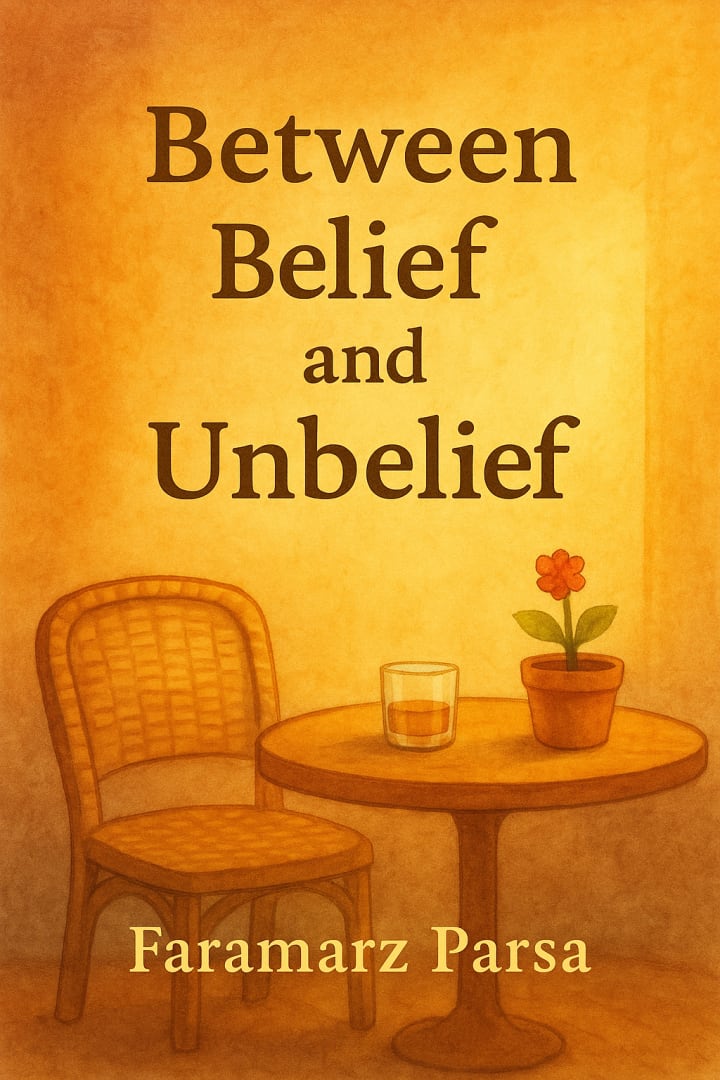
Between Belief and Unbelief
By Faramarz Parsa
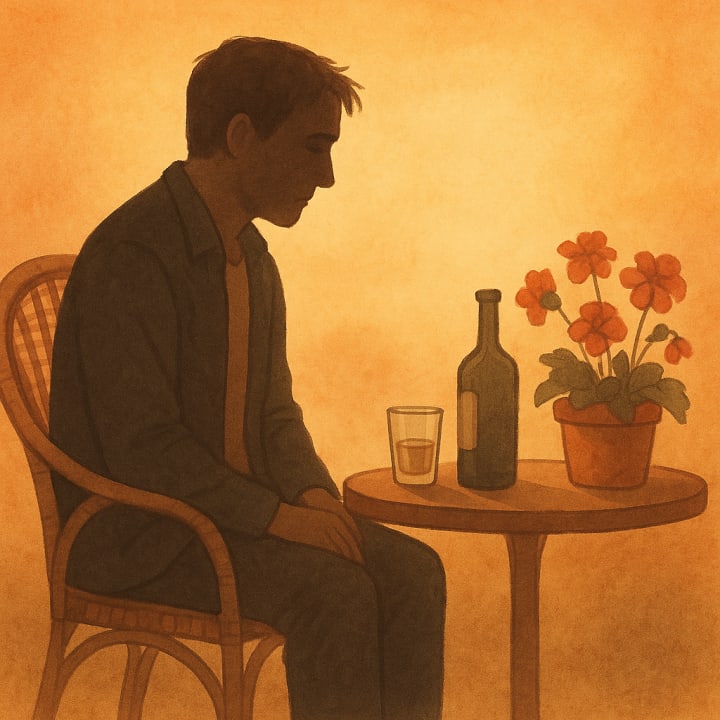
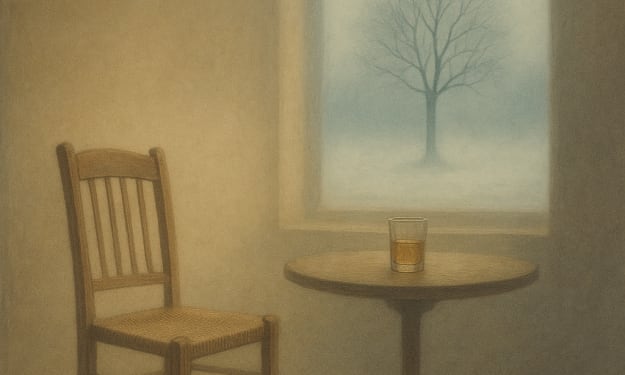
I sit on the wicker chair.
The geraniums, tired from the day’s heat, still hold their scent in the air—
like the memory of someone gone, yet never forgotten.
The round table before me has been my silent companion for years,
bearing the weight of tea cups, coffee mugs, and glasses of wine,
without ever complaining, without a single crack.
I breathe deeply.
The afternoon air slides into my chest and leaves quietly.
Half a glass of vodka sits beside a fading beer,
a thin mist rising from its rim,
like the sigh of an old memory leaving the body.
A faint smile crosses my lips—
not from joy, not from sorrow,
but from that quiet understanding that sometimes brings you face to face with yourself.
I close my eyes.
Behind my eyelids, a trembling light moves slowly.
I ask myself:
Where do I go after death?
Down? Up? Into darkness or light?
Will there be pain, any sense at all,
or will everything collapse into a silent weightlessness?
Silence answers first.
Yet within that silence, a voice rises—my own, yet not mine:
“You wish to know what lies beyond death?
Then lose yourself… to find it.”
I begin to feel lighter,
so light that if a hand reached out, it might pass through me.
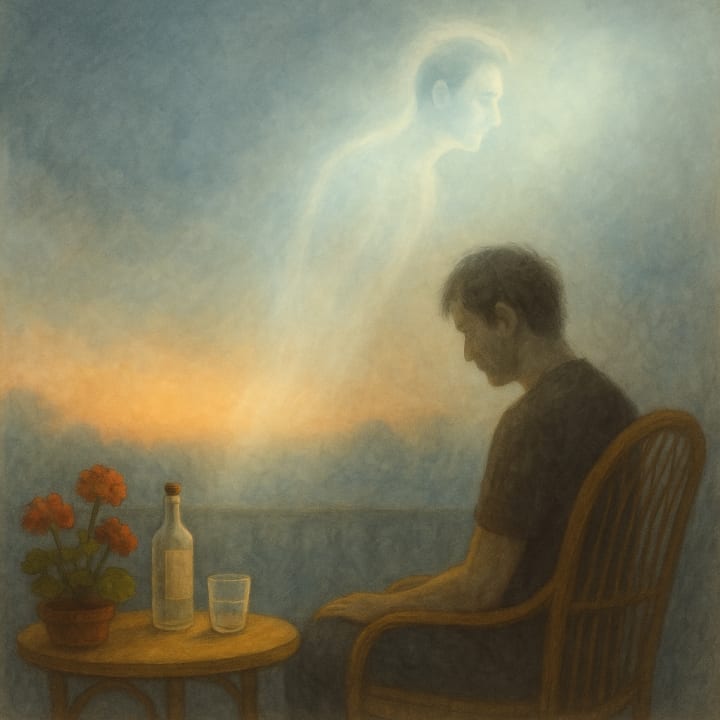
My body remains below, seated on that same chair,
but I am here—somewhere between sense and nothingness.
I ask:
If the soul has no body,
how does it burn in hell?
How does it feel pleasure in heaven?
How can it know pain
without nerves or skin?
The voice replies, slow and calm:
“The soul is the feeling.
Fire, blossom, joy, and torment—
they all grow within it.
Heaven and hell are not outside of you;
they live inside—
in your awareness, in your memories.”
I pause.
I recall the sins I chose deliberately,
and the kindnesses I performed by habit.
I ask:
If everything lives inside me,
then what of justice beyond?
How can the murderer and the forgiver not be the same?
The voice answers:
“Justice is another name for understanding.
The one who learns is forgiven.
The one who refuses remains in repetition.
No one is condemned;
all are students.”
Then I understand:
perhaps hell is the knowledge that comes too late,
and heaven, the peace of understanding in time.
Yet I ask again:
Why has no one returned from beyond?
Why does God remain silent?
Why is certainty always in others’ hands, never in mine?
The voice whispers:
“Because you measure the world through fear.
You wish to know so that you may not fear—
but knowledge itself is born of fear.
Human beings cannot live in darkness;
so they build the light of belief, even if it is made of illusion.”
Suddenly I feel all I once called faith
wash away like watercolor in a rain of doubt.
Something trembles inside me—
but in that trembling, there is calm,
like accepting that one may never know.
I open my eyes.
I am back—chair, table, flowers.
The vodka is still there,
but it tastes different now.
I pour a little into the glass, raise it, and say softly:
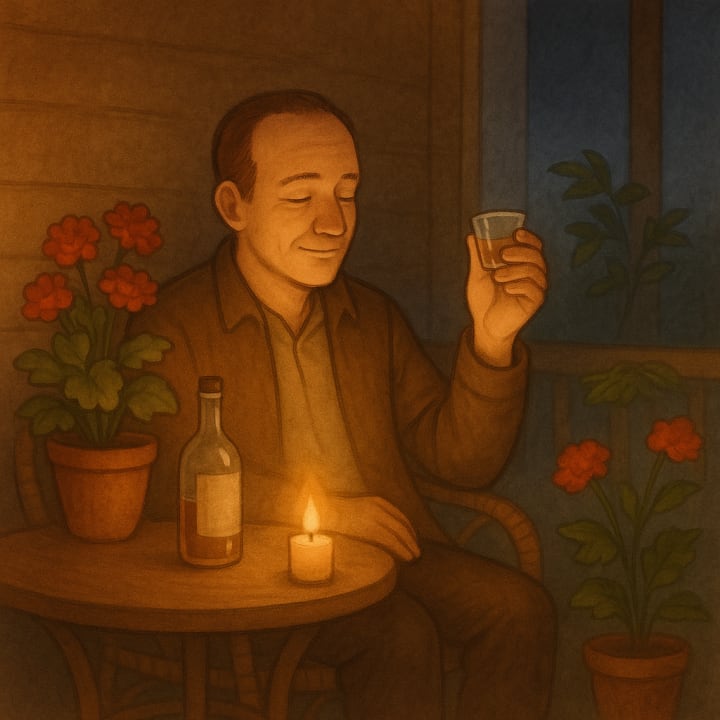
“To the beauty of nothingness—
between belief and unbelief.”
I drink.
The vodka burns in my throat,
but this time it feels like life, not death.
A faint smile touches my lips—
the kind only a weary heart understands.
I whisper:
“Since we are still here,
let’s not ruin it with what we’ll never know.
Life is the sweet mystery of not knowing.”
The wind moves the geranium leaves.
A bell rings in the distance.
Perhaps from outside,
perhaps from within.
It no longer matters.
I no longer ask.
I simply understand.
And in that understanding,
for the first time—
I am at peace.
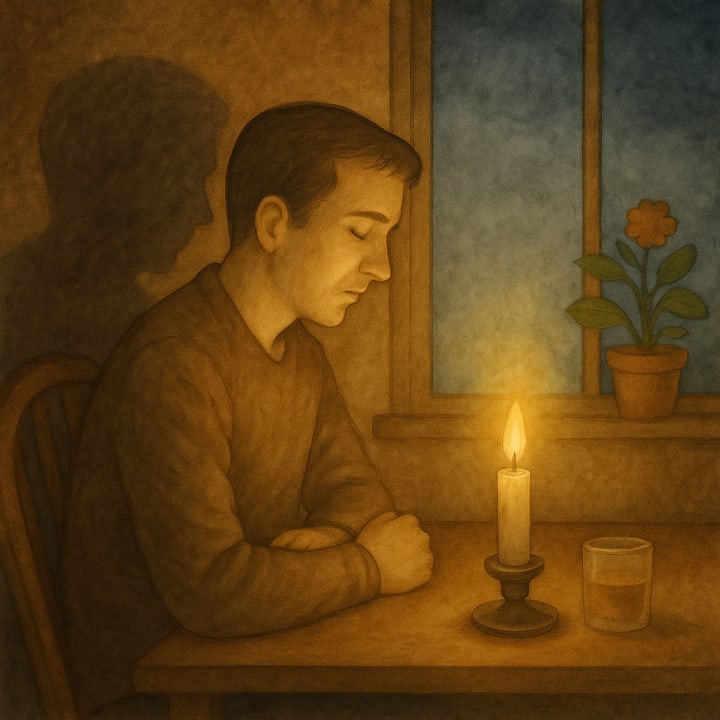
The Final Dialogue with the Self
Night seeps quietly through the window.
A small candle burns on the table beside the half-finished vodka.
Mist gathers on the glass,
and I find myself still thinking of that journey—
that strange passage I took,
not knowing if it was dream, death, or something in between.
But something has awakened within me,
and it refuses to sleep again.
I ask:
When I feel the prick of a needle,
is that pain born of the body—
or of the soul hidden within it?
If pain belongs to flesh,
should it not die with flesh?
Then why does the memory of pain stay alive—
why does the sting linger and never die?
No, I think pain is the mark of the soul.
It is the soul that burns,
not the skin.
The body is only the curtain upon which the fire is shown.
And if the soul exists,
then one must flee from sin—
not from fear of hell,
but from fear of that inner flame.
We cannot bear the burning of ourselves,
for the fire of the soul does not destroy—
it reveals.
But if the soul is only a story man invented to calm his ignorance,
then all is void—
no heaven, no hell,
no reward, no punishment.
Only a vast emptiness,
and we, faint shadows drifting within it.
Still…
if all is void,
why does the pain of the heart feel more real than any proof?
Why does the tear come before the thought?
Why does shame rise in the eyes without reason?
Perhaps the answer is simple:
the soul is the awareness of itself.
It did not create fear;
fear was born when it realized its own fragility.
It knows the body will die,
but it is condemned not to oblivion—
only to knowing.
If that is true,
then we are both the creator and the creation—
a mirror facing a mirror.
We feel pain because light still lives in us.
And as long as we can feel,
we are not lost to silence.
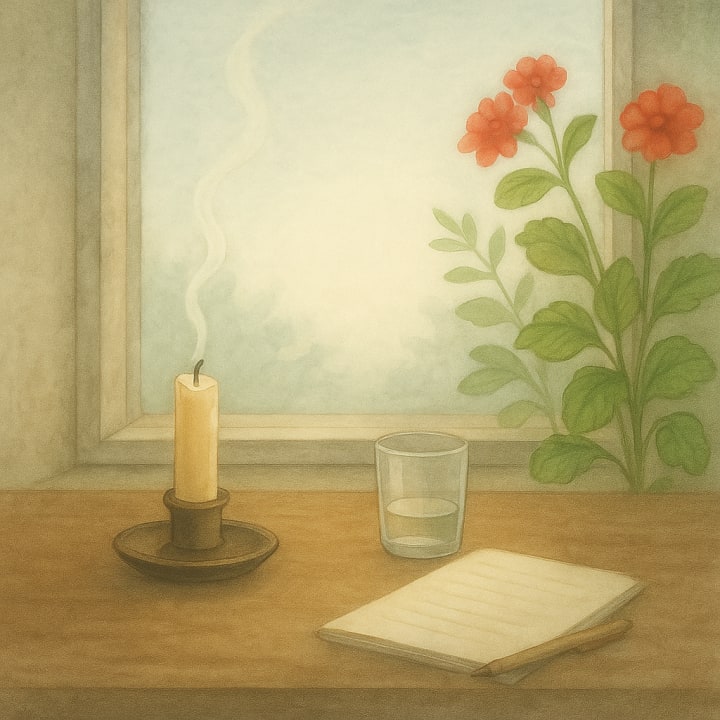
The candle burns lower.
The vodka is cold.
I lift the glass and whisper:
“If the soul is real,
then we are responsible for our wounds.
And if it is not,
still—let us be kind,
for a beautiful lie
is better than the truth of emptiness.”
The night wind trembles the geranium leaves.
I know questions still remain,
but there is no need for answers anymore.
For sometimes,
to think at all
is already salvation.
About the Creator
Ebrahim Parsa
⸻
Faramarz (Ebrahim) Parsa writes stories for children and adults — tales born from silence, memory, and the light of imagination inspired by Persian roots.
Keep reading
More stories from Ebrahim Parsa and writers in Confessions and other communities.
Word of the Day: ホチキス
I don't know the word for Staples. I remember I used to think that Hochikisu was an Onomatopoeia for a stapler rather than a brand name. I am pretty sure I already have this title as a theme, which is making me feel many sort of ways as Vocal is harassing me about payments currently.
By Kayla McIntosh20 days ago in Confessions
I Was Almost Forgotten by Life, Until I Chose to Remember Myself
Story There was a time in my life when I felt invisible. Not the kind of invisible where people accidentally overlook you, but the kind where it feels like the world has already decided you don’t matter. I walked through my days quietly, carrying thoughts I never shared and dreams I didn’t dare to speak aloud.
By On that3 days ago in Confessions
Getting Serious About Comedy (Part I)
If I were asked to remark on my life and the childhood that paved some road leading me to this point, I would have to say something about all the funny people who surrounded me for the last 26,872 days (and counting). Somewhere along that road, I became a big fan of laughter and the comedy that spawns it – and, I mean not only my own laughter, but the laughter of others, some of which I have actually been responsible for inducing.
By John Oliver Smith7 days ago in Humor


Comments (1)
Hi Author,I’m an avid reader who truly enjoys exploring different stories, and today I happened to come across one of yours. I have to say, I was completely captivated by it. Your writing style has such a unique charm every scene you described felt so vivid and alive. I’m genuinely impressed by your storytelling, and I’d love to know how long have you been writing such wonderful pieces?