


A Chilling True Crime Story from Canada: The Murder of Kimberly Proctor
Canada has witnessed its share of heartbreaking true crime cases, and the 2010 murder of Kimberly Proctor stands as one of the most chilling in modern history. Kimberly, an 18-year-old from Langford, British Columbia, was reported missing after failing to show up for work. Tragically, 36 hours later, her burned body was discovered under the Galloping Goose hiking trail.
The investigation quickly uncovered a horrifying truth. Two teenage boys, Kruse Wellwood and Cameron Moffat—acquaintances of Kimberly—had lured her to a home under false pretenses. There, they carried out acts of unspeakable violence, ultimately murdering her and attempting to cover their tracks by setting her body on fire. The brutality of the crime shocked the nation and led to life sentences for both perpetrators.
This case not only highlighted the dark potential of interpersonal violence but also underscored the importance of mental health awareness and early intervention for troubled youth The murder of Kimberly Proctor is a case that continues to haunt Canada, not only because of its brutality but because it revealed the dark side of two seemingly ordinary teenagers. After the crime, the community was left grappling with questions of why and how such violence could come from individuals so young. The case became even more chilling when it was revealed that the two boys had plotted the crime together, having discussed their plans before carrying it out. They had even prepared to dispose of evidence in a way that would make it seem as though Kimberly had simply vanished without a trace.
In the aftermath, the public reaction was a mix of disbelief and sorrow. The intense media coverage of the crime helped push conversations about the mental health of youth and the potential signs of violent tendencies. In fact, experts have pointed out that while Kruse Wellwood and Cameron Moffat both had troubled histories, there were few signs that could have predicted the horror they would eventually commit.
Kimberly’s family and friends continue to honor her memory, and the case remains a stark reminder of the potential consequences when mental health issues go unaddressed and when young individuals fall through the cracks of support systems.
This case, along with others like the disappearance of the Anjikuni village and the stolen Canadian toonies heist, adds to the tapestry of unsolved and shocking true crime events that have defined Canada’s darker history .
For those interested in exploring more about true crime in Canada, other infamous cases include the mysterious Wells Gray Park murders and the shocking betrayal of Penny Boudreau, who killed her own daughter to save her romantic relationship. Each case serves as a reminder of the complexities of human behavior and the need for vigilance in communitiesThe chilling nature of Kimberly Proctor’s murder sparked widespread discussions not just about crime, but about the failure of mental health systems to intervene in the lives of youth showing signs of violent tendencies. After the two perpetrators were caught and sentenced to life in prison, it became clear that this tragedy was more than just an isolated act of violence—it was a failure of a larger societal system that ignored warning signs.
The case also drew attention to the issue of youth violence and peer influence. Both Kruse Wellwood and Cameron Moffat were at an age where social dynamics and peer pressure played a crucial role in their decision-making. Their twisted bond, marked by shared fantasies and a desire for notoriety, led them down a path that left a trail of destruction and heartbreak. In the years since, many have wondered whether this crime could have been prevented if more attention had been paid to their behavior earlier on .
Kimberly’s murder was part of a broader pattern of unsolved and violent crimes across Canada that have captured the public’s attention. Cases like these raise questions about the nature of evil, the role of mental health care, and how society should handle troubled youth. But perhaps more than anything, they call for a reevaluation of how communities can better protect their young members from falling down dangerous paths.The tragic murder of Kimberly Proctor left deep scars on her community, raising uncomfortable questions about youth violence and mental health that persist today. While Kruse Wellwood and Cameron Moffat’s crime was shocking, it was also a wake-up call for many in Canada about the need for greater vigilance and intervention when it comes to troubled youth. After the murder, experts and advocates for mental health care pushed for stronger preventative measures, including more accessible support for at-risk teenagers.
Both perpetrators had histories of disruptive behavior, but they were also heavily influenced by each other. Their shared fascination with violence and crime seemed to fuel their brutal actions. This case underscores the importance of early intervention and the need for society to recognize warning signs before it’s too late. The media and public conversations around Kimberly’s murder also brought attention to the wider problem of youth violence, especially as more such cases were uncovered in the years following.
Kimberly’s legacy, while marked by her tragic death, has led to ongoing discussions about how Canada can better address the psychological needs of its young people and prevent future acts of violence. The question remains: how many more tragedies must occur before significant change takes place? And what can be done to ensure that at-risk youth are not only seen but also supported before they make irreversible choices?
This case, alongside other unsolved mysteries and heinous acts in Canada, highlights the need for a more proactive approach to mental health and crime prevention .
About the Creator
Taviii🇨🇦♐️
Hi am Octavia a mom of 4 am inspired writer I write stories ,poems and articles please support me thank you
Keep reading
More stories from Taviii🇨🇦♐️ and writers in Confessions and other communities.
The predator of Crescent Pines
The small town of Crescent Pines was known for its rolling hills, quiet streets, and tight-knit community. But in the summer of 2018, its peaceful reputation was shattered by a series of horrifying crimes that revealed a predator lurking in plain sight.
By Taviii🇨🇦♐️about a year ago in Confessions
The Piggy Project
I’ve had so many names in this life I lose track of which ones were ever really mine and which ones I wore because someone needed me to. Some were handed to me before I had words to refuse them, before I knew what they meant, before I knew I could say no. Most weren’t meant to hurt. That doesn’t mean they didn’t leave marks. Marks that told me who I belong to, who I am by way of who claims me, recognizes me in the good and bad, who walks beside me.
By Fatal Serendipity2 days ago in Confessions
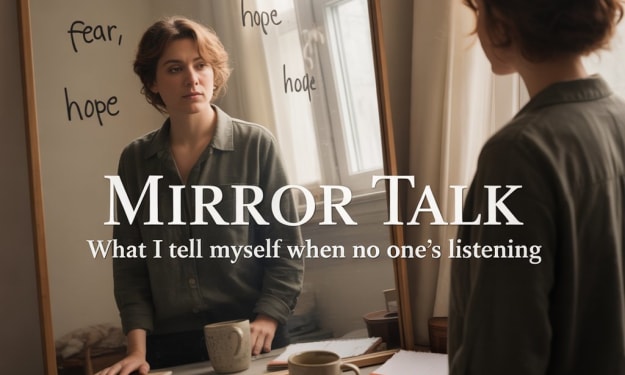
Mirror Talk
There’s a quiet space in my room that no one sees. It’s not the corner where I hide my notebooks, nor the window where sunlight drapes like a golden curtain. It’s the space inside me—the one that opens only when I am alone, and the world has stopped asking for answers I don’t have. Here, in this sacred silence, I talk to myself. Not the hollow chatter of routine thoughts, but the kind of conversation that feels raw, unfiltered, and terrifyingly honest.
By Taj muhammad5 days ago in Confessions



Comments
There are no comments for this story
Be the first to respond and start the conversation.