
The Pressure of Performance of Arch Manning and What Causes It
Has Arch Manning been playing up to the hype?
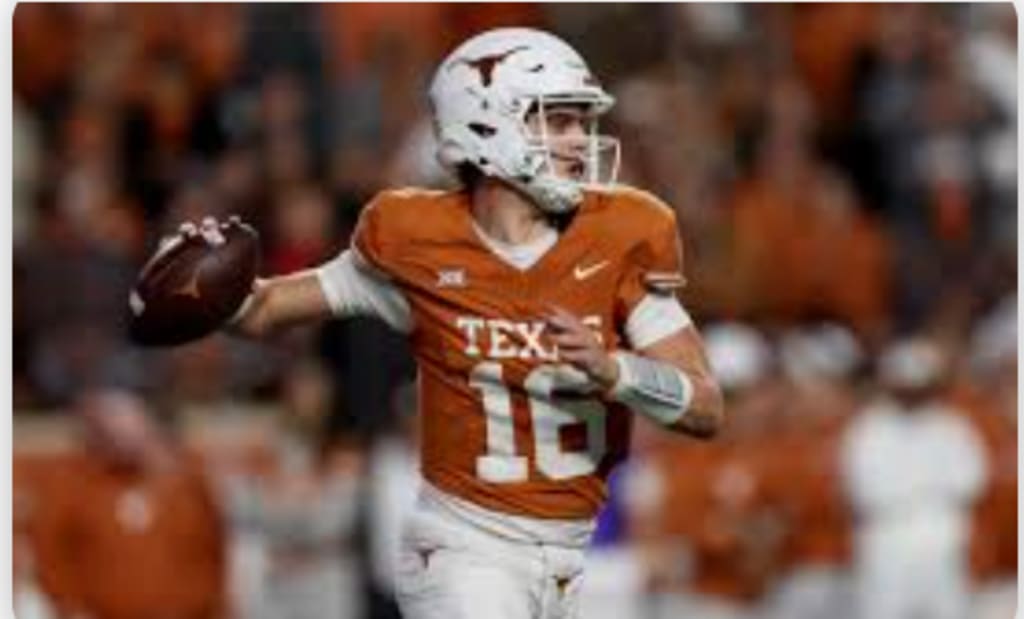
Arch Manning’s season took a physical hit during Texas’ dramatic win over Mississippi State when he suffered a concussion late in the game. The injury placed him in concussion protocol, sidelining him from practice and casting doubt on his availability for the following matchup against Vanderbilt. While he showed toughness in that comeback performance, the setback disrupted his momentum and raised concerns about his durability and recovery in a season already marked by inconsistency.
For apparent reasons, we all know Arch Manning has been surrounded by a lot of hype. We’ve seen it time and time again with athletes who have connections — that aura, that presence, that spotlight — often forced upon them before they’ve even had a chance to prove themselves. It can be overwhelming. It can distort expectations. And it can make it difficult for young athletes to navigate their formative years. Could that be a factor in why Arch has been underwhelming thus far?
The Weight of a Name
Arch Manning isn’t just any quarterback. He’s the son of Cooper Manning, nephew of Peyton and Eli, and grandson of Archie Manning — a lineage that reads like a football royalty scroll. From the moment he stepped onto a high school field, cameras followed. Recruiting analysts dissected every throw. NIL deals loomed before he even committed to Texas. The hype wasn’t just organic — it was engineered, amplified, and monetized.
That kind of attention is rare, even in today’s media-saturated sports culture. And while some athletes thrive under pressure, others need time to grow into their roles. Arch, still just 20 years old, is learning how to lead a major college program while carrying the weight of a legacy that few could shoulder.
The Numbers Tell a Mixed Story
Through eight games in the 2025 season, Manning has thrown for 1,795 yards, 15 touchdowns, and 6 interceptions. His QBR sits at 57.4 — good for 77th nationally. These aren’t disastrous numbers, but they’re far from elite. For a player once touted as a generational talent, the production has been inconsistent.
There have been moments of brilliance. Against Mississippi State, Manning led a furious comeback, throwing for 346 yards and 3 touchdowns. He looked poised, confident, and capable of taking over a game. But those flashes have been offset by puzzling performances — like the Kentucky game, where he completed just 12 of 27 passes for 132 yards and no touchdowns in a 16-13 overtime win. Or the UTEP game, where he posted a 44% completion rate and threw for only 114 yards.
The Hype vs. Reality Gap
So why the disconnect? Why does it feel like Manning hasn’t lived up to the hype?
Part of it is the nature of hype itself. When a player is projected as the next great quarterback before he’s even played a college snap, the expectations become nearly impossible to meet. Every incompletion is scrutinized. Every loss is magnified. And every average performance becomes a referendum on his future.
Another factor is the context around him. Texas has talent, but it’s not a perfect team. The offensive line has struggled at times. The run game has been inconsistent. And the defense hasn’t always given Manning a comfortable margin to work with. Quarterbacks are often judged in isolation, but their success is deeply tied to the ecosystem around them.
The Psychological Toll
There’s also the human side of this story. Manning is still a young man, navigating college life, media pressure, and the expectations of a fanbase hungry for success. The constant comparisons to his uncles — both Super Bowl champions — can be exhausting. Every time he steps on the field, he’s not just playing for Texas; he’s playing against the ghosts of Peyton and Eli.
That kind of psychological weight can affect performance. It can lead to hesitation, overthinking, and a fear of failure. Manning has shown flashes of confidence, but he’s also looked tentative at times — especially when facing pressure or trying to make tight-window throws.
Coaching and Development
Steve Sarkisian has defended Manning publicly, emphasizing that the team needs to play better around him and praising his competitiveness. But questions remain about whether Manning is being developed in a way that maximizes his strengths. Is the offensive scheme tailored to his skill set? Is he being asked to do too much too soon?
Quarterback development is rarely linear. Some players take off immediately. Others need time to adjust to the speed of the college game, the complexity of defenses, and the demands of leadership. Manning may fall into the latter category — a player with immense potential who needs patience and support to reach it.
NIL and External Pressure
Manning’s NIL valuation — reportedly around $4.7 million — adds another layer of pressure. When a player is earning that kind of money, fans and media expect instant results. But NIL doesn’t guarantee performance. It reflects marketability, not readiness. Manning’s brand is strong, but his game is still evolving.
The NIL era has changed the dynamics of college football. Young athletes are now public figures, business entities, and cultural icons before they’ve even played a full season. That shift can be destabilizing, especially for someone like Manning, who was already under a microscope.
The Path Forward
Despite the underwhelming start, Manning’s story is far from written. He’s shown resilience, bouncing back from poor performances with strong outings. He’s led game-winning drives. He’s handled criticism with maturity. And he’s still developing — physically, mentally, and emotionally.
The key will be consistency. Manning needs to string together solid performances, build chemistry with his receivers, and continue refining his decision-making. If he can do that, the narrative will shift. The hype may never fully match reality, but he can still carve out a successful career — one built on substance rather than legacy.
Final Thoughts
Arch Manning’s season has been underwhelming, but not hopeless. He’s a young quarterback in a high-pressure environment, learning how to lead and grow under intense scrutiny. The hype may have set him up for criticism, but it’s also a testament to his potential. If he can tune out the noise, trust his development, and lean into the process, he still has a chance to become the player everyone hoped he’d be.
And maybe, just maybe, that journey — with all its bumps and detours — will make his success even more meaningful.
About the Creator
Keep reading
More stories from Maadi Roshan and writers in Cleats and other communities.
Michigan State’s loss to Michigan and Why You Still Should Not Give Up On Aidan Chiles
Although Michigan State football has had an underwhelming season thus far, their recent matchup felt like a winnable game, regardless of what the final score might suggest. The team showed flashes of potential, moments where the game could have swung in their favor. But as has been the case in recent years, consistency remains elusive.
By Maadi Roshan3 months ago in Cleats
Darian Mensah and the Quiet Weight of Becoming Seen Online
There are names that pass through the internet like noise, and then there are names that linger. Darian Mensah feels like the second kind. You may come across the name during a late-night scroll, or hear it mentioned with curiosity rather than certainty. There is a sense that something human lives behind it. Not polished. Not loud. Just present.
By Muqadas khana day ago in Cleats
18 Teams, 18 Ultimatums: The One Move Every NFL Non-Playoff Team Must Make in the 2026 Offseason
While 14 NFL fan bases get to strap in for the chaos and joy of a Super Bowl chase, the other 18 are left staring into the offseason mirror. No confetti. No champagne. Just hard questions, tougher answers, and the uncomfortable truth that standing still is the fastest way to fall behind in today’s NFL.
By Lawrence Lease7 days ago in Cleats
Ludacris and Nelly draw backlash over bookings at MAGA-coded music festival
Ludacris and Nelly headlining a mostly right-wing event is good for them. It’s also great for the genre of hip hop. The two rap veterans have showcased their talents on other stages. Why can’t they perform for mostly MAGA folks and grab that bag?
By Skyler Saunders3 days ago in Beat


Comments
There are no comments for this story
Be the first to respond and start the conversation.