
Shahbaz Ahmed: The Maradona of Hockey Who Revived a Nation’s Passion
From cement grounds to world glory — the incredible journey of Pakistan’s legendary forward who led his country to its last World Cup triumph and inspired generations across borders
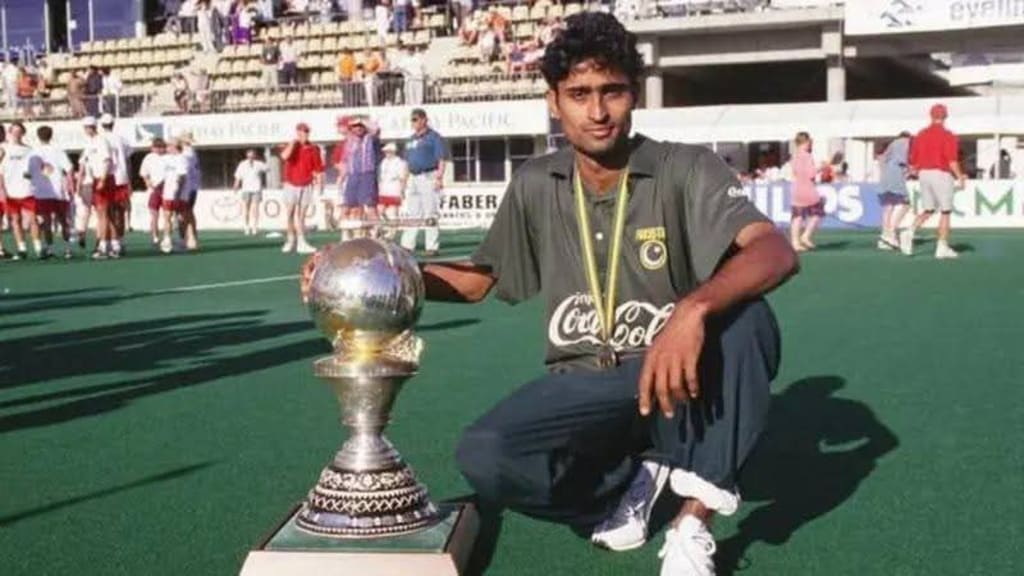
It was the year 1986 when the Pakistani hockey team’s camp was set up at the famous Minto Park in Lahore in preparation for the hockey series against India. In that camp, a 17-year-old youngster caught the eye of Brigadier Atif, who had brought him into the national camp based on his impressive performance in the national hockey championship.
Brigadier Atif, watching the incredible agility and ball control of the young player, remarked to former Olympian Saeed Anwar sitting beside him, "Look at this young man — he’s not even intimidated by experienced full-backs like Qasim Zia and Nasir Ali."
This was the first introduction of Shahbaz Ahmed Senior on the national hockey scene — a player who would later be counted among the finest forwards in hockey history. Masterful stick work, lightning speed, stunning body dodges, classical dribbling, incredible ball control, and perfectly timed passes — these qualities earned him nicknames like "The Maradona of Hockey" and "The Man with Electric Heels."
Shahbaz Ahmed was the kind of player whose magnetism brought fans back to stadiums at a time when interest in hockey was dwindling. After his retirement, neither did Pakistani hockey witness a revival, nor did another player of his caliber emerge.
---
The Last Peak of Pakistani Hockey
On December 4, 1994, Pakistan won its fourth and last Hockey World Cup in Sydney, Australia, under the captaincy of Shahbaz Ahmed. The final was against the Netherlands and, after a 1-1 draw in regular time, the match was decided through penalty strokes — a historic moment when the late goalkeeper Mansoor Ahmed blocked Delmée’s stroke, crowning Pakistan as world champions.
The year 1994 was particularly memorable for Pakistani hockey because under Shahbaz Ahmed’s leadership, Pakistan also won the Champions Trophy held in Lahore. These were the last two major titles the team won before slipping into a long period of decline.
---
"No One Was Willing to Take the Penalty Stroke"
Recalling the 1994 World Cup, Shahbaz Ahmed said, “We had defeated Germany in the semi-final on penalty strokes. The same situation arose in the final against the Netherlands, but due to the immense pressure of the match, no one from our team was ready to take the strokes. We couldn’t even find five players to volunteer. Though I had never taken a penalty stroke before and my flick wasn’t great, I stepped forward because I knew if the captain hesitated, the others would lose courage too.”
He added, “During that tournament, Tahir Zaman received news of his father’s passing. He was a key player and was devastated, but he said he wouldn’t return home because the team needed him more at the World Cup.”
According to Shahbaz, “Tahir Zaman didn’t play in the first match, but after that, he delivered outstanding performances throughout the tournament. In fact, goalkeeper Mansoor Ahmed, Tahir Zaman, Usman, and Kamran Ashraf all performed exceptionally in that World Cup.”
---
"Draws Were Held for Shirt Numbers"
In the 1994 World Cup, Shahbaz Ahmed wore jersey number 9, though he had usually worn number 10 throughout his career. He said, “The number 10 shirt is traditionally worn by the world’s top players, and I too wore it for 10 years. But in the 1994 World Cup, shirt numbers were assigned by lucky draw, and I got number 9 — which turned out to be lucky for me.”
---
"I Didn’t Play Well, That’s Why We Didn’t Win the Olympics"
Shahbaz Ahmed represented Pakistan in three Olympic Games, but he regrets not winning gold in the 1992 Barcelona Olympics under his captaincy.
He admitted, “That team was the strongest of my career. Everyone believed we could win gold, but I didn’t click in the semi-final. If I had played like I did in the 1994 World Cup and Champions Trophy, we could have reached the final. My poor performance affected the whole team.”
---
The Habit of Becoming 'Man of the Tournament'
Shahbaz Ahmed scored 92 international goals in his career but assisted in even more, earning him the reputation of being a selfless forward who never played for personal glory.
What truly set him apart was how often he was named “Man of the Tournament” — including at the 1987 Indira Gandhi Tournament, 1989 BMW Trophy, 1990 Asian Games, 1990 World Cup, and the 1994 World Cup.
He was the first player to be named “Man of the Tournament” in two consecutive World Cups.
Shahbaz Ahmed is the only hockey player in Pakistan to be awarded the Hilal-e-Imtiaz — Pakistan’s second-highest civilian award — an honor shared only with Imran Khan, Jahangir Khan, and Jansher Khan.
---
Dhanraj Pillay Was Also a Fan
India’s famous forward Dhanraj Pillay, himself admired globally, was a huge admirer of Shahbaz Ahmed.
In an interview with BBC Urdu, Dhanraj said, “Before I even entered international hockey, I had already heard of Shahbaz Ahmed from senior players. They spoke of his speed, control, and that if he continued to play like this, he would represent Pakistan for a long time.”
He added, “Shahbaz bhai would advance with the ball like a snake and catch defenders off-guard just with eye contact. They couldn’t get close to him. I saw this in him and tried to learn it. His understanding with teammates was amazing. Just by looking at him, they knew where his pass would go.”
Dhanraj recounted, “I’ve seen crowds come to stadiums just to watch Shahbaz — both in international and league matches.”
He witnessed the iconic moment in the 1994 World Cup when Shahbaz collected the ball in his own half, beat Australia’s Ken Wark with a single dodge, sprinted into the opponent’s D, and passed to Kamran Ashraf for a goal.
Dhanraj said, “Shahbaz bhai taught me that to master anything, you need relentless practice. What touched me most was how generously he shared his knowledge, despite Pakistan and India being rivals.”
Even though both players have long retired, their friendship remains strong and they still keep in regular contact.
---
Practicing on Cement Grounds
Shahbaz has often been asked how he developed such speed and ball control. His answer: “I knew that to excel on Astroturf, I had to practice on a surface even faster — so I trained on cement grounds. I’d also hit the ball rapidly against a wall for hours. This sharpened my reflexes so much that Astroturf actually felt slow to me.”
---
“Whatever Your Marks, You’ll Join Our College”
He recalled, “When I was in eighth grade, people started noticing my game. Some were so pleased they even stuffed money into my pockets. By ninth and tenth grade, teachers from Government College Faisalabad approached me and said, ‘Whatever marks you get in matric, you must join our college’ — because they had seen my potential.”
Shahbaz always speaks with great respect for former Olympians Brigadier Atif, Saeed Anwar, and Asad Malik, crediting them for playing a vital role in shaping his career.
About the Creator
Keep reading
More stories from Ikram Ullah and writers in Cleats and other communities.
Liverpool Retires Diogo Jota’s Jersey Number 20 After Tragic Death
In a heartfelt move that reflects the deep impact one player had on a global football community, Liverpool Football Club has officially retired the jersey number 20 in memory of its late Portuguese striker, Diogo Jota, who tragically passed away earlier this month in a car accident.
By Ikram Ullah6 months ago in Cleats
Top 5 Players with Most Days as No. 1 ODI Batter
One Day International (ODI) cricket has been one of the most popular formats of the game since its beginning in 1971. With only 50 overs available, batters must combine skill, patience, and smart shot selection to succeed. In such a competitive format, individual consistency becomes extremely important, especially when players are judged through ICC rankings. Holding the top position is a sign of dominance, but staying there for years is even more difficult. The record for most days as №1 ODI batter highlights the rare cricketers who performed at the highest level for long periods. These players scored runs in different conditions, against the best bowlers, and under constant pressure. This article focuses on the legends who achieved the most days as №1 ODI batter, showing why they stand above the rest in ODI history.
By Sports Record and Stats 3 days ago in Cleats
What Marc Guehi Brings to Manchester City After £20m Move from Crystal Palace
Manchester City have strengthened their defence by completing the signing of England international Marc Guehi from Crystal Palace for an initial £20 million. The 25-year-old centre-back has signed a five-and-a-half-year contract at the Etihad Stadium, keeping him at Manchester City until 2031.
By Sneaha Zyniiabout 3 hours ago in Cleats




Comments
There are no comments for this story
Be the first to respond and start the conversation.