
Manchester United: Amorim’s mediocrity
Two things can be true at the same time


Two things can be true at the same time: Manchester United has, off-pitch, a million problems that constricts every manager’s job in the post-Alex Ferguson Era. However, Ruben Amorim has been, at best, average.
The young portuguese manager has implemented his ways since his arrival to Old Trafford, not only his favorite formation and playstyle (3-4-3), but also his way of working and standards for every player in the squad: Amorim is not the type to adapt to the players, but rather the opposite. Even though this mentality has given rise to some awkward situations, such as Marcus Rashford loan to Aston Villa, it also has proven fruitful in some occasions: United’s win in the Manchester Derby, a good display at Anfield and knocking out Arsenal of the FA Cup. Furthermore, Garnacho, who initially lost his place in the squad, has won it back, proving that Amorim gives a chance to every player that fights for it.
On the pitch, even though the team can, sometimes, create overloads on the wings to pin the opposition down and has had good defensive displays (against Liverpool and Arsenal), there are major problems in Amorim’s system in key moments of the game: press and build-up.
United's press:
Focusing on the following image, we can witness United’s pressing problems in open play. Knowing that United’s system requires overloads on the wings, Bournemouth’s full-backs stay deep while the wingers pin United’s wing-backs, making it two one-on-one duels on the wing, denying the overload. Centrally, they maintain two center backs against Zirkzee press- Bournemouth have advantage in numbers and can play on the ball as they want. As to find the free man, one of the pivots lurks behind Zirkzee, while the other one tries to stay in between the lines, baiting United’s double pivot, so the #10 can stay behind Ugarte and Mainoo.
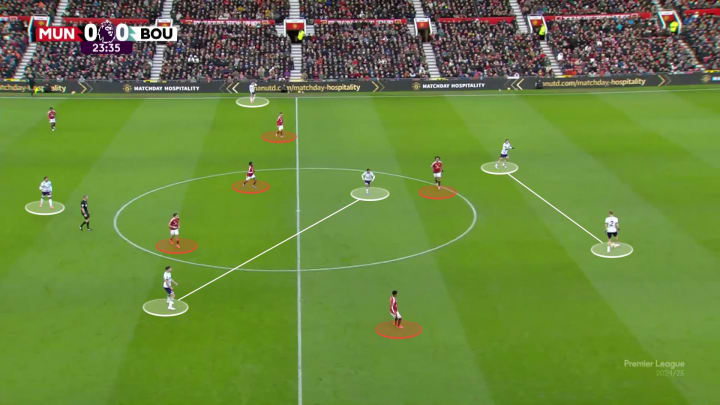
United’s press gets easily bypassed and the ball goes to the free man behind United’s midfield. This puts United’s central center back (in this case, Maguire) in an awkward position: do I jump or stay? Amorim probably wants a dynamic and agile center back to quickly jump on the #10 to cover the midfield, but there aren’t many center backs in the world who are comfortable jumping to the midfield like that in the world, besides, the problem would still be there: United’s press is too passive.

Maguire is unsure on how to position himself in this situation, disrupting the backline. #9 tries to get in behind, while the wing-backs are still pinned down by Bournemouth’s wingers and United midfield is far behind: clear chance for Bournemouth.

In the same match, Bournemouth found other ways to exploit United’s press, but keeping the same principle. Here, Bournemouth’s left-back inverted to create a three-man situation centrally, Diallo cleverly did the same and joined Bruno (temporarily switched with Zirkzee) in the press, however, this is the same situation as before: Bournemouth had a +1 advantage centrally, this time, 3-2. On the right wing, two one-on-one duels and Bournemouth’s left winger is pinning United’s right wing-back. Looking at the midfield, all the same, the double-pivot attracts United’s double-pivot, so the #10 can receive the ball between the lines.
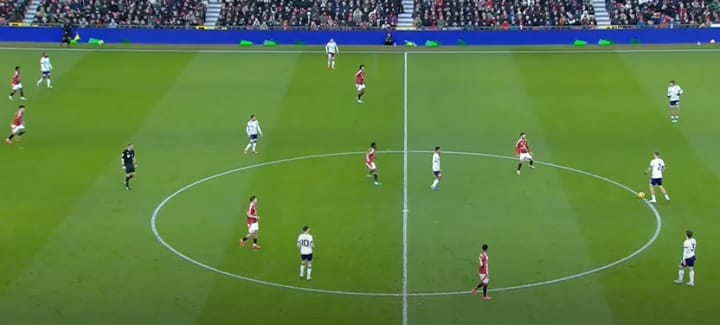
Even though Bournemouth applied the same principles to get out of United’s press, this situation is only different because Bournemouth drifted onto their right side, entering Lisandro Martinez zone, instead of Maguire’s. The argentine is far more agile than the englishman and he quickly jumps on the #10 when he realizes the situation.

Bournemouth didn’t want to engage in unnecessary duels and risks; teams with better individual talent would still play the ball to the #10 and play it to the wing, but Bournemouth had other options, tactically. As Lisandro jumps, this creates a temporary gap in the backline and Bournemouth plays it directly to the striker, who is able to receive the ball between the center backs and have a shot.


These two situations are just examples of how teams can exploit United’s system by denying the overloads on the wings and baiting the midfield, thus finding the spare man. United press is passive and because they play a back-5, they cannot put pressure on the ball, so the opponent is always better positioned to win second balls and to recycle with ease. The only moment of the game where United is able to apply pressure on the ball is when their opponent has a goal kick- this way, the game restarts and players have time to get into position.
It’s true, however, that United’s squad is not suited to play a back-5, but all of these things are a system problem- even with the perfect players for this system, some teams would still be able to exploit the gaps and flaws United leave behind.
United's build up:
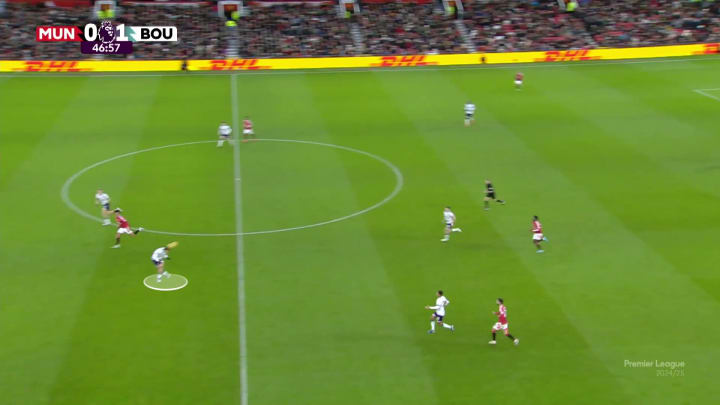
United’s problems continue in the build-up. Commonly, the central center-back inverts to the midfield and joins one of the #6’s at the edge of the box, creating a square with the center backs. As we see in the following image, United are easily pressed, as Bournemouth apply a three-man press: two men man-mark the players at the edge of the back and he #9 positions himself to the right, inviting Onana to play it short to the left.

When the ball gets to Lisandro, Bournemouth aggressively press, forcing him to kick it long, as the other options are marked as well: United cannot find the spare man.

When I analyzed Arsenal’s structure, I mentioned that sometimes Arsenal kick it long from the goal kick, so that Havertz can knock it down to the midfield and play from there. Through the following image, we can see how both situations are distinct: Arsenal baits the press and their plan is to kick it long, so they have advantage up top, in order to have better chances to win a rebound or a second ball. United, however, were forced to kick it long due to their inability to play short. Zirkzee is not a duelist as Havertz is and, even if he were, he has no support whatsoever, furthermore, United does not have the number advantage upfront, as Zirkzee is in a 2v1 against the center-backs and Bournemouth’s midfield is better prepared to win the rebound.
Ruben Amorim is one of the most exciting new-school coaches and there isn’t a manager in the world who would have an easy time with this Manchester United side. In fact, the portuguese is right when he’s stubborn and forces players to adapt to him and not the other way around, as that’s the first step to properly rebuild the english sleeping giant. Nevertheless, there are structural problems that Amorim needs to address in order to succeed at Manchester.
Sources:
-Manchester United 0-3 Bournemouth
-EBL
About the Creator
Rui Gonçalves
Freelance writer, aspiring author.
I mostly talk about sports and politics.
Find me on all my socials: https://linktr.ee/ruiwrites
Keep reading
More stories from Rui Gonçalves and writers in Cleats and other communities.
Champions League shenanigans
The 2024/2025 football season marks the debut of a new format for the acclaimed Champions League. The group stage was reformed into a single league competition, featuring 36 clubs, each one playing 8 games randomly drawn; the first 8 teams are automatically through to the round of 16, as clubs ranked 9-24 enter a play-off for the remaining spots.
By Rui Gonçalvesabout a year ago in Cleats
⭐ Upside App Review
The average grocery store operates at 46% capacity. If you’re someone who drives regularly—whether it’s for work, family activities, daily commuting, or even rideshare and delivery gigs—then you already know how gas prices feel like they’re constantly climbing. Over the years I tried loyalty programs, rewards cards, coupon sites, and even planning my routes around the “cheapest stations,” but nothing really added up to meaningful savings… until I downloaded the Upside app.
By Organic Products 4 days ago in Cleats
Shadow Fist: A Gritty Independent MMA Drama From Andreas Szakacs Productions
At first glance, Shadow Fist appears to be a gritty mixed martial arts drama set in the underground fight scene of Mexico City. But beneath the punches, bruises, and adrenaline of the ring lies a deeper story—one about resilience, identity, and the difficult journey toward redemption.
By Andreas Szakacsabout 20 hours ago in Cleats
The Politics of Playing Dress-Up
Well, to start off I'd like to say a happy world book day to all who celebrate. I know I haven't really posted anything on my socials about it but I'm not a jubilant kind of person. I lay low most of the time. Let's start off with a popular anecdote from the vaults...
By Annie Kapur3 days ago in Geeks


Comments
There are no comments for this story
Be the first to respond and start the conversation.