
How to continue the legacy of our grandparents
A story that defines the way we live as fans

[Disclaimer: The original version of this article, addressed to the people of Rosario (Argentina), was published on Newell’s Old Boys’ official website on the 24th of April, 2020. The following is a direct translation that contains political and geographical references, and it is not intended to offend the residents of any territory.]
* * *
The story I am about to tell may spark controversy. Hopefully, after you have read it, there will be a few questions in your head about being Argentinian, about fanaticism, about who are your enemies and who are your rivals. I will not take any more credit than the one for putting these words here but, just to be clear, this is something I did not start myself.
The year is 1869 and,
after crossing half of the world, a sixteen-year-old boy gets off a ship and knocks on a door, holding a recommendation letter in his hand. He gets a job, studies, becomes an English teacher, founds a school, and leaves an indelible legacy in the history of world football. The character is Isaac Newell and the city, Rosario. This all seems easy to say, dull even, summed up in a few lines. Only when we look a little more closely at these words does everything take on a special significance. Now give yourself a few seconds, put this all into perspective and reread. Imagine yourself at that age, leaving your family, arriving in this unknown country without even speaking the language, and achieving your greatest dreams. It would be like something out of a movie, wouldn’t it? Incredibly, and fortuitously, that boy and his story were real, and truly important in our lives.
More than a century later: the year is 2019,
a twenty-eight-year-old “boy” gets on a plane, and after a couple of train rides, reaches a station where a stranger is waiting for him. The only thing they share is having talked on the phone about someone who had died many years before they were born. They walk around the city, visit historic places, and thank each other by shaking hands. The character is me and the city is Rochester, and the neighbouring town of Strood, in England. This second part of the tale is not an accomplishment, nor a milestone, nor did it leave any sort of heritage. Though it served as a significant lesson to me, and helped me to grasp how values do transmit from generation to generation, even without us being fully aware of it.

As someone from Rosario, as an Argentinian, you know what to love and what to hate.
You were told from childhood, you grew up with it, and never questioned it. It is true, and there is no need to repeat those violent comments towards the inhabitants of those islands. Or even the ones about those from the opposite team. In fact, we live with remarks of that kind, we teach them to our children, and proudly laugh when they repeat them. This is when you ask yourself “What the hell am I reading?,” bear with me. Isn’t it normal to feel a bit guilty when you chant from the stands “We’ll kill them all”, knowing you have best friends who are Rosario Central supporters?. Now, what is not so common is meeting an Englishman welcoming you as if you were at home, gifting you his team’s shirt, and telling you stories about the famous people from his land. And this, after growing up listening to stories about the Malvinas War, learning about a kind of hate that was not there when you were born, for someone you have never met.
I lived for some time in Ireland and, as any person fond of traveling, I was having one of those days when you miss home, your family, your friends, and your traditions. Believe it or not, the single thing that always drew me closer was football. Not only as a sport but also as the emotion and everything around that Sunday ritual: what is more Argentinian than to have a barbecue with your friends and then go to the stadium? Or to watch the match from home screaming at the TV with your family? It reminds me of my grandpa, the first match I went to as a kid (that day of the inauguration of the stands, against the U20 Argentinian National team coached by Pekerman), the posters of old championships hanging in our store, the chats on a Monday, among other things. It was one of those rainy weekends when watching a goal compilation, you shed a tear (‘Ugh, I was there…’, ‘What a goal…’). And almost without noticing, I ended up reading about this man who liked sports and together with his wife Anna Margareth, founded a school located on the intersection of Entre Rios Street and the river. Suddenly, I was feeling closer to home than ever, remembering all those times I walked past that corner and I would look down to where the backyard was located. That was where the first matches were played, where they started using the official rules that this man, crazy about sports, had brought with him. That was where the passion that makes you jump off the seats and swear to the skies started, the same passion that many of our idols had spread across the world. That is insane. How was I not aware of this?
I was about to move to Australia
and I wanted to take it with me, I wanted to do the same, for some reason I felt a bond. I read a bit about the Australian Football League —which is only fifteen years old— and rules about clubs, and I dreamt about creating Newell’s Old Boys of Melbourne. Light years away from Isaac and Anna’s vision, and to start somewhere, I created a Facebook page in English: Newell’s Old Boys - Australia. Right away, I discovered that someone had done the same in England with the intention of commemorating the life and work of Isaac Newell with a statue in his hometown. I instantly sent a message asking about their project and letting them know I wanted to go there to visit Taylor’s Lane, the street where Isaac had been born and lived. The answer I got was one of surprise and courtesy: Adrian Pope, football fan, passionate about synchronicity, and responsible for a twenty-year-long struggle for recognition of this legacy, was offering to meet me in Strood and show me every corner related to the history of Newell’s. I would then learn that I was not the first one to visit for the same reasons and that Adrian was experienced guiding people through this small place, despite being from another town called Cranbrook. His love for our colours started years back while teaching English in Argentina. He went to a series of matches in Buenos Aires, and one of them was a Racing v. Newell’s game in Avellaneda, in 2002. It was there that the name of the opposing team caught his attention, enough for him to research its origins: an English teacher from Kent, a hundred years ago. Just like him, but in the past. He identified with Isaac immediately. This was the start of a long journey of discovering his work, beginnings, and ideas, that continues to this day.
Before visiting Strood, Adrian told me he knew someone in Ireland who had a Twitter account with Newell’s news in English. Not only that but this person was about to travel to Argentina for the sole purpose of watching a few matches. I had to write to him. After a couple of messages, I learned that Jamie started following Newell’s through Tottenham Hotspur’s former manager, and three-time champion with us, Mauricio Pochettino. He also told me that Poch, together with Marcelo Bielsa at Leeds United, had talked so much about their love for the red and black that a large number of football fans had started asking about Newell’s and its history. Jamie quickly devised a plan to get shirts and sell them around Europe.
The passion was real, and this was only the tip of the iceberg.
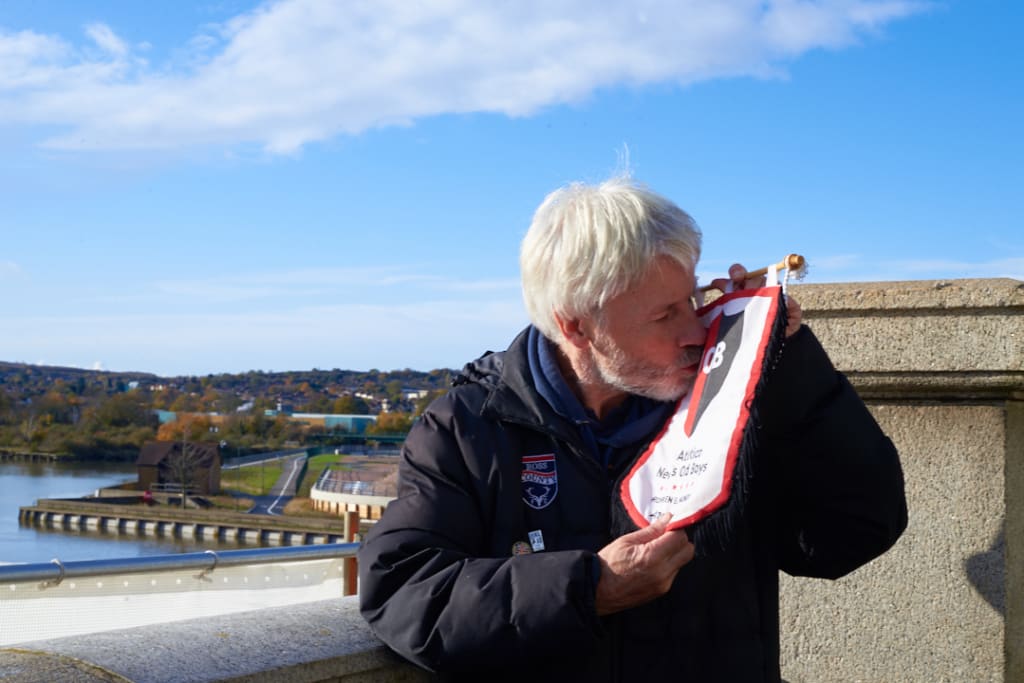
When I arrived in Strood, Adrian was waiting for me at the station. He was wearing sports clothes and had a bag in his hand. He introduced himself and welcomed me with a gift: an official Gillingham FC shirt. Isaac would have been a fan of this club from League One, the third tier in English football, had he stayed in England. As we were walking in the direction of Taylor’s Lane, not far from Rochester station, Adrian explained to me that the jacket he was wearing had an embroidered crest from a Scottish team and that it was, of course, no coincidence. Ross County FC would have been the team of the first president of the Central Argentine Railway Athletic Club, now Rosario Central, Newell’s Old Boys’ lifelong rivals. The reason to be wearing that? Having a Scottish best friend, who is a fan of this team, a team Adrian first watched in the early Noughties.
The first thing that came to my mind was this would not be allowed to any fanatic in Rosario. Note the word used. Here’s the definition — Fanatic: “person filled with excessive and single-minded zeal, especially for an extreme religious or political cause.” I thought for a moment or two, that to really understand passion in an Argentinian way, you had to be born on our soil. It took me seconds to realize that what I was thinking was absurd, this man wanted to organize a “derby”, for Gillingham FC and Ross County FC to play against each other. An English team and a Scottish team. A team from the far north of Scotland against a team from the county of Kent, in England’s south-east corner, and just 33.3 km from France at its closest point near Dover. He also proposed using the respective shirts of the Argentinian counterparts in the second half. This was a suggestion of Newell’s’ historian and statistician, Angel Carlos Burgos, who had also visited Strood. The idea was to celebrate the creation of all these clubs and their direct relationship. Same as the statue, this was a project that had not yet awakened enough interest to come to fruition. While I imagined all the work he’d put into it, I felt pity for the lack of recognition that Adrian had received thus far. However, he talked and answered each question with renewed enthusiasm. It really was a true passion.

He pointed towards an elderly woman closing a door, in this short street meters away from the River Medway. It looked like, with time, this street had become an alley. We were standing where Isaac Newell was born. It was simply incredible to imagine that if that person had never existed, the life of many of us would have been so different. The chain of events that resulted in me standing there was overwhelming.

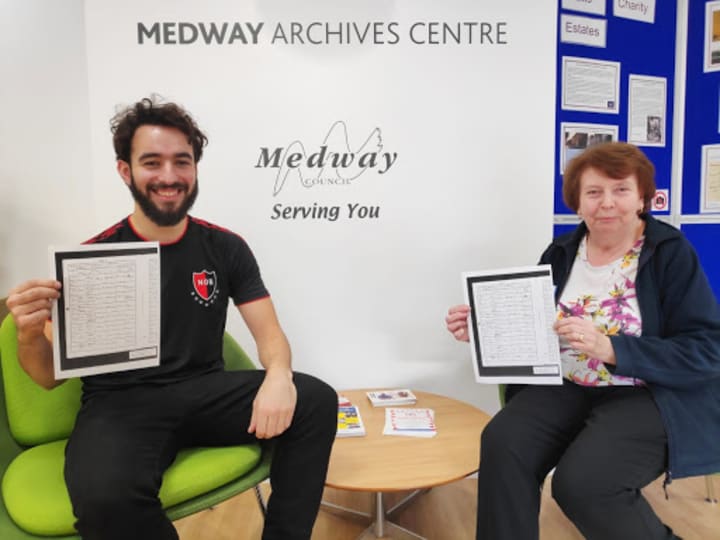
As we walked to the Medway Archives Centre, I began to understand how little acknowledgement Isaac’s life had in his home country, and why Adrian was motivated to do his part. The public building that had records of all birth, marriages, and deaths in the “Medway Towns” (Strood, Rochester, Chatham, and Gillingham) was the workplace of Cindy O’Halloran. This lovely lady, having had a conversation with Adrian before my arrival, opened the offices just for us. By the way she and Adrian were chatting, I figured out that she was involved in the study of Isaac’s legacy. Cindy handed me a copy of Isaac’s birth certificate, almost as a relic, and to someday hang on the walls of the Australian branch. She keeps on selflessly pushing the idea that the Newell surname should be included somewhere in Strood’s multi-million pound redevelopment. Adrian did not lose any opportunity to document everything in photographs, as a testimony of the tour he was guiding. To them, my presence was important. It validated their efforts, and I was happy to participate in that way.
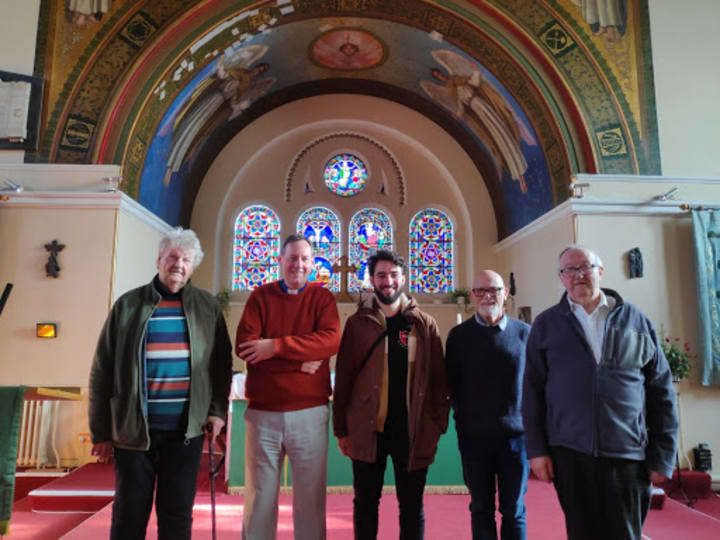
As I was learning about other characters like Charles Dickens the writer, who lived close to Isaac in the nearby village of Higham, we arrived at St. Nicholas church. In this place where our founder was christened, I met several people that, to my surprise, would tell me stories of our club. For those who didn’t know about that man who disembarked in Argentina a century ago, Adrian retold the whole story. He would do so in a succinct fashion, using Lionel Messi’s name as an introduction, and from that point on showing them why they should feel proud.
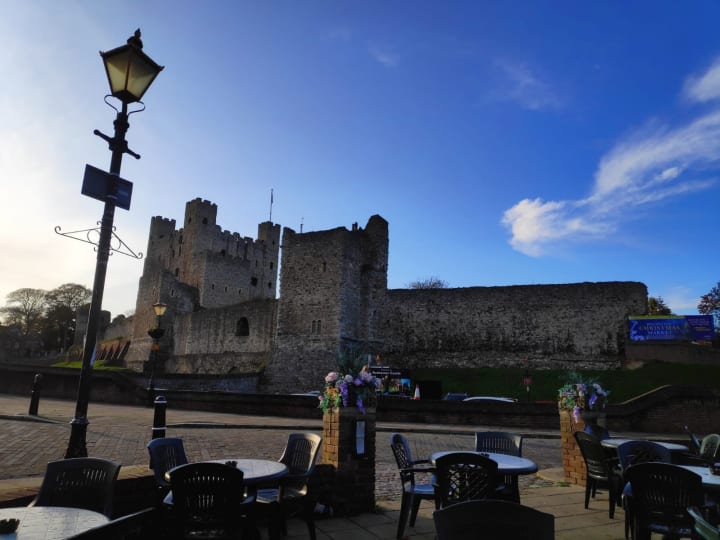
The schedule was tight. Adrian had to go back to work, but he continued with the itinerary out of goodwill. He showed me the castle gardens on the other bank of the river, opposite Taylor’s Lane, and the site where he planned to have the statue erected.
There was one last surprise to come, though: visiting Priestfield Stadium, home of Gillingham FC. On our way there, Adrian told me about a man who had visited Rosario, by the name of Doug Hudson. He is a musician, the voice of Priestfield Stadium, and has been a special guest of our club’s Cultural Department. During his visit, he left a copy of his song “Campeones”, which he wrote and plays at the Gills’ ground. I believe the lyrics will amaze you if you give it a listen. On arrival, Adrian used —once again— the trick of naming the GOAT (Greatest Of All Time), Lionel Messi, and telling the story, with a man at the entrance, to somehow get us next to the pitch. He would go everywhere with his Newell’s pennant, which he even used to stop the star player of the team, Jack Tucker, after he’d finished training.
His love for Newell’s Old Boys was the same as the one he had for Gillingham.
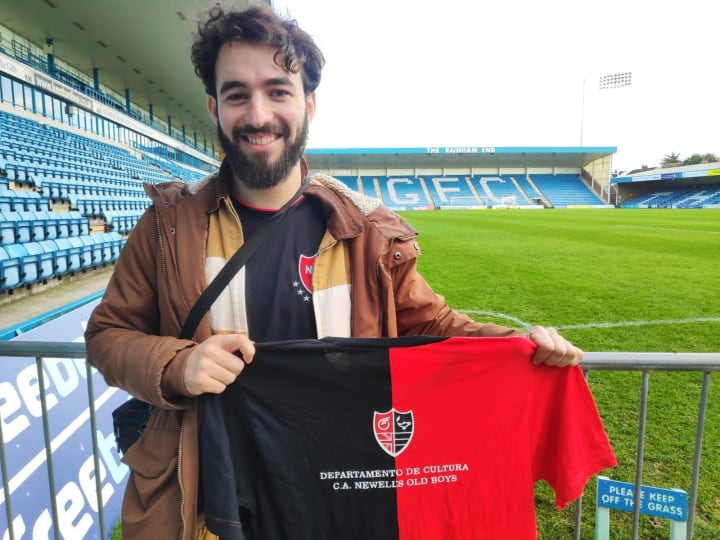
When everything was finished, I thanked him. He asked me for permission to tag me on his page, thus promoting tourism in this humble town and letting more people know about what Isaac had achieved. There was no hesitation from my side, and I accepted while bidding him farewell. The journey back to London felt rather short going over what I had enjoyed, and grasping what Isaac had probably wanted to promote: sportsmanship, camaraderie, the pride in one’s origins, and the respect for history. And myself —and all of us— more than once, had behaved in a way that was against those values from the stands or in front of the tv, wishing ill upon our rivals. Our rivals who are, above all, a competitor. Born from someone else’s dreams, like our grandparents who landed in this country with the ambition of a better life.
The way in which we live today makes it difficult to draw the line between where passion ends and violence starts. Discerning is not easy, just like changing hate for respect, but one is not a fan of a club for football reasons alone. We are fans for the values that represent us, and distinguish us from whatever others defend. Past generations left this legacy but to keep it, improve it, and to honour it, it is surely a job for this generation. The club or the country does not matter, the shirt you wear or the flag you wave is not relevant either.
If we lose this understanding, and we don’t respect others, why do we even play?
Communication must have failed, or memories must have gotten corrupted at some point during the process of the transfer of knowledge. Otherwise, it is not possible to understand how being Argentinian could mean being better than someone from a different country. It is not easy to justify either, to whoever was not brought up here, how being a “fan” could be synonymous with wanting to hurt someone who doesn’t share our ideas. If I, at any moment, thought that man from England would never comprehend what it is to feel like someone from Rosario, it has to be because his dictionary does not define passion as violence. I am positive the rival is not minimized but rather seen as a peer, at their level to, then, rightfully defeat it on the ground. We are nothing without our counterpart, and we are less for wanting their demise. Today’s youth will tell the anecdotes, with the responsibility that entails, and I hope we do it better when describing passion. We should give it meaning by enjoying victories with humility, and explaining defeats without ever discrediting our rivals. We may start, only after getting that right, to honour our grandparents, the way they had once hoped.
* * *
I would like to specially thank Adrian Pope for all his help with this project. This article was originally published on Club Atlético Newell’s Old Boys' official website. Should you would like to read the version in Spanish, you can do so here. And, if you enjoyed the story, please don't forget to share it and subscribe, clicking the link below. Thank you!
You can explore my work and connect with me, clicking on the link below.
If you got here through the prologue I wrote for the book "Sólo Negocios", by the author Miguel Angel Delgado Alcolado, and you would like a copy, you can buy it here.
About the Creator
Alejandro G. Conta
Full-time procrastinator, casual writer.
Keep reading
More stories from Alejandro G. Conta and writers in Cleats and other communities.
Top 5 Players with Most Days as No. 1 ODI Batter
One Day International (ODI) cricket has been one of the most popular formats of the game since its beginning in 1971. With only 50 overs available, batters must combine skill, patience, and smart shot selection to succeed. In such a competitive format, individual consistency becomes extremely important, especially when players are judged through ICC rankings. Holding the top position is a sign of dominance, but staying there for years is even more difficult. The record for most days as №1 ODI batter highlights the rare cricketers who performed at the highest level for long periods. These players scored runs in different conditions, against the best bowlers, and under constant pressure. This article focuses on the legends who achieved the most days as №1 ODI batter, showing why they stand above the rest in ODI history.
By Sports Record and Stats 2 days ago in Cleats
The Incomplete Mayo Cut Plug collector set
If you grew up around New England collectors, you probably heard about certain cards the same way older relatives talked about Ted Williams or Fenway before the renovations. Not as things they owned, but as things they once crossed paths with. An uncle might mention a tobacco card from the 1890s that passed through a local shop years ago, handled carefully, talked about for a bit, and then gone. More often than not, he was talking about the 1895 Mayo Cut Plug cards. The story usually carried a sense that you had missed something important.
By Glen Campbell5 days ago in Cleats



Comments
There are no comments for this story
Be the first to respond and start the conversation.