
Eredivisie: how Netherlands is building a top-5 league
It's no longer a boring league


Eredivisie was considered a non interesting league that was no match against UEFA’s top 5. This, however, has changed in the last years and the Netherlands project is both exciting and intimidating for other european countries.
Five years ago, Eredivisie announced that from the 19/20 season forward, dutch clubs would distribute their revenues from UEFA competitions nationally. This redistribution was simple enough: 5% of a dutch’s club revenue in UEFA’s competitions group stages would be splitted amongst other professional dutch clubs and, for the phases after group stages, the same would happen for 3,75% of the revenue. From the total of this redistribution, 85% of it would go for the remaining Eredivisie clubs that did not participate in any UEFA competition that year and the remaining 15% would be divided between the second division clubs. Eredivisie was the first european league to announce such solidarity mechanisms. The money flow didn’t stop there, as the league adjusted the proportionality in the media revenue distribution model, allowing mid and low table clubs to earn more money from media revenue that they were earning before.
Even though that the UEFA revenue solidarity system was innovative itself, a proper money distribution between national clubs isn’t totally brand new to Europe: countries like Spain and Germany also engaged in this system to prevent disproportion between national clubs. Nevertheless, the grand plan and project behind this distribution was surely well thought, here are the key points from the 2018 announcement:
- Every team must have a youth development academy.
- If a club wants to buy a player from other club’s academy, the compensation from that deal is now 35 000 euros per training year instead of the former 14 000 euros per training year.
- Encouraging clubs to invest in a natural grass or hybrid pitch instead of artificial ones.
- Clubs agreed to be more flexible and move games if that provides the opponent to have a better preparation for an upcoming UEFA match.
- Clubs that are in the group stages of UEFA competitions enter the TOTO KNVB in latter stages.
The idea is for every club to have a strong youth development plan, encouraging teams to look for their own homegrown talent, while making it difficult for big clubs to snatch smaller club’s academic talent.
It’s a big step to move from artificial pitches to natural grass ones, as these are proper playing conditions: artificial pitches are more prone to cause injuries.
Eredivisie’s solidarity doesn’t stop with the green bills: clubs have agreed to move their matches in order for the clubs who are playing european matches to have more time to prepare for those events. Furthermore, clubs enrolled in european competitions enter the Dutch’s cup in latter stages.
Therefore, what’s making the difference for dutch clubs is not only the redistribution of money, but the clear plan and idea on how to invest it wisely. Of course, this would be half-baked if the clubs failed to provide an individual accurate plan to boost themselves, which hasn’t been the case and numerous interesting projects have surfaced outside most mediatic clubs (AZ Alkmaar and Twente, for example).
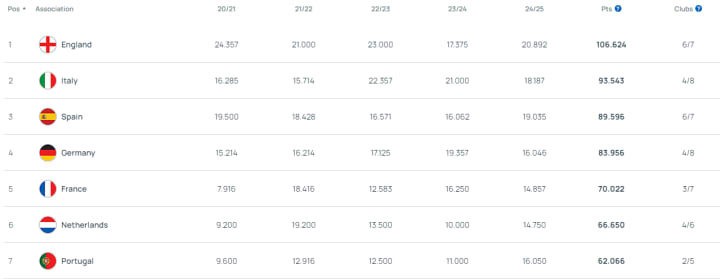
Such changes have lead Netherlands to climb in UEFA’s ranking, overtaking Portugal and growing considerate distance from them, benefiting from the creation of UEFA’s Conference League, which allows clubs outside of dutch’s powerhouses to compete and earn must-needed points for Netherlands:
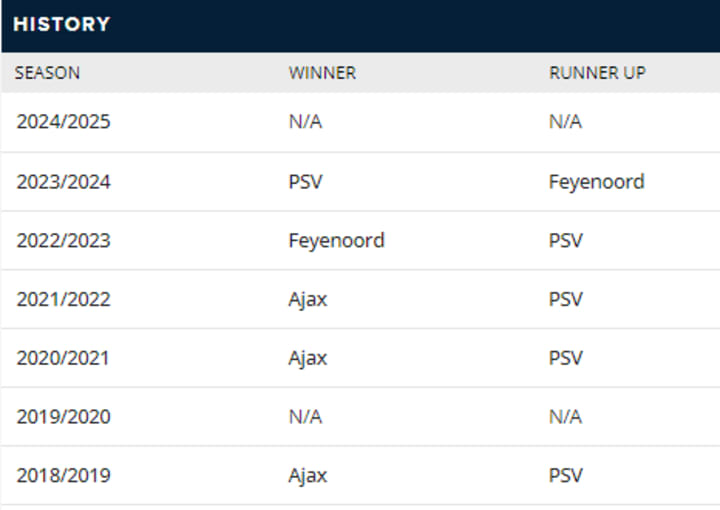
In fact, the overall level of the league grew to a point where the Ajax hegemony is no longer. PSV and Feyenoord were also able to be crowned champions, even though Ajax is at cruising speed to regain the title, but that just proves the point that Eredivisie is a far more competitive league now.
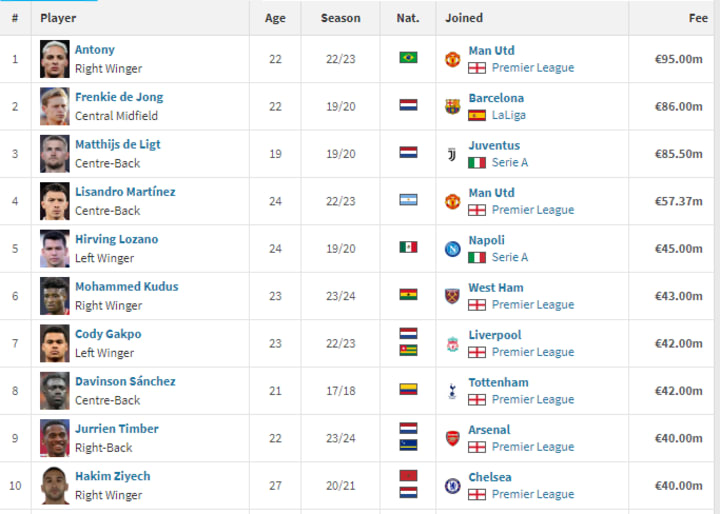
Money generates money. With overall exemplar recruitment, dutch’s clubs have been buying good talent for a fair price in not-so-mediatic places- Feyenoord, for example, has had interesting deals for asian talents Maeda and Hwang In-Beom. Thus, by developing both homegrown and external talent, they’re ready to export it to top 5 leagues and earn a high profit on the overall deal: analyzing the top 10 Eredivisie clubs biggest sells, we note that 9 of them happened after the 2018 announcement:
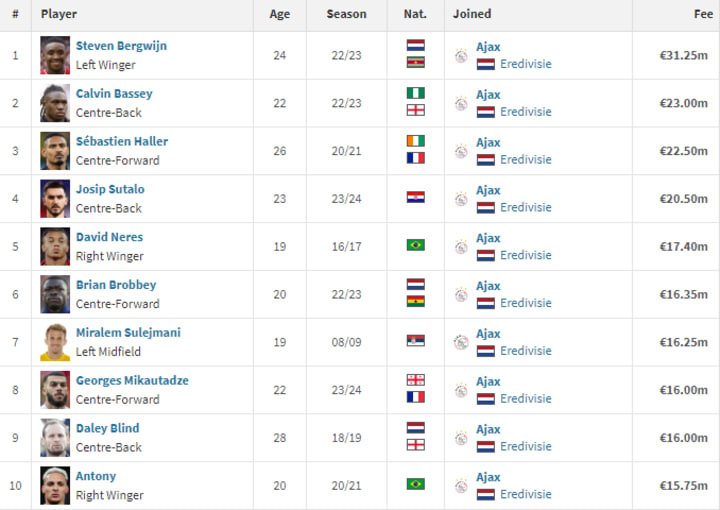
Growing their financial power, it comes from no surprise as well that from the top 10 record signings in this league, 8 of them happened after the said announcement:
Not only the individual level, but also the collective and management levels of dutch’s clubs have risen, hence, they’re now far more competitive in Europe: at this point of the season, there are still two Eredivisie clubs playing in the Champions League and other two playing in the Europa League. Additionally, even managers have been transferred to bigger clubs outside Netherlands: Roger Schmidt, Erik Ten Hag, Arne Slot and Ruud van Nistelrooy are recent examples.
Eredivisie’s project is one of the most successful ones in recent memory. Surpassing Liga Portugal, only time will tell if they have the capacity to climb even more in the ranking and steal a spot as a top 5 league.
I don’t believe Netherlands, as a country, will stop as a top 5 league. With so many national talent now playing in some of the biggest clubs in the world and many other to be revealed, questions will surely appear as how can a dutch club win the Champions League and what chances Netherlands has in the upcoming World Cup.
Sources:
About the Creator
Rui Gonçalves
Freelance writer, aspiring author.
I mostly talk about sports and politics.
Find me on all my socials: https://linktr.ee/ruiwrites
Keep reading
More stories from Rui Gonçalves and writers in Cleats and other communities.
Squares and triangles
I still believe Ruben Amorim is one of the most exciting new-school managers and has now the opportunity to adapt and evolve his tactical approach. That evolution will naturally and eventually happen and will probably reflect on how Amorim’s teams build-up.
By Rui Gonçalvesabout a year ago in Cleats
Shadow Fist: A Gritty Independent MMA Drama From Andreas Szakacs Productions
At first glance, Shadow Fist appears to be a gritty mixed martial arts drama set in the underground fight scene of Mexico City. But beneath the punches, bruises, and adrenaline of the ring lies a deeper story—one about resilience, identity, and the difficult journey toward redemption.
By Andreas Szakacs6 days ago in Cleats


Comments
There are no comments for this story
Be the first to respond and start the conversation.