

Introduction
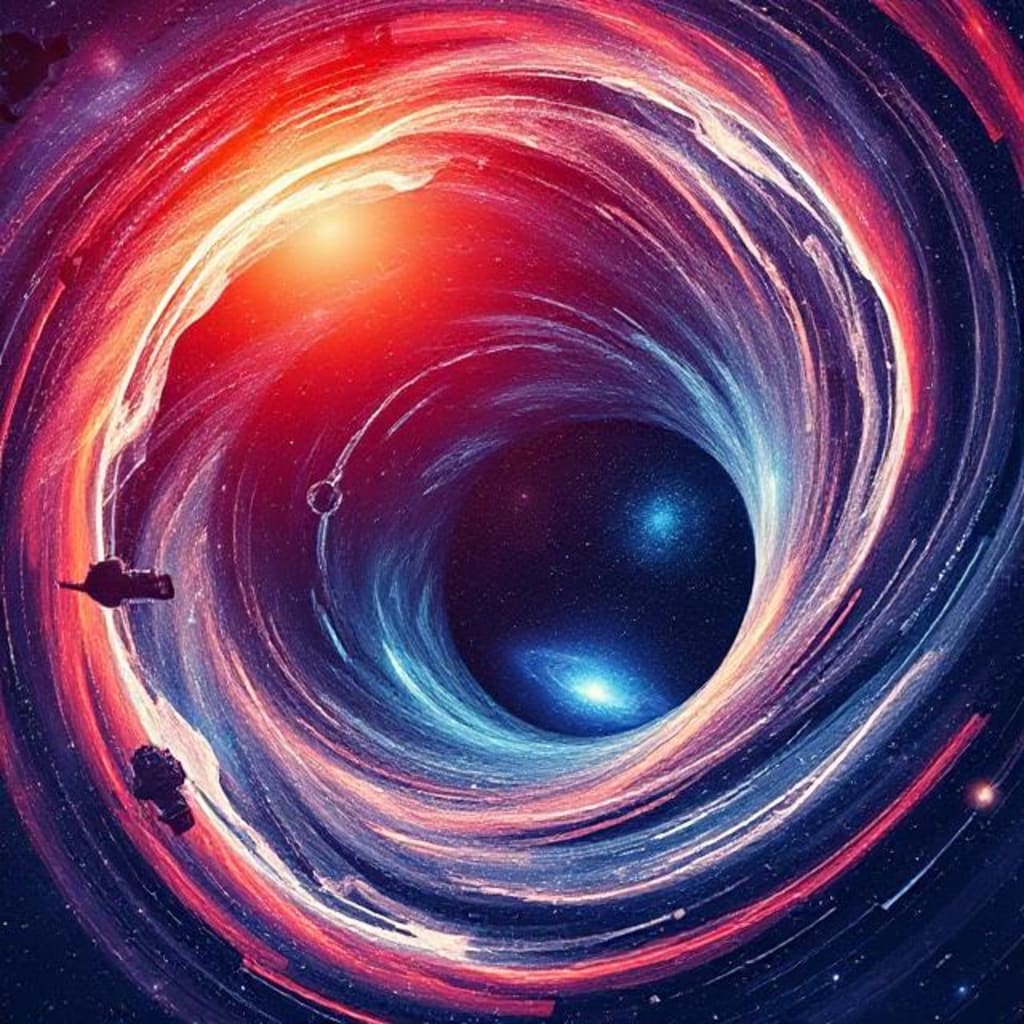
Physicists and fans of science fiction alike have long been intrigued by the concept of wormholes—hypothetical tunnels connecting various points in spacetime. If they exist and are traversable, they could serve as shortcuts across the vast cosmos. Even more intriguing is the possibility that they permit time travel. However, if time travel is feasible, does it conflict with the idea of free will? Could someone use a wormhole to change the past, and if so, what happens to personal agency and causality? The implications of such a scenario touch upon deep philosophical and scientific questions, questioning whether our choices truly shape reality or if we are bound by an unalterable destiny.
This article delves into paradoxes and possible solutions provided by physics and philosophy to the fascinating intersection of wormholes, time travel, and free will. Understanding Wormholes: Spacetime's Theoretical Gateways A wormhole is a solution derived from Einstein’s General Theory of Relativity, describing a tunnel-like structure that connects two distant locations in space and time. The formal name of the idea, which was first proposed in 1935 by Nathan Rosen and Albert Einstein, is the Einstein-Rosen Bridge. If these structures are real, it could theoretically be possible to travel across the universe instantly. However, the possibility of wormholes allowing for time travel is one of the most significant effects. If one entrance of a wormhole experiences time dilation—due to being near a strong gravitational field or moving at relativistic speeds—an observer could enter one side and emerge in the past or future relative to their starting point.
This raises profound questions: If an individual can travel into the past, do they still have free will? Can they alter events, or are they constrained by the laws of time?
Free Will and the Paradoxes of Time Travel
Our understanding of reality is fundamentally based on the idea of free will, or the capacity of humans to make their own decisions. If we possess free will, our decisions should shape the future rather than being predetermined or unchangeable. However, the possibility of time travel introduces paradoxes that complicate this notion.
1. The Grandfather Paradox: A Challenge to Free Will
One of the most famous time travel paradoxes is the Grandfather Paradox. Imagine a person using a wormhole to travel back in time and prevent their grandfather from meeting their grandmother. If they succeed, they would never have been born, which means they could never have traveled back in time to commit the act in the first place.
This paradox suggests that time travel to the past could be impossible—or at the very least, that certain actions would be prohibited by the laws of physics. If such a restriction exists, it would imply that free will is limited when it comes to events that have already occurred. In other words, even if we appear to make choices freely, certain actions may be fundamentally impossible in a self-consistent timeline.
2. The Novikov Self-Consistency Principle: A Possible Resolution
To resolve these contradictions, physicist Igor Novikov proposed the Self-Consistency Principle, which suggests that the universe prevents paradoxes by ensuring that any actions taken by a time traveler were always part of history. In this view, events are self-consistent, and time travel cannot create logical contradictions.
For instance, if you traveled back in time and attempted to prevent your grandfather’s marriage, some event—whether by coincidence or force—would always intervene to stop you. Perhaps your weapon would malfunction, or you would be distracted at a critical moment.
Although this principle maintains logical consistency, it raises philosophical questions regarding free will: if the universe corrects paradoxes, does that imply that free will is a figment of the imagination? Do time travelers actually have options, or are they just tools for a timeline that never changes? 3. The Many-Worlds Interpretation: A Quantum Perspective
An alternative perspective comes from quantum mechanics, particularly the Many-Worlds Interpretation (MWI). According to this theory, every possible outcome of a decision occurs in distinct, branching universes. If this is true, traveling back in time would not change the original past but would instead create a new parallel reality.
For instance, your original timeline would not change if you traveled back in time and prevented your grandfather from meeting your grandmother; however, a new timeline would start where you were never born. This model preserves free will at the expense of a growing number of realities. While this avoids logical paradoxes, it raises another issue: If every choice spawns a new universe, does free will truly exist, or is every decision simply another inevitable path within an infinite multiverse?
Is Time Travel Through Wormholes the End of Free Will? If wormholes enable time travel, we are left with three main possibilities:
Self-Consistency through Determinism: If Novikov's principle is true, free will is limited in a way that prevents paradoxes. Choices are only free within the limits of a self-consistent history.
Branching Realities: If Many-Worlds is correct, then free will exists, but every choice creates a new universe, meaning that every possible action occurs somewhere.
Hard Determinism: Free will may be an illusion if time travel forces events to unfold in a single, unchangeable manner. Each of these possibilities challenges our intuitive understanding of free will. While wormholes remain theoretical, their implications force us to reconsider whether our choices shape reality—or whether reality is fundamentally rigid, with events unfolding in ways that are inevitable.
Conclusion: A Universe Where Choice is an Illusion?
Questions about causality and free will arise as a result of the possibility of time travel and wormholes. If past events cannot be changed, then our choices may be limited to what is already "allowed" within the timeline. If branching realities exist, free will is preserved, but at the cost of an infinitely splitting multiverse.
In the end, our comprehension of free will, causality, and time is far from complete. Wormholes, if they exist, could force us to redefine what it means to make a choice, and whether free will is truly an intrinsic part of human existence or merely an illusion shaped by the fabric of the universe itself.
Final Thought:
If you could step into a wormhole and travel back in time, would you still believe your choices were truly your own? Or would you just be acting out a script that the laws of physics have already written for you? The answer remains one of the greatest mysteries of both science and philosophy.
About the Creator
MD Ariful Islam
Writer, thinker, and storyteller. I share fresh perspectives on [your niche or interests], sparking new ideas and conversations. Let’s connect!
Keep reading
More stories from MD Ariful Islam and writers in Chapters and other communities.
Exploring Our Universe
Our universe is vast, mysterious, and awe-inspiring—a cosmic expanse that stretches beyond what the human mind can fully comprehend. From the tiniest subatomic particles to the largest galaxies, the universe is filled with an incredible array of phenomena that challenge our understanding and fuel our curiosity. The more we learn, the more we realize how little we truly know about the cosmos, sparking a deep desire to understand the very fabric of existence.
By MD Ariful Islam12 months ago in Chapters
The Guardian Chapter V
Alexander left his Coming of Age ceremony with Cronos and the elders with as many new questions as he had answers for his old questions. Cronos had confirmed his suspicions were correct. Not only was there a link between the Beast Masters and the inhabitants of the Citadel, but it was the Citadel's fault that the Beast Masters existed in the first place. Instead of banishing the law breakers which allowed them to wreak havoc on the rest of humanity, the Citadel elders should have stripped them of their powers before they became too strong. Now Alexander would need to battle the Beast Masters and the Jikininki. It would be difficult for him to forgive the Citadel Elders because their poor decisions led to the deaths of his parents and more than half the planet's human population.
By Mark Gagnon28 days ago in Chapters
If the Strait of Hormuz is closed for a long time, it will benefit Russia.
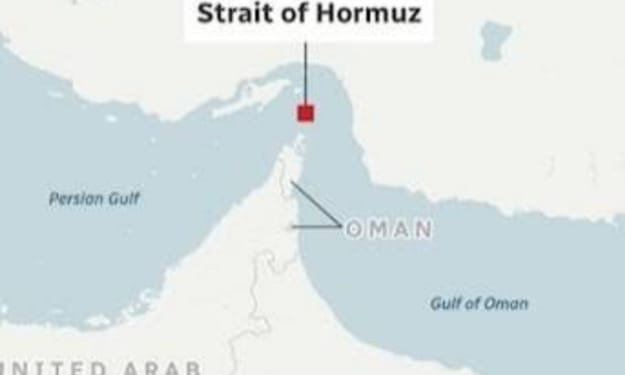
A war involving the United States and Israel with Iran carries the risk that the Strait of Hormuz could remain closed for a prolonged period. This is a crucial route in the global economy through which 20% of the world’s oil and liquefied natural gas is supplied from the countries of the Persian Gulf.
By Real content8 days ago in Chapters

Comments
There are no comments for this story
Be the first to respond and start the conversation.