
When the Loot Divides, the Trust Dies
In the Fog, Every Road Leads to a Trap

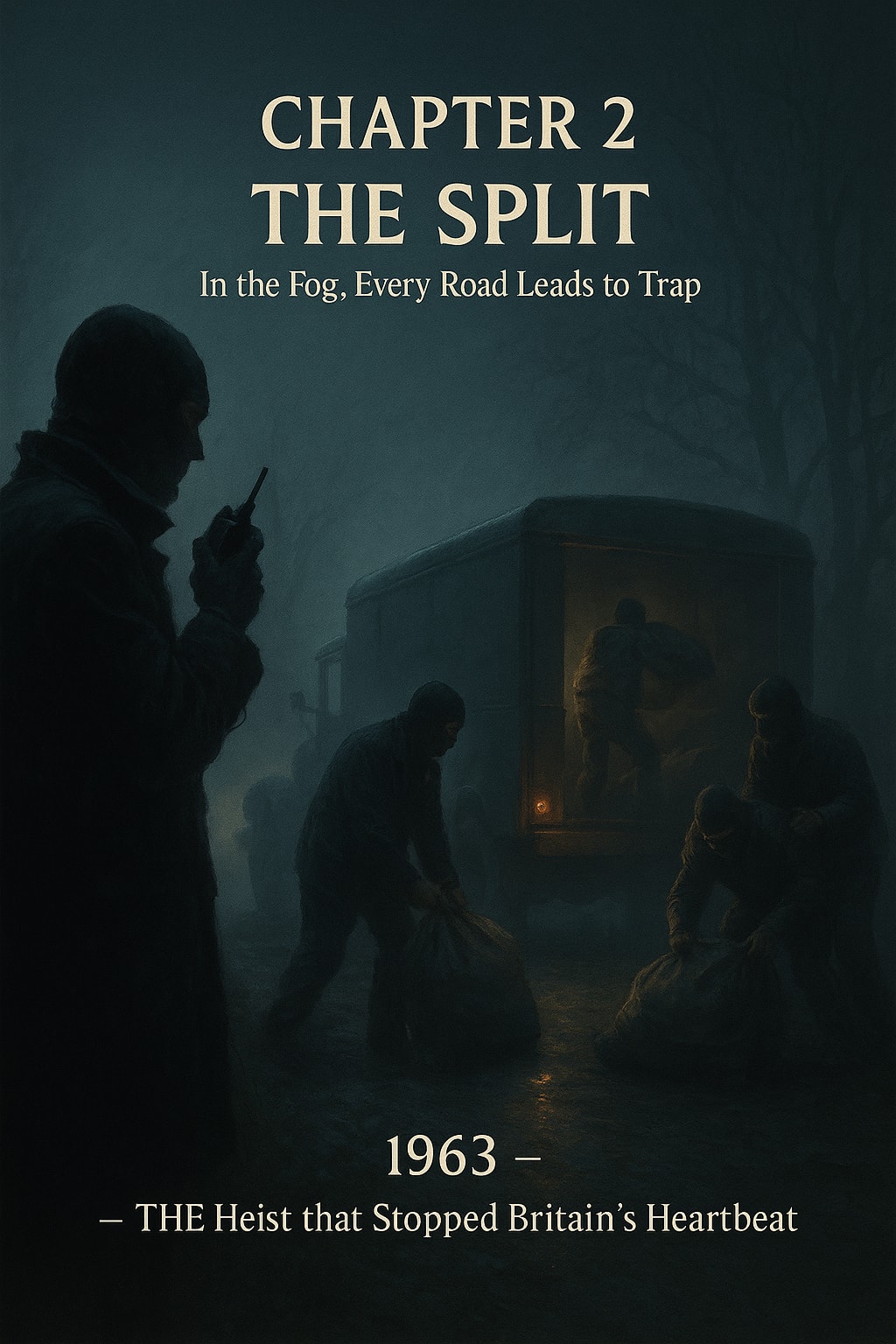
The lorry’s engine growled against the night, a low, angry sound swallowed by the thick fog curling over the Buckinghamshire lanes.
Inside, the stolen canvas sacks sat like silent passengers — forty in total — each one heavy with banknotes still warm from the counting machines.
Ronnie sat in the passenger seat, gloves damp from the rain, the metallic taste of adrenaline still sharp on his tongue. Every bump in the road rattled the floorboards and made the bags shift with a dull thud.
No one spoke.
The driver, Charlie, kept his eyes locked on the narrow road ahead, leaning forward as if sheer willpower could force the fog to part. The headlights carved two weak tunnels through the mist, revealing only the next few feet of wet tarmac.
From the back of the lorry, a muffled voice broke the silence.
“How long till the farm?”
Ronnie checked his watch — 3:24 a.m. “Fifteen minutes. Keep quiet.”
Far behind them, the Royal Mail train sat stranded in the dark, its metal still hissing from the sudden stop. The red signal light glowed like a wound in the night.
Detective Inspector Frank Millar stepped carefully along the wet ballast, the soles of his polished shoes crunching on loose gravel. He was still half-asleep when the call came through — “train stopped, possible robbery” — but one look at the scene had snapped him wide awake.
A thirty-one-carriage Royal Mail train, uncoupled from its engine. A driver slumped unconscious. Dozens of empty canvas sacks littering the high-value coach.
Millar crouched beside one of them, running a finger over the rough fabric. The faint scent of paper money clung to the fibers. He straightened and scanned the tracks — faint tire impressions in the mud, still wet.
“They left in something big,” he muttered. “Lorry, maybe two. And they weren’t in a hurry — they knew exactly what they were after.”
The lorry turned off the main road, tyres squelching onto a dirt track. Out here, the fog was even thicker, swallowing the trees into grey shadows.
Ronnie glanced back through the small window into the cargo bay. Buster sat on a stack of sacks, shotgun resting across his knees. His eyes never stopped moving, flicking between the men and the canvas bags like a dog guarding its bone.
They reached the farmhouse without headlights, coasting in on momentum. The building loomed out of the fog — dark windows, sagging roof, the faint smell of damp hay.
Charlie killed the engine. For a moment, the silence was so complete they could hear the rain ticking against the tin roof. Then the doors swung open and the robbers moved fast, each man grabbing two sacks and vanishing inside.
Inside the barn, the air was warmer, heavy with the smell of old wood and oil. A single lantern swung from a beam, throwing restless shadows across the walls. The sacks piled up in the corner, the heap growing until it looked more like a barricade than stolen cash.
“Count it?” Buster asked.
“Not yet,” Ronnie said. “We don’t stay here long. By morning, we’re split. Two men north, two south, the rest scatter.”
That got them talking.
Back at the tracks, Inspector Millar listened to the stationmaster’s report.
“They hit the signal first. Somebody climbed the post, pulled the green filter, and set it to red manually. Clever work.”
Millar lit a cigarette, the glow briefly painting his face in red-orange. “Clever doesn’t make them invisible. Get me every patrol car within thirty miles. Block the main roads. And find out if any farm vehicles went missing tonight.”
He looked back toward the foggy horizon. Somewhere out there, a lorry was melting into the night, carrying more money than most men would see in ten lifetimes.
And Millar intended to find it.
By 4:15 a.m., the farmhouse was alive with quiet, tense activity.
The robbers sat around an old wooden table, steam rising from mugs of instant coffee. The sound of the kettle was loud in the stillness. Outside, the fog pressed against the windows like a living thing.
Ronnie spread a map across the table.
“Two routes out,” he said, tracing them with a gloved finger. “Here — north through Wolverton. And here — south to the M1. Once you’re on those roads, you don’t know each other. If they catch you, you don’t know me. Clear?”
Charlie frowned. “And the money?”
“Split later,” Ronnie said. “It’s too hot now. We hide it, wait six months, then divide.”
Buster’s jaw tightened. “That wasn’t the plan.”
Ronnie’s eyes locked on his. “The plan changes if it keeps us out of prison.”
The room went quiet.
At 4:37 a.m., a pair of police motorcycles roared down the main road less than half a mile away, their sirens muffled by the fog. The sound made every man in the barn freeze.
Ronnie blew out a slow breath. “Time’s up. Load your gear and move. Now.”
The men dispersed, boots thudding on the wooden floor. Outside, the lorry’s engine turned over with a reluctant growl.
As Ronnie climbed into the passenger seat, he caught sight of the sacks piled in the shadows of the barn. For a second, he hesitated, the red glow from the dashboard lights painting them like forbidden treasure.
Then Charlie slammed the lorry into gear and they were gone, swallowed by the fog, their taillights fading like embers into the night.
Behind them, in the empty barn, the lantern swung slowly, creaking in the stillness. The shadows it cast seemed to shift unnaturally, like they were waiting for someone to come back.
In the fog outside, the distant wail of sirens grew louder.
This was the night’s second split — not just of men and money, but of trust itself. And though the robbers didn’t know it yet, the fog was not just hiding them.
It was herding them.
About the Creator
Keep reading
More stories from WAQAS AHMAD and writers in Chapters and other communities.
Bagram Air Base Targeted? Pakistan–Afghanistan Border War Intensifies
Clashes between Pakistan and the Taliban in Afghanistan have entered their sixth day, during which Pakistan has claimed to have carried out airstrikes on 56 locations inside the neighboring country. Meanwhile, the Afghan Taliban claim they have foiled an operation targeting Bagram Air Base.
By Real contentabout 9 hours ago in Chapters
Cassie and Johnny
I’m the kind of dame you notice. I’m no femme fatale, but you can’t ignore me, at least not until I warn you about what’s coming, then everybody ignores me. Hell, they usually blame me afterwards and give Johnny all the credit for saving the day, but my Johnny couldn’t save a seat at the movies without my help. Sure, he’s brawny, but brainy? Not so much. Like that time I asked him to spot me five bucks, and he said he didn’t see it anywhere on me, and believe you me, he looked but good.
By Harper Lewis6 days ago in Critique


Comments
There are no comments for this story
Be the first to respond and start the conversation.