
What if we fell into a black hole?
Imagine yourself floating peacefully in space, surrounded by bright stars and distant galaxies. Suddenly you notice a region of total darkness, a black spot in the vastness of the universe. This black dot is a black hole. But what would happen if, by an incredible coincidence, you fell into a black hole?

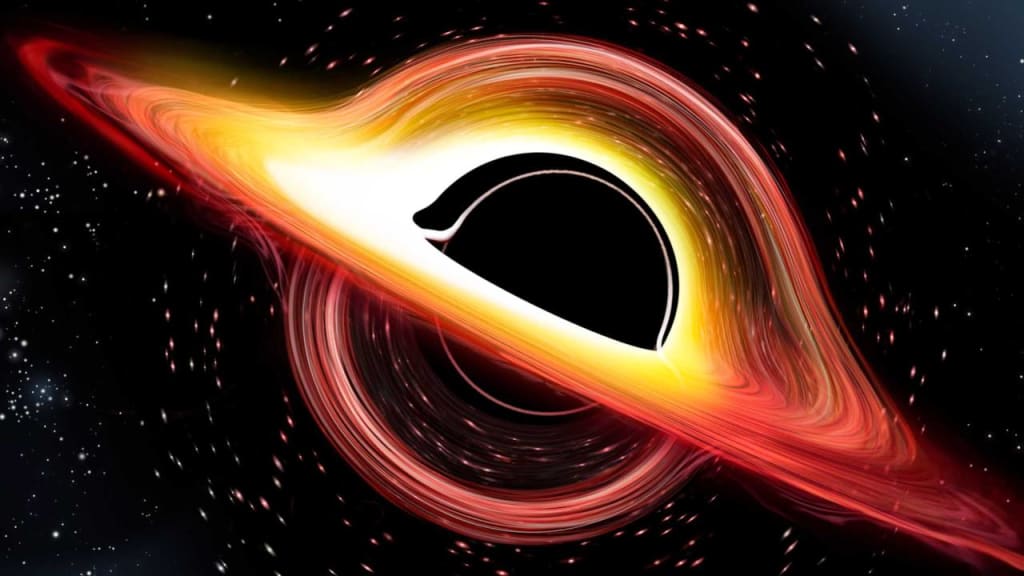
This imaginary interstellar journey takes us into the deepest mysteries of the universe.

What is a black hole?
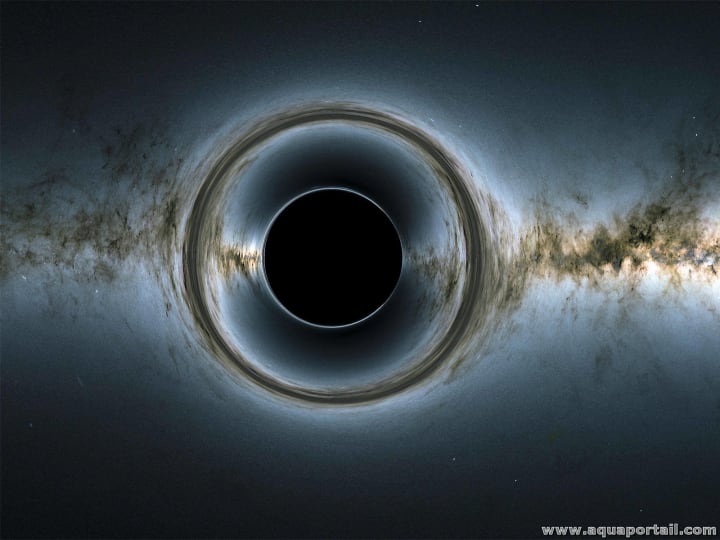
To begin , a black hole is a region of space where gravity is so strong that nothing, not even light, can escape. They form when massive stars exhaust their nuclear fuel and collapse under their own weight. This implosion creates a singularity, an infinitely dense point where the laws of physics as we know them cease to work. Around this singularity lies the event horizon, the boundary beyond which return is impossible.
Approaching the black hole , If you were near a black hole, one of the first things you would notice would be the gravitational tidal effect. These forces, caused by the difference in gravity between your feet and your head, would begin to stretch you significantly. This phenomenon is often amusingly described as "spaghettification", where your body is stretched like spaghetti.
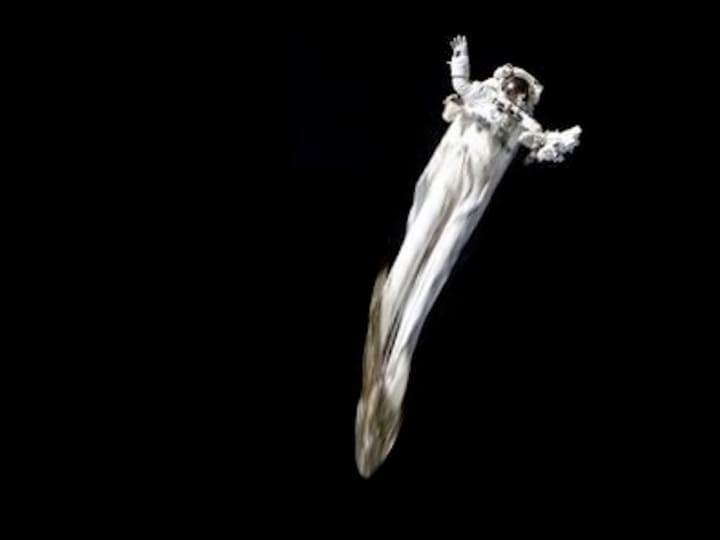
This vertical stretching of objects into thin, long shapes (much like spaghetti) in a strong gravitational field results from an intense tidal force. In extreme cases, near a black hole, the stretching is so powerful that no object can resist it, regardless of the cohesion of its components.
The closer you get, the more intense these forces become.
Before crossing the event horizon, you would have a spectacular view of the universe.
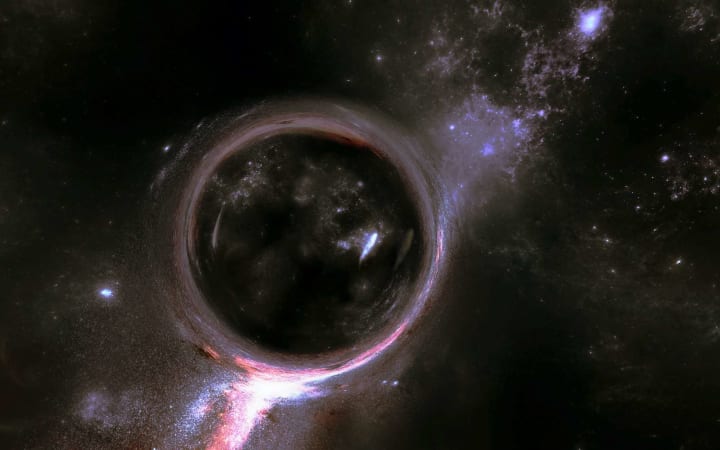
Stars and galaxies would be distorted into bright arcs around the black hole, due to the extreme curvature of space-time. This phenomenon, called gravitational lensing
Crossing the event horizon
Crossing the event horizon is a point of no return. To an outside observer, it would appear that you slow down and freeze as you approach this boundary, due to the slowing of time caused by extreme gravity.
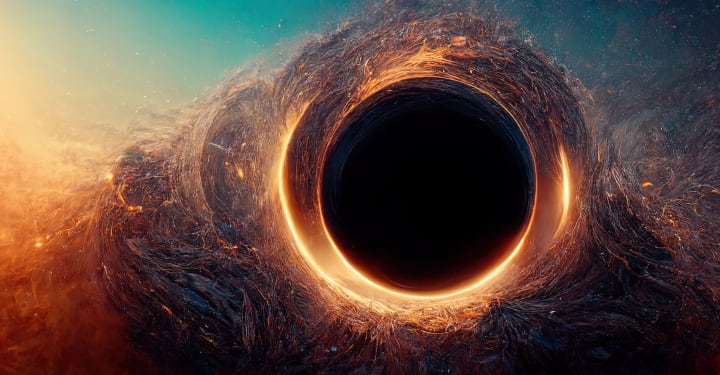
However, from your own perspective, you would pass the event horizon without noticing any particular change except a rapid acceleration towards the singularity.
Inside the black hole
Once inside, the laws of physics as we know them no longer apply. Gravity becomes so intense that even light is bent in extreme ways. You would inevitably be drawn to the central singularity, a point of infinite density and curvature of space-time. Spaghettification would become complete and, unfortunately, all matter would be destroyed before reaching the singularity.
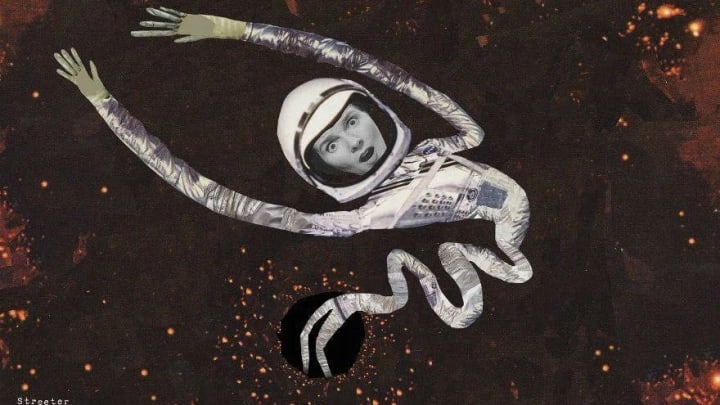
“Either there would be nothing left of you.”

The mysteries of black holes
Black holes remain one of the greatest mysteries in astrophysics. A fascinating question is what happens with the information. According to quantum mechanics, information cannot be destroyed. However, in a black hole, all information about fallen objects seems lost. This contradiction between general relativity and quantum mechanics is known as the black hole information paradox and remains an area of active research.
Black holes in science fiction
Black holes have captured the imagination of science fiction authors and filmmakers. Although these ideas are theoretical, they offer a fascinating perspective on the possibilities of space exploration.
So, what if we fell into a black hole? It would be a scary and amazing adventure into the depths of the universe. Although we cannot actually survive such an experiment, the study of black holes

About the Creator
ECO-EXPLORERS
Studying in India opened the doors to a multitude of opportunities for me to deepen my knowledge in this exciting field. With each new discovery, I feel inspired and motivated to contribute to this vision.
Keep reading
More stories from ECO-EXPLORERS and writers in Chapters and other communities.
What if the oceans volatilized?
The immediate impact on marine life. The first and most obvious effects would be the disappearance of marine life. From the tiny planets to the majestic whales, including coral reefs and fish of all kinds, all the inhabitants of the oceans perished. This massive extinction would upset the food chains and cause the collapse of marine ecosystems..
By ECO-EXPLORERS2 years ago in Chapters
Bagram Air Base Targeted? Pakistan–Afghanistan Border War Intensifies
Clashes between Pakistan and the Taliban in Afghanistan have entered their sixth day, during which Pakistan has claimed to have carried out airstrikes on 56 locations inside the neighboring country. Meanwhile, the Afghan Taliban claim they have foiled an operation targeting Bagram Air Base.
By Real contentabout 13 hours ago in Chapters



Comments (1)
Hey, just wanna let you know that this is more suitable to be posted in the FYI community 😊