
Understanding the Different Types of SEO
Unlock the Secrets Behind Every Type of SEO


SEO is evolving faster than ever. From AI search engines to voice-driven results and smart content experiences, optimizing for search is no longer a one-size-fits-all game. For marketers, agencies, and business owners, understanding the different types of SEO is essential to building a search strategy that works in 2025 and beyond.
This guide breaks down seven major SEO types: GEO SEO, Answer Engine Optimization (AEO), AI SEO, Traditional SEO, Voice Search SEO, Search Experience Optimization (SXO), and Generative Engine Optimization (GEO)—with real-world examples and when to use each.
1. GEO SEO – Geolocation-Based Search Optimization
What it is: GEO SEO focuses on optimizing content for location-specific search results. It’s all about local relevance—whether you’re targeting a city, region, or neighborhood.
Best for: Local businesses, service providers, multi-location brands
Example: A bakery in Vancouver wants to rank for "custom birthday cakes near me." GEO SEO involves using location keywords like "birthday cakes Vancouver," Google My Business optimization, and local citations.
2. AEO – Answer Engine Optimization
What it is: AEO is about optimizing your content to appear as a source in AI-generated answers (like Google SGE, Bing Copilot, and Perplexity AI). It focuses on clear, structured, question-based content.
Best for: Blogs, knowledge bases, ecommerce sites, B2B content marketers
Example: Instead of just writing a blog titled "Best Time to Water Plants," you format it with structured FAQs, schema markup, and concise answers. Now your content is eligible to be cited by an AI engine when users ask, “What’s the best time to water indoor plants?”
3. AI SEO – Using AI to Power SEO Strategy
What it is: AI SEO uses machine learning tools to optimize content, analyze ranking potential, and identify gaps. It’s the back-end intelligence behind faster, data-driven SEO.
Best for: Agencies, data-driven brands, content teams with large websites
Example: A fashion retailer uses MarketMuse to optimize its product category pages. The AI suggests keyword clusters, on-page improvements, and even content outlines. This saves time and improves ranking potential.
4. Traditional SEO – The Foundation
What it is: The original SEO approach based on on-page optimization, technical SEO, backlinks, and keyword research. Still very relevant today.
Best for: All websites—it’s foundational
Example: An ecommerce store optimizes title tags, meta descriptions, uses header tags properly, compresses images for speed, and builds backlinks. These remain important even in 2025.
5. Voice Search SEO – Optimizing for Spoken Queries
What it is: Voice SEO focuses on natural language queries, often longer and more conversational. It aims to answer queries posed to smart devices like Siri, Alexa, or Google Assistant.
Best for: Service-based businesses, recipe blogs, local queries
Example: Instead of optimizing for "pizza recipe," you optimize for "How do I make a crispy pizza at home using a regular oven?" Content is conversational, uses featured snippets, and is mobile-first.
6. SXO – Search Experience Optimization
What it is: SXO combines SEO with UX (user experience). It focuses on user satisfaction, intuitive navigation, fast loading, and content that solves a user’s intent efficiently.
Best for: Ecommerce, SaaS, blogs, healthcare, and service sites
Example: An insurance company improves its quote form’s speed, uses structured headings, adds a chatbot for instant answers, and tracks scroll depth. This enhances dwell time and conversions.
7. Generative Engine Optimization (GEO)
What it is: Generative Engine Optimization is the practice of structuring and writing content that AI-powered search engines (like Google SGE, Bing Chat, and Perplexity) can easily reference or summarize in their responses.
Best for: Educational blogs, expert explainers, B2B content, FAQ-rich pages
Example: A SaaS company writes a well-structured article with a clear summary, bullet points, and schema markup. When someone asks Bing AI, “What is the difference between cloud ERP and traditional ERP?”, the engine pulls a summary from that blog post.
GEO works hand-in-hand with AEO but puts more emphasis on generative context, source reliability, and prompt-friendly formatting.
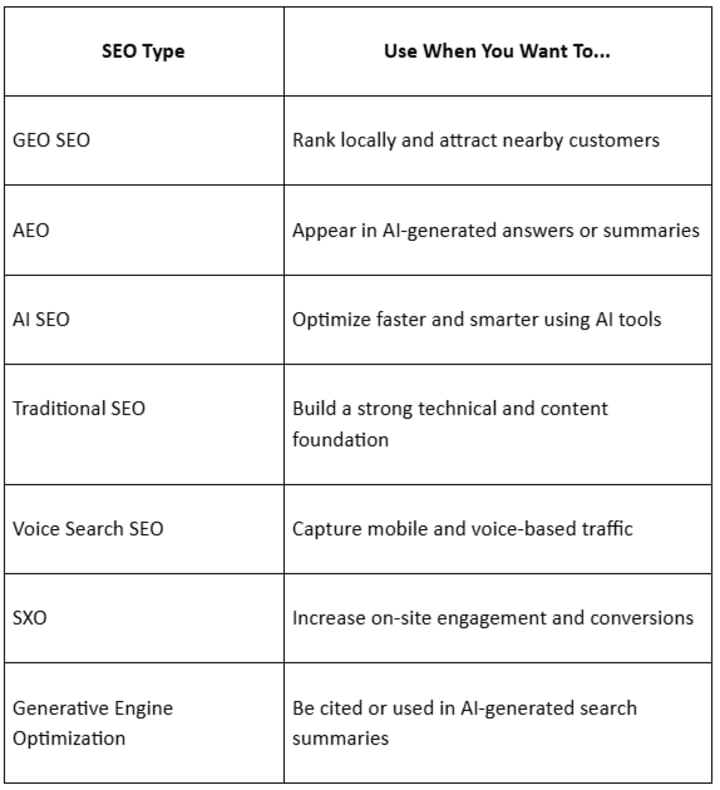
When Should You Use Each SEO Type?
Bonus: How They Work Together
In most modern strategies, these SEO types overlap. A Montreal-based digital agency might:
- Use GEO SEO to attract local leads
- Apply AEO techniques to show up in AI search summaries
- Implement AI SEO tools to create better content
- Maintain traditional SEO best practices for structure and crawlability
- Optimize for voice queries like “best social media agency near me”
- Improve the search experience (SXO) with better UX and page speed
- Format long-form content using GEO techniques for visibility in AI engines
Final Thoughts
SEO isn’t dead. It’s just evolving. Today’s SEO expert must think across formats, tools, and user behaviors.
By understanding these seven SEO types—GEO SEO, AEO, AI-driven, Traditional, Voice, SXO, and Generative Engine Optimization—you can create a layered strategy that’s not just about rankings, but also visibility, usability, and trust.
Need help with your SEO approach? Consider working with a team that combines technical skills and AI-driven strategies with a human touch.
About the Creator
Heri smith
I am seasoned digital marketing expert.
Keep reading
More stories from Heri smith and writers in Chapters and other communities.
How to Rank Product Listings on ChatGPT: A Step-by-Step Guide for Sellers and Agencies
With the evolution of AI-powered assistants, ChatGPT has become more than just a conversational tool. It's now a growing hub for product discovery. OpenAI's integration of shopping results within ChatGPT has opened up new opportunities for e-commerce brands, digital web agencies, and internet marketing agencies to make their products more visible in user queries.
By Heri smith8 months ago in Geeks



Comments
There are no comments for this story
Be the first to respond and start the conversation.