
"Two Thousand Gone: The Night the Students Disappeared"
The July Revolution: A Nation’s Youth Silenced in Blood
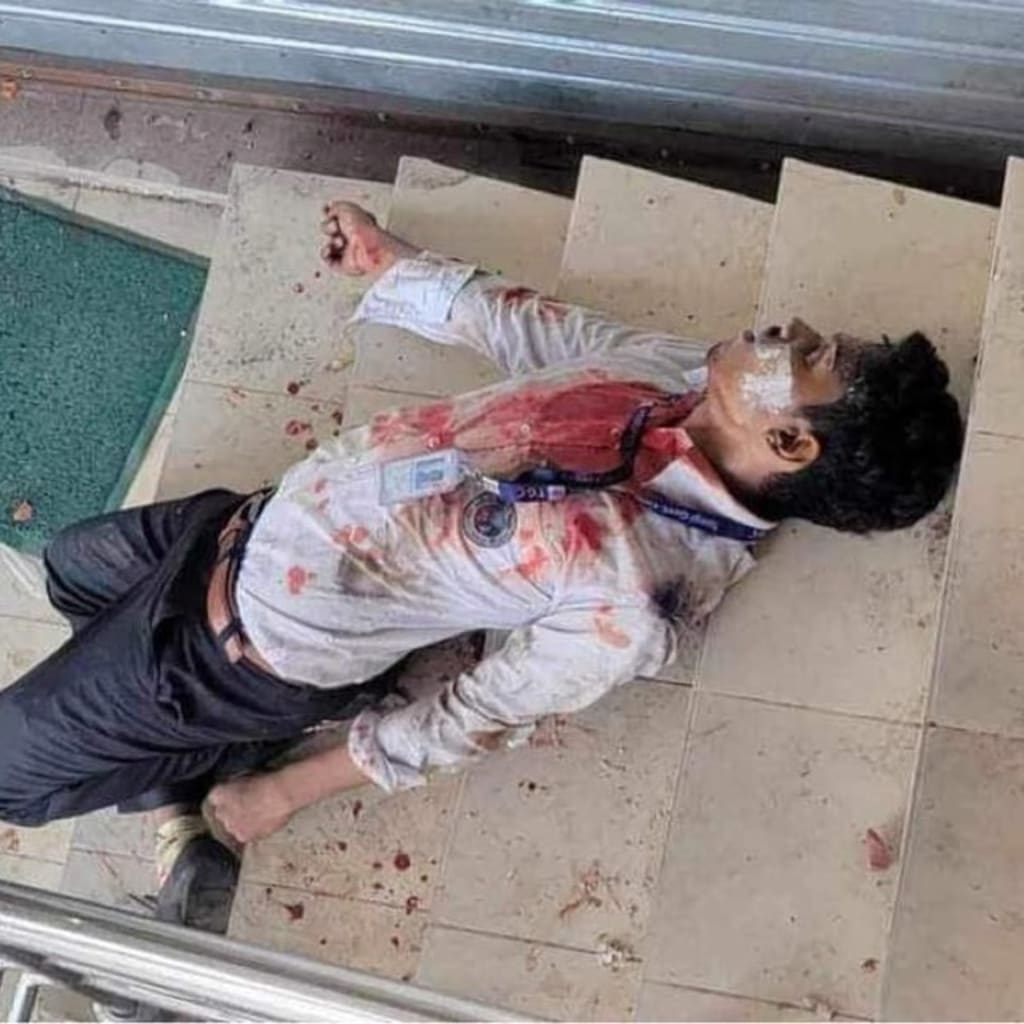
In the heart of South Asia, Bangladesh has long been a country of resilience. Born through a war for language, dignity, and independence, it has endured decades of political unrest, natural calamities, and economic hurdles. But never in its modern history had the nation witnessed a tragedy as devastating and heartbreaking as the July Revolution—a tragic confrontation between the country’s youth and the state machinery that would end in the blood of over two thousand students staining the streets.
What began as a peaceful student uprising against authoritarianism and corruption turned into a full-blown crisis. On the hot, humid morning of July 14, thousands of students from universities and colleges across the country marched in unison, calling for justice, transparency, and reform. Their placards bore messages like “We Want Democracy, Not Dictatorship” and “Corruption is Killing Our Future.” They were armed not with weapons, but with pens, phones, and the unyielding energy of youth. None of them expected their protest would end in death.
The Spark: Why the Students Rose
To understand the explosion of youth anger in July, one must look back a few months. Bangladesh, already struggling under the weight of inflation, unemployment, and a decaying education system, was shaken when a secret document was leaked to the press. It exposed high-level corruption within the Ministry of Education—millions of dollars meant for scholarships, digital classrooms, and rural school programs had been siphoned off by senior bureaucrats and politicians.
What made matters worse was the silence from the government. No resignations. No investigations. No apologies. For the millions of young people watching their futures slip away, it was a final slap in the face.
University students began mobilizing on social media. Hashtags like #FutureOrFuneral and #JulyUprising began trending. The call to protest grew louder with each passing day. On July 14, it all came to a head.
The Day of the Massacre
They came in thousands—students from Dhaka University, Rajshahi, Chittagong, Khulna, Sylhet. Many wore black as a symbol of mourning for the death of justice. They assembled at Shahbagh, the historic heart of Dhaka, where many political protests had taken place over the years.
The protest remained peaceful for hours. Students sat on roads, sang songs of resistance, recited poems, and held speeches. Even the elderly gathered in solidarity. But by noon, the atmosphere began to shift.
Eyewitnesses say hundreds of police in riot gear began surrounding the area. Water cannons, sound grenades, and tear gas units were rolled in. Around 2 PM, the order came. Without warning, police fired tear gas into the crowd. Panic erupted. Students ran in all directions. Then came the rubber bullets—followed by live rounds.
Videos live-streamed on Facebook and YouTube showed the horror in real-time. Young boys and girls were seen falling, bleeding, crawling for help. Bystanders tried to carry wounded students to safety, only to be beaten by police batons. Hospitals quickly overflowed. Blood soaked the pavements of Shahbagh, Dhanmondi, and Mirpur.
By nightfall, the official death toll was reported as 12. But independent media and human rights groups told a different story. Over 2,000 students, most under the age of 25, had been killed across the country. More than 6,000 were injured. Thousands more were arrested or simply “disappeared.”
Government Denial and Media Blackout
In the days that followed, the government went into damage control. State-run media channels either ignored the event or spun it as a “necessary crackdown” against “anarchist elements.” Journalists who tried to report the truth were detained. Foreign media was blocked. Social media platforms were shut down nationwide.
The prime minister appeared on TV, flanked by military generals, declaring the protests to be part of a “foreign conspiracy” to destabilize the country. “We cannot allow chaos in the name of democracy,” she said. But the faces of grieving mothers and bloodied university campuses told a very different story.
International Outcry
The global reaction was swift. The United Nations called for an independent investigation into the killings. Amnesty International described it as one of the worst state-led massacres in South Asia in the last 50 years. Students across the world held candlelight vigils in memory of the victims. Yet, no sanctions were placed. No international court proceedings were initiated. The world watched—and moved on.
Bangladesh's major allies, preoccupied with their own geopolitical interests in the region, offered only muted responses. Trade deals continued. Arms contracts were signed. And the voices of two thousand dead students were buried beneath the noise of diplomacy.
The Families Left Behind
Perhaps the most heartbreaking consequence of the July Revolution was the devastation left in its wake. Parents who had worked their whole lives to educate their children were now collecting their corpses. Funeral after funeral was held in silence, as police watched over the proceedings to ensure no slogans were raised.
Sabina Akhter, a widow from Rajshahi, lost her only son, Arman—a third-year student of political science. “He didn’t even know how to hold a stick. He went to protest peacefully. They shot him in the head,” she wept. Her story was echoed by thousands of others.
Mothers have now formed a collective known as “Shahid Mayer Jonno” (For the Martyrs’ Mothers). Their mission is simple: to demand accountability. Every week they gather at Shahbagh, even when threatened or arrested, holding the pictures of their sons and daughters, waiting for justice that may never come.
What Now?
Ten months after the massacre, Bangladesh is a changed nation. Campuses are heavily patrolled. Student unions have been disbanded. Professors who supported the protests have been fired or exiled. The education system, already fragile, now lies in ruin.
But the spirit of the youth hasn’t died. Underground groups continue to organize. Anonymous blogs and radio channels tell the stories of the fallen. Their names, once ordinary, have become legends whispered in dorm rooms, alleyways, and village tea stalls.
There is fear, yes. But there is also memory. And memory, as Bangladesh’s own history shows, can be a powerful force for future uprisings.
Lessons from the Bloodshed
The July Revolution is not just a story of state brutality—it is a reminder of what happens when power goes unchecked, when dissent is criminalized, and when youth are pushed to the edge. Bangladesh was born from the dreams of young people who rose against injustice. In 1971, it was students who stood at the frontlines of the Liberation War. In 2025, they once again rose—only this time, their enemy wore the same flag.
This event has raised uncomfortable questions. What is the price of protest in a so-called democracy? Who holds the state accountable when the state becomes the killer? And how long can a nation bury its conscience before it begins to rot?
A Revolution That Refused to Die
Though it failed to achieve immediate change, the July Revolution has ignited a spark that may one day turn into a fire. The stories of the fallen—brave, defiant, and heartbreakingly young—have become symbols. Their sacrifice may be the seeds of a future uprising, one that cannot be gunned down.
History has shown that revolutions are not always successful in their first chapter. But the July Revolution has ensured one thing: the youth of Bangladesh will not forget. And they will not forgive.

Anyo
About the Creator
Keep reading
More stories from Farhan Rafid and writers in Chapters and other communities.
"The Future in Yellow: The Simpsons' Predictions and Islamic Insight"
Over the years, The Simpsons, a beloved American animated series known for its satirical humor and long-running episodes, has bewildered audiences with its uncanny ability to seemingly "predict the future." From the presidency of Donald Trump to the COVID-19 pandemic and even specific technological advancements, fans and conspiracy theorists alike have pointed to moments in the show that later played out in real life.
By Farhan Rafid9 months ago in Chapters
Karachi Violence During Anti-US Protests: 9 Killed as Pakistan Reacts to Iran Conflict Escalation
Protests are continuing in various cities across Pakistan, including Karachi and Islamabad, against the attacks by the United States and Israel on Iran and the killing of Supreme Leader Ayatollah Ali Khamenei.
By Real content3 days ago in Chapters
Review of 'Man on the Run'
My wife and I saw Man on the Run, a nearly 2-hour documentary on Amazon Prime, about Wings, Paul McCartney's group that flew around the world from shortly after The Beatles broke up in early 1970 to shortly after John Lennon was murdered at the end of 1980, making a Beatles reunion forever impossible.
By Paul Levinson4 days ago in Beat


Comments (1)
This is a tragic story. It's hard to believe such a peaceful protest turned so deadly. I wonder how things could've been different if the government had taken action when the corruption was first exposed. And what kind of long-term impact did this have on Bangladesh's youth and its future?