
January, 1883
Worcester, Massachusetts
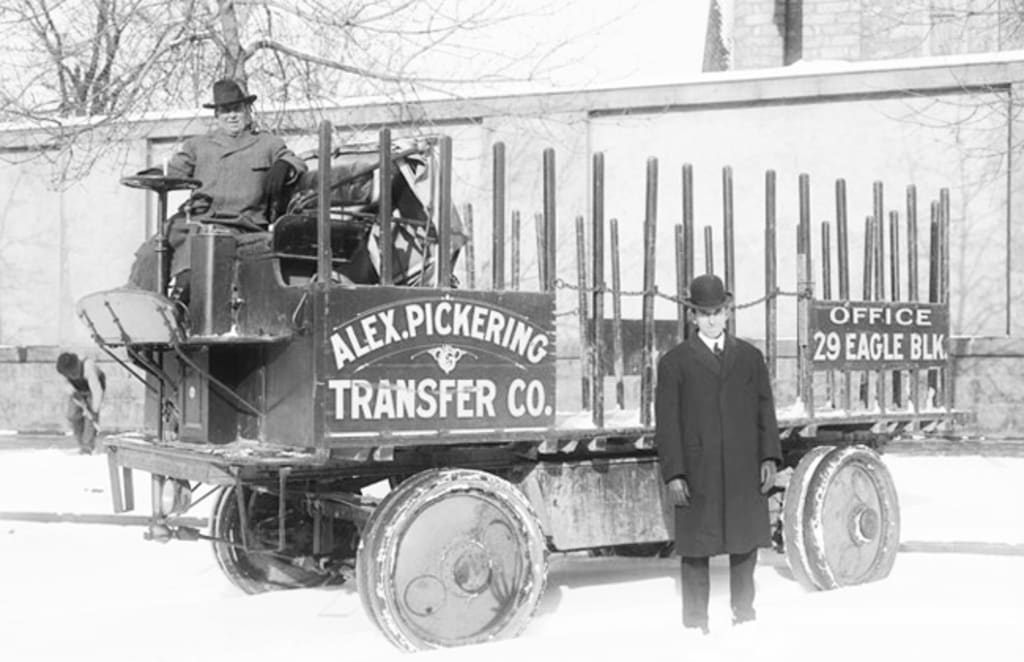
Two horses stood snorting in of front the house on Maple Hill, their breath misting in the cold January air. The wagon behind them was piled high with furniture, trunks of clothes and the other sundry belongings of the house’s occupants. The door opened and two men in coveralls and thick winter coats came out. They were carrying a heavy chest of drawers and sweating profusely, despite the freezing temperature. They picked their way carefully across the bare snow covered yard from the house to where the freight wagon stood weighed down with furniture. Their hobnail boots skidded on patches of ice hidden under the snow several times.
The door opened again and Nahum emerged. He had been taking one last turn through the house, checking in the corners and behind closet doors, making sure that nothing had been left behind. Fannie, cradling their three-month-old son in the crook of her arm, lingered just inside the open doorway, savouring the warmth of the house as her husband crossed the yard to where the movers were loading and tying down the last of the Goddards’ possessions into the back of the wagon.
The movers paused as they watched Nahum approach. They tipped their caps and said, “Good morning, Mr. Goddard.”
Nahum nodded and said, “Good morning,” in return. He thrust a gloved hand into the inside pocket of his winter coat and handed each of the men a five-dollar bill. “This is the last load,” he said, gesturing the contents under the tarp in the wagon bed. “You can take this along to the train station, and my wife and son and I will follow you shortly.” Nahum produced several more dollar bills from within his bill fold and handed them to the two movers, “Get some porters to help you unload all of this when you get there.”
They nodded in understanding and clambered up on the driver’s seat behind the horses. The reigns snapped and the horses leaned into their traces. The horses snorted and their breath frosted in front of them in an icy white cloud as their hooves clopped loudly on the frozen ground. The heavy wagon rounded a bend in the road and disappeared.
No sooner had the movers and the wagon disappeared, than a carriage with a driver appeared. The carriage rolled to a stop.
“Good morning,” the driver called. He fished in his pocket for a scrap of paper. “Is this the Goddard residence?”
Nahum nodded. “Yes. Please excuse me while I fetch my wife and son.” He turned and, crossing the yard, went back into the house. A second or two later, he re-emerged with Fannie and the baby in tow. The driver clambered down from his perch and held the carriage door while Fannie carefully climbed inside, balancing the baby in her arms. Nahum followed and shut the door. The interior was worn and smelled musty. Nahum took the seat opposite his wife and infant son. He rapped on the roof of the carriage and it lurched into motion.
The carriage ride from the house to the train station took half an hour. The train station faced onto Washington Square in downtown Worchester. A tall clocktower built of Tennessee granite thrust upward into the clear winter sky. The clock was striking eleven with a deep, sonorous BONG-BONG-BONG. The roof line of the station’s train shed rose to a peak above the grey limestone façade of the ticket hall. The carriage lurched to a stop under the portico at the far end of the station, in front of a set of double doors inset with etched glass and brightly polished brass door handles. “UNION STATION” was carved into the granite lintel over the door.
The driver clambered down from his perch and helped Fannie out of the carriage. Nahum paid and tipped him. The driver nodded his thanks and clambered back up onto the driver’s seat before snapping the reigns and rumbling off. The ticket hall was a large echoing room. A circular counter made of varnished oak with a highly polished marble top dominated the middle of the space. Half a dozen ticket agents stood at the counter and about a dozen people were milling about.
Nahum glanced at the clock over the the double doors leading to the platforms. It was just pas eleven-thirty in the morning. He extracted his pocket watch from his vest pocket and examined it. It was running a couple of minutes slow. He would have to wind it later. He turned to Fannie. “Darling, why don’t you take the baby and sit down while I see to the tickets.”
Fannie nodded and turned toward the wooden benches that dominated the far half of the ticket hall. The ticket agent, a young man in his early twenties with sideburns and neatly parted hair turned toward Nahum.
“May I help you, sir?” he asked.
Nahum nodded. “Yes, I have a reservation for a compartment for myself, my wife and my son on the twelve-thirty train to Boston. I’m here to collect my tickets.”
After taking his name, the ticket agent bent down, opened a drawer under the counter and rifled through it. “Goddard-ah-here.” He shut the drawer and straightened up, holding a sheaf of train tickets in his hand. “Here are your tickets, Mr. Goddard,” he said. “You are in car number six-eight-four, compartment C. Your tickets also indicate that you have engaged an express boxcar. Is that correct?”
Nahum nodded. “Yes,” he said. “I would like to ensure that my belongings have been loaded according to my wishes. Can you arrange this for me?”
The ticket agent nodded. “Yes, Mr. Goddard. Please wait a moment.” He turned and whispered something to one of the other ticket agents, who excused himself and immediately rushed off. He returned several minutes later with one of the station porters in tow.
The porter set off with Nahum following behind. They crossed the ticket hall toward the etched glass doors leading to the train shed and the platforms. The porter held the door open as Nahum stepped on the station platform. The smell of creosote and coal smoke hung in the air. Winter sunlight illuminated the train shed through a series of skylights that were covered in soot from the trains that arrived and departed the station daily. The porter gestured to the far end of the platform, where a locomotive sat belching steam into the air. Behind the tender and in front of the mail car, a boxcar stood with its door slid open. Trunks, packing cases and furniture stood scatted here and there on the platform next to it. The two movers from the house grunted in unison as they lifted a heavy steamer trunk into the open car.
Nahum thanked the porter and then followed them inside the boxcar. The only light inn the car’s interior was the daylight that spilled in through the open door.
The footsteps of the three men were loud in the confined space. One end of the boxcar was filled with shelves ladened with parcels wrapped in brown paper and tied with string. Items too large to fit on the shelves were stacked neatly on the floor. Everything was piled according to its eventual destination. The other end of the car was filled with a wide of assortment various large and otherwise ungainly objects. Everything was packed in tightly. Here and there among the organized clutter, Nahum could make out the familiar shape of a tall chest of drawers that had belonged to Fannie and had been located in the bedroom at the end of the hall where she had given birth. A heavy blanket covered it.
Nahum nodded approvingly. “Yes,” he said. “This looks quite satisfactory.” He turned and exited the boxcar, stepping back on to the station platform. With the porter in tow, Nahum walked briskly back into the ticket hall, the soles smacking against the terrazzo floor. He walked back over to the large circular ticket counter in the middle of the hall. The ticket agent Nahum had spoken to earlier detached himself from another passenger and made a beeline for where Nahum stood at the counter, a sheaf of train tickets in his hand.
“Mr. Goddard,” he said, “I trust everything is to your satisfaction?”
Nahum nodded. “Yes. Everything looks to be quite acceptable.”
“Good,” replied the ticket agent. “That will be $50.00.”
“Oh, yes of course,” replied Nahum. He reached into his coat pocket, pulled out his billfold again and produced that requisite fifty dollars, which he handed to ticket agent, who counted out counted out the bills and slid the tickets across the counter toward Nahum. Nahum picked up the tickets, inspected them and tucked them into his pocket and went to join Fannie and the baby.
About the Creator
Terry Long
I am a perpetually emerging writer on the neurodiversity spectrum with a life long interest in the space program. I live north of Toronto, with my dog Lily. I collect and build Lego kits as a hobby.
Keep reading
More stories from Terry Long and writers in Chapters and other communities.
To Slip the Surly Bonds
October 5, 1882 Worchester, Massachusetts “Push, Mrs. Goddard, push!” said Dr. Dunwood. Fannie Louise Goddard lay on her bed, her night clothes drawn up above her waist, exposing her distended abdomen. Her face wore a thin sheen of perspiration. It was twisted into a grimace as she breathed in and out rapidly. Her legs were spread apart in front of her.
By Terry Long11 months ago in Chapters
Iran vs Israel War: What Options Does Iran Have After US-Israeli Airstrikes Weaken Its Military?
what options does Iran have in this war, and what strategy is it pursuing? Depleting Resources Dr. H.A. Hellyer, a Middle East security expert at the Royal United Services Institute (RUSI) in the United Kingdom, says Iran’s current military approach is not to defeat the United States or Israel in a conventional war, but to make any conflict long, region-wide, and economically costly.
By Real content7 days ago in Chapters


Comments
There are no comments for this story
Be the first to respond and start the conversation.