
Theory of Proxemics.
By American Anthropologist Edward T. Hall.

Edward T. Hall an American anthropologist represented his theory of proxemics in year 1966. While teaching at the Illinois Institute of Technology in Chicago, Hall introduced proxemics to designate “the interrelated observations and theories of man’s use of space as a specialized elaboration of culture". Hall believes spaces speak to us as loud as words. He believes the concept of American linguist Benjamin Lee Whorf the concept is the linguistic relativity hypothesis in this concept Whorf states that the language we speak influences the way we think about reality or our thoughts upon reality. We think that we are doing everything right but according to our culture, we don't notice unusual unless outsiders mention or point out the unusual. The anthropological adage goes like " We don't know who discovered water but we are pretty sure that wasn't the fish." It always takes an outsider to notice, once an American asked an Indonesian about the Balinese funeral the tradition of placing fresh fruits on the grave, " When will your aunt come out of her grave to eat the fruits" Indonesian replied, "At the same time when your uncle comes up to smell the flowers". A person who lives in America will not find it unusual to place flowers on the graves and similarly, a person who lives in Indonesia will not find it unusual to place fruits on the graves. It always takes an outsider to notice.
Hall states that our culture defines and influences our outlook on life in Arad, Asia, and Southern Europe there is a "contact" culture, they don't feel it unusual to touch while meeting someone even if the person is unknown to them, like a handshake or hug they don't feel it unusual but in America, there is a "noncontact" culture and they feel it unusual to touch while meeting, not in close friends and relatives but in meeting someone new or unknown because that is not their culture. Americans feel an aversion to casual touch and intrusion in life. The young generation of every nationality all around the world also feels an aversion to intrusion in life.
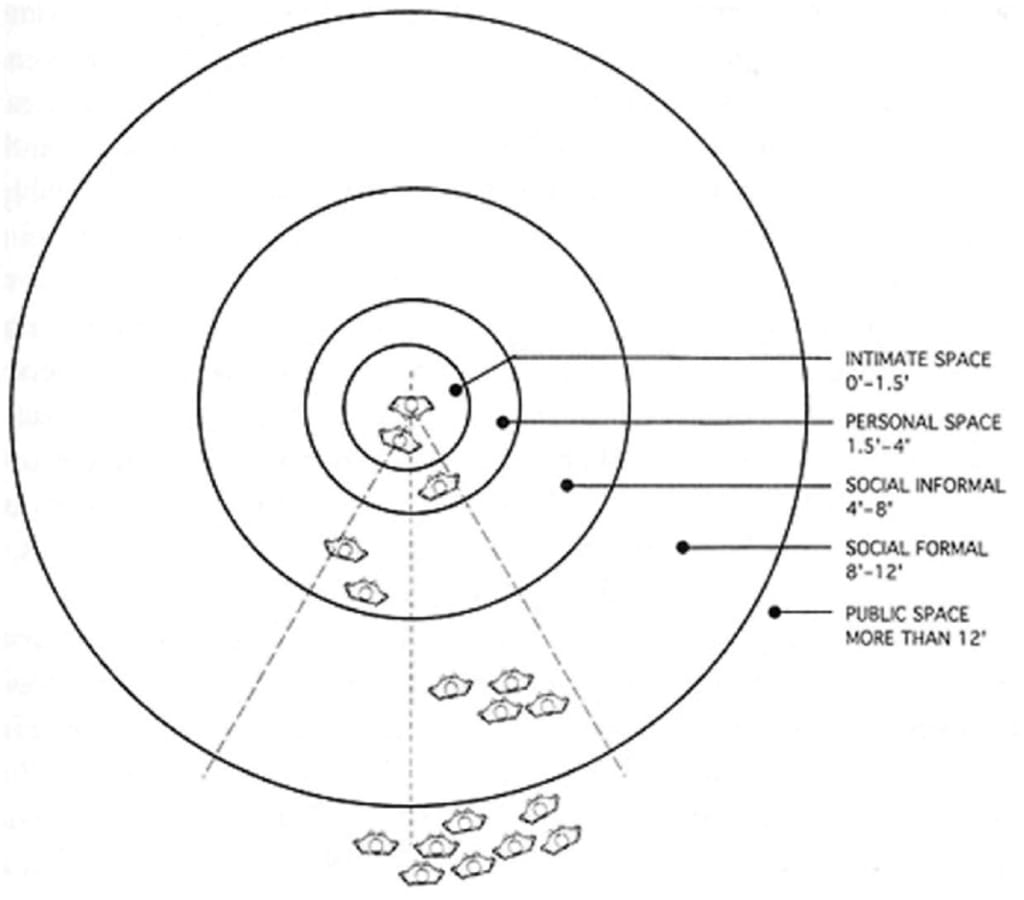
Hall only described American proxemics through his theory of proxemics, he divided the human distance into four parts, the first and closest distance is the intimate distance which our family includes, such as our siblings, parents, children, and spouse. The second distance is the personal distance in which our relatives, cousins, and close friends who know us personally. The third distance is the social distance in which our classmates, friends, colleagues, teachers, or students who just know us socially and don't know us personally, it can also defined as formal distance. Fourth distance is public distance in this distance strangers include the people we interact with as strangers no matter whether routinely, usually, rarely, or once in a lifetime.
The distances or proxemics of humans are based on culture, stereotypes, beliefs, and many more factors like surroundings, upbringing, and many more. Societal norms are the main things that shape our proxemics and proxemic behavior. People who belong to different families, schools, cities, and countries have differences in their proxemic behavior. Sometimes it is the culture, religion, and generation we belong to. Sometimes it is our fairs, traumas, experiences, and situations we are in and we are feeling. Sometimes it depends upon our mood if we are happy and confident person we will be friendly and participate, if we are in a bad mood then we compose ourselves and start avoiding interactions no matter if they are interpersonal or public.
I will not oppose this theory because this is a fact but I want to add something else that Edward T. Hall missed totally in his theory of proxemics, he missed a major factor which is beliefs, beliefs that shape our distances, nature, and sentiments. People can kill and be killed on a single factor which is beliefs, beliefs help people to stay united and close to each other even more than a family, we can take examples from history and present times, in the era of Esa Ibn-e-Maryam ( Jesus Christ in the Bible) his believers were ready to do anything to protect their beliefs. This can also be taken from the example of Prophet Muhammad (PBUH) his believers and he was ready to die to protect their beliefs. In present times, this can be seen by the actions of a country's army and protestors, the army believes that they are the backbone of the country and they must save it and work for it because without them a country is nothing that is the reason why they all are ready to sacrifice their lives for the sake of their nation, they all become closer than a family and protect each other, give their lives for each other, what brings them closer? What makes them to sacrifice their lives? That is all belief. Their beliefs make them do this all.
His theory is perfect for atheists but for beleivers, this is not complete.
In anthropology and psychology, we study proxemics extensively. This research by Edward T. Hall holds significant importance we can understand it as poetry when reading poetry we don't know in which situation the poet was in when he wrote that poem or verse but every person around the world can take the meaning of that verse or poem according to their situation. Poets never disappoint readers because everyone can relate to the poetry despite in which situation the poet wrote that. This is the beauty of proxemics and poetry. The theory of proxemics given by Edward T. Hall highlights this point of poetry and this is what attracted me the most to write about it.
About the Creator
Zainab Noor.
Writing Services Below:
Contra profile link: https://contra.com/zainab_noor_i3lzpuz1?utm_campaign=social_sharing&utm_medium=independent_share&utm_source=copy_link
Upwork profile link: https://www.upwork.com/freelancers/~01e97cf98ed1445d9e
Keep reading
More stories from Zainab Noor. and writers in Chapters and other communities.
Donald Trump — Power, Politics, and a Divided Nation
Donald John Trump is one of the most recognizable and polarizing figures in modern American history. Known first as a businessman and television personality, he later became the 45th and 47th President of the United States. His life story is filled with ambition, success, controversy, and constant public attention. Whether admired or criticized, Trump’s influence on politics and media is undeniable.
By Haroon Pasha5 days ago in Chapters
Pearl
1980 something. we all hung out at Pearl and you and i were nothing special, or so i thought. i mean we all danced, drenched in our own sweat, our own saline solution of fear, too many beers, shots, laughter, tears, fucks in the bathroom and i don't know when we began to be afraid. do you?
By ROCK aka Andrea Polla (Simmons)4 days ago in Fiction



Comments
There are no comments for this story
Be the first to respond and start the conversation.