
The Weight of a Future I Never Chose
It is my story.
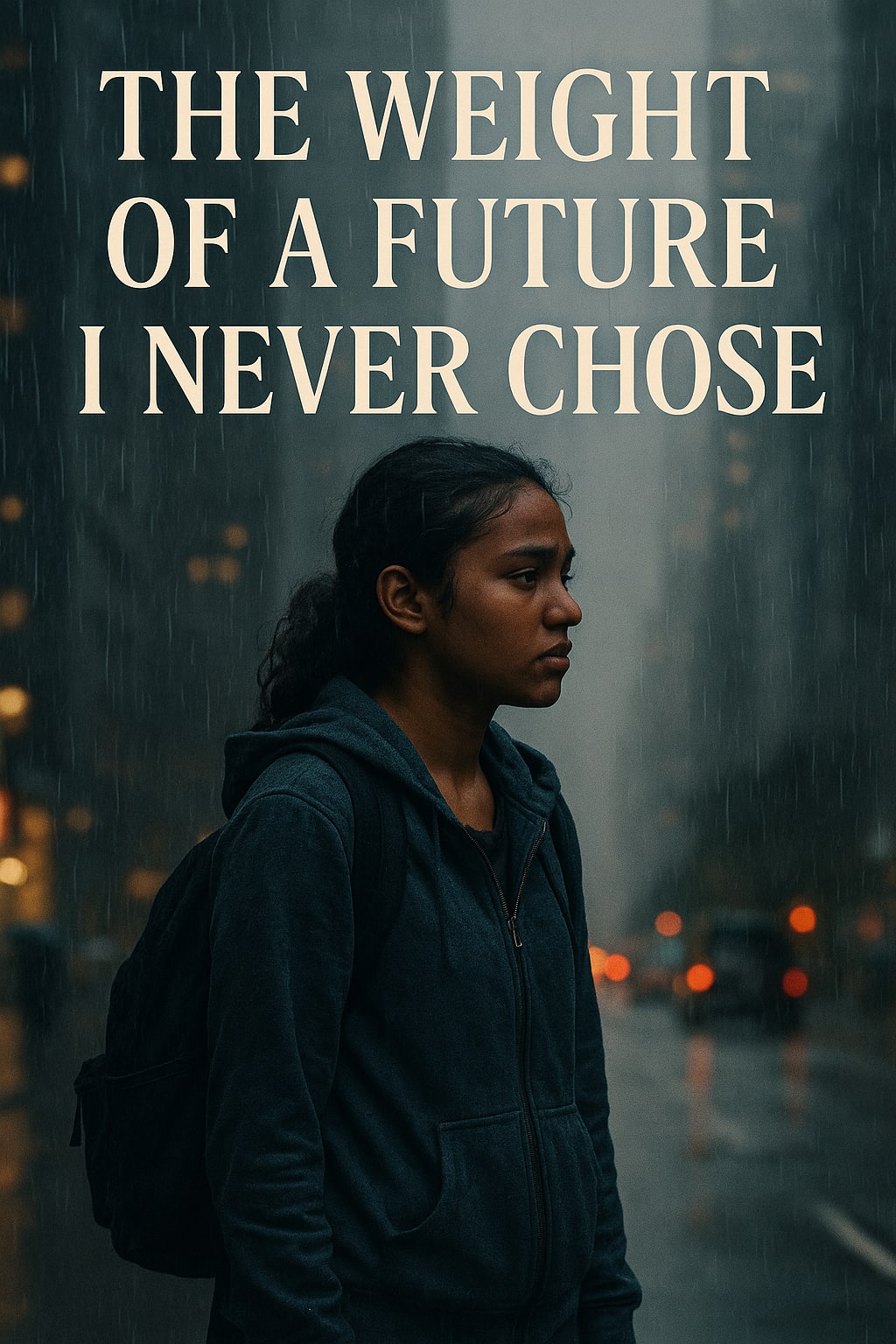
CHAPTER ONE — The House That Never Wanted Me
I can’t obviously remember the day I was born, but I remember the story they told me about it—
that the room fell silent when I arrived,
that my father’s face tightened,
that my mother looked away,
and that no one said welcome.
I grew up feeling like I had entered the world on the wrong foot,
as if my very existence was an inconvenience people were forced to tolerate.
In our house, my name was never spoken with softness.
If anything, it was spoken like a warning—
a reminder that I was the child who shouldn’t have been a girl.
My father never allowed me to forget that.
His disappointment lived in the air, in the walls, in the way his footsteps made me freeze.
I learned to read the shift in his breathing the way other children learned to read bedtime stories.
I knew which inhale meant shouting,
which sigh meant a slap,
The type of silence that meant danger.
He had a way of looking at me as though I had robbed him of something.
Not money, not pride—
something deeper, something he believed he deserved just by being a man.
“Girls bring nothing but trouble,” he used to say.
Sometimes to my mother.
Sometimes to no one in particular.
Mostly to me.
I was nine when he first hit me so hard I couldn’t breathe.
I accidentally broke the glass frame on the table. It was expensive, I guess
That was all it took.
something inside him shattered with the glass.
I remember his fingers digging into my arm,
the hard thud of my body hitting the ground,
The burning on my cheek as he started slapping me at first,
But I was in shock when the first kick landed, as he kicked me in the ribs again and again. There was no hesitation, no shock on his face—
just a rage he had kept ready for the first excuse to unleash it.
That night, I learned something children shouldn’t have to learn:
Pain can be so loud that it silences you.
I didn’t cry.
Not because I was brave—
But because crying made things worse.
Crying meant more shouting, more accusations,
more proof that I was “too emotional,”
which in my father’s vocabulary meant “weak.”
My mother would stand in the doorway,
her eyes empty, her hands stiff at her sides.
Sometimes she would yell at him to stop.
Sometimes she would yell at me to stop making him angry.
Most of the time, she walked away.
The house taught me early that love was conditional
and safety was a privilege reserved for boys.
My younger brother— oh, he lived in a different universe entirely.
Brand-new clothes, new toys, attention, affection…
the things I never even learned how to desire.
If he cried, the whole house trembled to comfort him.
If I cried, I was told to be quiet before I ruined the mood.
I grew up in the shadow of someone else’s worth.
School wasn’t much different.
I walked through hallways with a torn backpack,
the same one I’d carried for years,
the fabric frayed like the edges of my patience.
Children laughed at it.
They laughed at me.
“Poor girl,” they whispered.
“Look at her clothes.”
“Her parents must hate her.”
They weren’t wrong.
But they never understood that poverty wasn’t the worst part—
being unwanted was.
At night, when the house finally slept,
my parents locked their bedroom door.
Sometimes they locked the living room door too.
I wasn’t sure which was worse—
being shut out or being inside.
I used to sit in the dark hallway, sleep on the makeshift bed on the floor,
my knees pulled to my chest,
listening to the distant sounds of a family that did not include me.
The light from under their door was the only proof they existed.
I was eleven when I realized no one was coming to save me.
No teacher, no relative, no neighbor.
And certainly not my mother and father.
There is a particular loneliness that belongs only to unwanted children.
A loneliness so deep, it becomes the air you breathe,
the language you think in,
the skin you wear.
I didn’t know it then, but the girl curled up in that hallway
would one day become a woman who could stand in the ruins of her past
and still find a way to walk forward.
But back then…
I was just a child,
trying to stay small enough not to be noticed
and strong enough to survive another day in a house that never wanted me.
CHAPTER TWO — The Only Place I Ever Felt Safe
I didn’t grow up surrounded by softness.
Affection was not a language spoken in our home, and kindness was a currency no one spent on me.
But there was one person—
one fragile, fading human light—
who made the world feel less hostile,
less sharp around the edges.
My grandfather.
He wasn’t a hero.
He wasn’t powerful or loud or intimidating.
In fact, by the time I was old enough to remember him, his body had already begun to betray him.
His hands trembled, his voice was thin, and the lines of age were carved deep into his skin.
But he was the only person who ever looked at me as if I was worth loving.
He didn’t say it.
He didn’t have to.
There are some people whose silence is softer than other people’s words.
When school ended each day, I would run home—not because home was a place I loved, but because his room was.
I would leave my bag by the door and walk straight to him, pushing open the old wooden door that smelled faintly of dust and medicine.
He always smiled when he saw me.
Not a wide, bright smile—
His muscles were too tired for that—
but a small, grateful curve of the lips,
a smile that said, “Someone is here for me.”
He tried to hide his embarrassment,
the shame of a once-strong man now unable to hold a spoon steady.
When he lost control of his bladder, he’d look down with watery eyes,
as if apologizing for being human.
No one else touched him.
No one else helped him.
They looked at him as if he were an inconvenience—
a stain on the perfect life they believed they deserved.
But I would take his hands,
wipe them clean,
lift his fragile body with my small arms, guide him to the bathroom, dress him, comb his hair, cut his nails.
I was only a child, but I learned tenderness long before I learned multiplication.
He never said, “thank you.” Not once.
And yet he thanked me every single day with the way he looked at me—
as if I was the only person left in his shrinking world who still remembered he existed.
Sometimes, when I fed him, tears gathered in his eyes. He’d blink them away, embarrassed. But I saw them.
He wasn’t crying because he was weak. He was crying because he was alone.
until I walked into the room. For those small pockets of time,
I felt something I would later realize was love.
Not the loud, dramatic kind.
Not the conditional, suffocating kind I saw in movies.
But a quiet, steady, grateful warmth that made me feel like maybe,
just maybe, I wasn’t a mistake.
But nothing gentle stays long in my life.
One morning, I woke up to a sound I had never heard before—
a hollow, echoing silence.
A silence that felt too deliberate.
Too heavy.
My grandfather was gone.
His bed was empty.
His blanket was folded.
And the house…
The house hasn’t changed.
No one cried.
No one mourned.
No one spoke his name.
Life continued as if life hadn’t just ended.
But something in me broke open that day—
a small, hidden truth.
If love was a garden,
He had been the only flower in the wasteland of my childhood.
And now even that single flower has been uprooted.
My mother’s grief did not soften her.
It hardened her.
Turned her sharp.
She lashed out at the world,
at herself,
and most of all—
at me.
The beatings grew harsher.
The yelling is more venomous.
The house felt darker.
Where there had once been one fragile beam of sunlight,
now there was only the shadow of what had been.
My grandfather was the only person who ever held space for me.
His death wasn’t just the end of his life—
It was the end of my childhood.
After he left, I learned a new truth:
Sometimes the person who saves you doesn’t stay.
Sometimes they just hand you the memory of gentleness
so that one day, you can recognize it again.
I have spent years trying to keep that small memory alive— the trembling smile, soft eyes, the way he made me feel like I wasn’t invisible.
And even now,
I carry the warmth of his room in the darkest parts of myself.
He was the one place I ever felt safe.
And losing him was the first time I understood
that the universe can take away even the little it gives—
especially from girls like me.
CHAPTER THREE — The Betrayal at Sixteen
I was sixteen when I learned that betrayal doesn’t always come from enemies.
Sometimes it comes from the people you trust so deeply that it never occurs to you to guard yourself against them.
He wasn’t a stranger. He wasn’t a shadow lurking outside. He was family or at least that’s what everyone kept calling him.
A “big brother,” In our culture, we address the husband of a cousin or sister as brother, they said.
Someone I should respect. Someone I should trust. And I did.
I trusted him in the way only a lonely child can trust—
with blind faith, with open hands, with no idea that some people speak gently only to get close enough to hurt you.
At first, everything felt harmless.
He joked with me.
He listened when I talked about school.
He made me feel seen in a world where everyone else looked past me.
But something changed.
It was subtle at first—
a look held too long,
a question that felt too personal,
a silence that pressed too close to my skin.
I tried to ignore it,
because girls like me are trained to doubt our instincts long before we learn to defend them.
But then came the moment when his words slipped out of the familiarity I knew
and into something twisted,
something wrong,
something that turned my stomach cold.
I remember the room around us—
the dim light,
the quiet hum of an evening that should have been ordinary.
And then his voice,
so casually,
so confidently,
saying things no grown man should ever say to a sixteen-year-old girl.
He was 32 at that time and married to my cousin.
I froze. Not because I didn’t understand— but because I understood too clearly.
Because the mask he’d been wearing slid off with such ease
that I realized it had always been a mask.
My heart was pounding so loudly I could barely hear him anymore.
I felt suddenly trapped in a room I had been standing in my whole life,
but never truly seen.
I realised he was getting closer to me, but I had lost all my power due to the shock
When I finally found the courage to leave, my hands were shaking. My thoughts were shaking.
My whole sense of safety was shaken. But what came after was worse.
I thought someone—anyone—would protect me when they found out what he had said or what he tried to do.
I thought adults would step in. I thought family would understand.
But no one cared about what happened. They cared about who it happened to. And it happened to me—
a girl they already believed was the root of every inconvenience.
Instead of comfort,
I got accusations.
“Why were you talking to him that much?”
“Did you smile too much?”
“You must have encouraged him somehow.”
“Girls need to know their limits.”
“He wouldn’t say such things unless you gave him a reason.”
Suddenly, the crime was mine. it didn’t matter that I was sixteen.
It didn’t matter that he was married. It didn’t matter that I had been nothing but respectful.
The narrative was simple:
When a man misbehaves, a girl must have provoked him.
That is the first rule in the world I came from.
I watched adults gather around him with sympathy.
I watched women look at me with disgust.
I watched people who had never protected me
stand up to protect his reputation.
While I was still trying to understand what had happened, the verdict had already been made:
I was guilty.
I was guilty of being too friendly.
Guilty of being naïve.
Guilty of existing in the wrong place at the wrong time.
Guilty of being a girl.
No one asked me if I was scared.
No one asked me if I was okay.
No one asked what he said.
They didn’t want the truth.
They wanted a scapegoat.
And in families like mine,
The scapegoat is always the daughter.
That was the moment something inside me cracked—
not loudly,
not dramatically,
but quietly, like a bone breaking in the dark.
I realized then that danger does not always come from the outside.
Sometimes it comes from the people who walk freely through your door,
sit at your table,
speak your language,
and smile at your mother.
Sometimes the knife is hidden in a familiar hand.
What he did to me was terrible— but what everyone else did afterward
was unforgivable.
They didn’t just silence me.
They erased me.
They folded my trauma into a story that blamed me
and excused him
and called the whole thing a misunderstanding.
But it wasn’t a misunderstanding.
It was a betrayal.
And not just by him—
by an entire community that saw my youth as guilt, my fear as weakness, and my truth as an inconvenience.
I was sixteen when I learned that being right means nothing if the world has already chosen to believe you are wrong.
And that was the year they sent me away.
Not to heal me.
Not to protect me.
Not because they believed in my future.
But because they wanted my silence
to be someone else’s responsibility.
CHAPTER FOUR — The Day They Decided My Life Without Me
The decision was made in a whisper I wasn’t meant to hear.
I was passing by the living room when I heard my father’s voice,
low and sharp, like he was slicing the air with it.
“She can’t stay here anymore. She’s causing too many problems.”
Too many problems.
That was the phrase they used about a sixteen-year-old girl who had done nothing but exists in a world that hates the shape she came in.
My mother murmured something back, something about shame, something about neighbors talking, something about me not “acting like a good girl.”
Good girl.
I had heard those words all my life,
yet no one had ever explained what they meant.
Maybe because in my family,
“good” meant silent.
Invisible.
Blameless for the sins committed against you.
I stood behind the door,
listening to adults decide my fate as if they were ordering furniture.
“She’s going abroad,” my father declared.
Firm. Final.
A verdict without a trial.
They didn’t open the door and ask me.
They didn’t sit me down and explain.
They didn’t consider what I wanted,
what I feared,
or what was happening inside my chest.
I was simply a girl.
And in the world I came from, girls are sent away the same way unwanted letters are returned to the sender.
________________________________________
When they told me, days later,
they said it like they were doing me a favor.
“You’ll study there,”
“You’ll have a better life,”
“You won’t cause more issues for the family.”
But I saw the truth in their eyes.
This wasn’t about my future.
It was about burying the embarrassment they felt because a man had crossed a line and it was easier to blame me than to confront him.
In our culture,
protecting a girl is optional.
Protecting a man’s reputation is mandatory.
They spoke about Turkey as if it were salvation.
A new beginning, they claimed.
An opportunity.
But how do you start a new life when no one ever let you finish the old one?
________________________________________
The night before my flight,
I didn’t sleep.
I sat in my room packing clothes I barely had,
folding them carefully as if neatness could control the chaos of being exiled from my own home.
My brother slept peacefully in the next room,
wrapped in comfort I had never touched.
My parents moved around the house,
not grieving,
not relieved,
just… neutral.
As if sending me away after sixteen years of surviving under their roof
was the most ordinary thing in the world.
At dawn, my father opened the door.
“Get ready,” he said.
Not unkindly—
but not kindly, either.
Just… a command.
There was no hug.
No blessing.
No apology.
Not even a look long enough to acknowledge that I was his child.
On the car ride to the airport,
I watched the city blur past the window.
It felt like my reflection was fading with it.
Who was I without this place?
without this pain, without this identity, they had crushed into me for so long?
When the plane took off,
my chest tightened—
not because I was leaving home, but because I had never truly had one.
I wasn’t flying toward a future.
I was fleeing a past that refused to claim me.
________________________________________
When I landed in Turkey, the air felt unfamiliar, the sunlight sharper, the noise louder.
For the first time in my life, no one here knew my name.
No one knew what had been done to me.
No one knew the girl who had been blamed for her own wounds.
And in that anonymity,
there was fear—
but also a thin thread of freedom.
I was alone,
but I was finally mine.
And yet, as I stepped into that foreign airport,
one truth clung to me like a shadow:
I hadn’t been sent away to grow.
I had been sent away to disappear.
CHAPTER FIVE — The House That Wasn’t a Home (Continued)
So I did the one thing I had always been punished for doing:
I chose myself.
I packed my bag in silence, my hands trembling, not from fear,
but from the strange thrill of disobedience.
The thrill of deciding that no one—not even well-meaning strangers—
would write my story for me again.
When I stepped into the hallway with my bag slung over my shoulder, the woman who brought me there blocked the door.
“Where are you going?” she asked.
Her voice wasn’t angry.
It was worse— it was disappointed, as if I had failed a test I never agreed to take.
“To the dormitory,” I said.
“To the university. To where I was supposed to be.”
She shook her head slowly,
her expression soft but firm.
“You don’t understand this country yet. You don’t understand the dangers.
Girls like you… You need guidance.”
Girls like me.
Girls without families.
Girls without protection.
Girls who didn’t know the rules and therefore had to be controlled.
“I will take my chances,” I replied.
She studied me for a long moment.
Something flickered behind her eyes—
not anger,
not fear,
but recognition.
Like she had once been me,
and had chosen differently.
She stepped aside.
“Very well,” she said quietly.
“Go. But the world is not kind to girls alone.”
I knew that already.
What she didn’t understand was this:
The world had never been kind to me when I wasn’t alone, either.
I walked out of that apartment and didn’t look back.
________________________________________
CHAPTER SIX — How to Survive With Almost Nothing
Freedom, I quickly learned, is expensive.
And I had arrived in Turkey with almost nothing:
A suitcase with a few clothes.
A bit of money saved from my childhood.
A scholarship that covered tuition and nothing more.
And a family who had made it clear
that I was no longer their responsibility.
I found a temporary room—
small, cold, barely furnished— but it was mine.
The first night, I sat on the mattress on the floor
and realized something absurd:
For the first time in my life,
no one could hit me.
No one could scream at me.
No one could tell me who to be.
It was quiet.
Lonely.
Terrifying.
But it was mine.
Days passed.
My money thinned like breath on a winter morning.
I learned quickly that hunger was a patient enemy— it didn’t strike suddenly. it crept.
Some days I ate nothing but bread. Other days,I rationed tea like it was medicine.
But I refused to ask anyone back home for help.
I would starve before I gave them the satisfaction.
Then one afternoon, everything shifted.
A neighbor mentioned a family looking for a tutor for their son.
I didn’t think anyone would trust me to teach— but they did.
I earned my first money in Turkey that day.
It wasn’t much,
but when the notes touched my palm,
I felt something startling:
pride.
The world had tried to break me for sixteen years,
and yet here I was—
feeding myself with the knowledge I had fought to learn
despite everyone who tried to keep me small.
Soon, more students came.
One turned into two, two into five.
I built myself
one hour of tutoring at a time.
I was surviving.
Barely.
But surviving nonetheless.
________________________________________
CHAPTER SEVEN — The Friends Who Were Never Really Friends
University was supposed to be a fresh start. When I saw films about teens going to college, it felt like a dream. Having friends, going to parties.
I thought it was a chance to reinvent myself, to be someone who wasn’t defined by pain.
But trauma has a scent.
People who want to use you can smell it like perfume.
The first girl I befriended was warm, funny, and energetic. She acted like she wanted to protect me— but what she actually wanted was a shadow to stand in so she could shine brighter.
She borrowed my things without asking. Used my notes. Took credit for my work. Talked behind my back the moment I wasn’t convenient anymore.
The second was worse. She wanted my attention, my emotional labor, my time— as long as her world was falling apart.
But when mine did, she disappeared.
I realized something nobody warns you about:
People can be cruel even when they aren’t hitting you. They can drain you, take from you,
manipulate your kindness, and leave you emptier than before.
Trust, for me, became a fragile thing— something I held with both hands
and still feared dropping.
________________________________________
CHAPTER EIGHT — Numb Is a Kind of Survival
There came a point when my heart simply… shut down.
Not because I wanted it to, but because it had to.
You can only feel so much before your body decides feeling is a luxury.
So I stopped letting things in. Compliments didn’t touch me. Insults didn’t sting. Friendship didn’t comfort.
Love—when it appeared—felt like a language I had never learned. But unfortunately, when you don't know the language, you can't understand how to define right or wrong in a relationship. When it ended, I was drained . He betrayed me in the worst way possible. When I tried to break up, he called my father to tell me about our relationship, as if he could force me to stay in the relationship if my reputation was ruined. I got out, but something inside me I left behind.
I moved through life like someone underwater, watching everything through a muted filter.
People called me strong. They admired my independence.
They saw confidence in my silence. But I wasn’t strong. I was numb.
And numbness, I realized, is just survival disguised as stability.
CHAPTER TEN — The Weight of a Future I Never Chose
Mornings in Ankara never felt like beginnings to me.
They felt like reminders—
that I hadn’t slept enough,
that the day would be long,
and that I was already behind before I even left my bed.
I used to step out of the dorm just as the sun rose, its light brushing the tops of buildings that didn’t belong to me.
Students walked in small groups, laughing, exchanging notes, sharing a life I was never invited into.
I walked alone, always alone, with a backpack too heavy for my small shoulders, carrying books I barely understood and exhaustion that had settled into my bones like a second skeleton.
Campus looked beautiful from far away—
historical buildings, modern labs, coffee shops humming with energy— but once you stepped inside as a foreigner,
the warmth disappeared.
My first classes were always in the morning.
I chose them on purpose, so I could work in the evenings.
It was a survival strategy, not a study plan.
While others went home to nap or drink coffee,
I rushed to my job,
smiling at strangers while something inside me collapsed hour by hour.
But the real collapse began inside the classroom.
Most of the professors spoke English only when they remembered there were foreigners in the room.
The rest of the time, Turkish poured out—fast, casual, effortless—
and the class followed,
and I sat there drowning silently.
Sometimes I caught a professor glancing at me,
as if reminding himself I existed, then continuing in Turkish anyway.
Sometimes it felt deliberate—
not out of cruelty, but out of indifference. Being invisible hurts in a special way.
But being visible only as an outsider hurts even more.
The local students rarely spoke to me.
When they did, it was with that polite-but-not-really tone,
like they were doing charity.
“She’s here because of the quota,
I once heard a boy whisper behind me.
Another girl added, “Third-world kids come here and make it hard for us to get in.”
Their words were knives, but the worst part was how they didn’t even bother lowering their voices.
I wanted to turn around and scream, “I didn’t take your place. I took my life and ran, that’s what I did.”
But the words died in my throat. They always did.
No one ever told me that studying in a foreign country could feel like trespassing.
________________________________________
At night, after my shift at work, I returned to the dorm with aching feet and a mind too tired to think.
I would open my textbook, stare at the pages,
and understand absolutely nothing.
Numbers.
Symbols.
Formulas.
They were like ghosts—passing through me without leaving a trace.
Back home, in high school, we had to choose a stream:
science, commerce, or arts.
I chose commerce.
Not because I wanted to,
but because that’s where life pushed me.
I never saw a physics problem.
I never studied chemistry.
I barely touched mathematics beyond the basics.
And yet here I was,
in a department built on everything I had never learned.
Binary.
Logic gates.
Algorithms.
Linear algebra.
Physics
Calculus
I remember sitting in a lecture hall one day,
surrounded by students who understood every word
while I struggled to make sense of even one sentence.
The professor wrote something on the board—
It was a basic Limit problem
He turned to us and said,
“You should know this already.”
His eyes paused on me.
As if I had done something wrong by existing.
As if not knowing made me defective.
Heat rushed up my face.
My hands trembled under the desk.
Shame is a silent scream;
no one hears it, but it rings inside your skull for days.
I wanted to disappear.
I wanted the floor to swallow me before anyone noticed the tears burning behind my eyes.
But I stayed.
God knows why.
Maybe because I had nowhere else to go.
________________________________________
The truth came to me slowly,
like a bruise revealing its colors over time.
This wasn’t my dream.
It wasn’t even my path.
It was my father’s command—
a decision thrown at me when I was too young to defend myself.
“You will study computer science,” he had said.
“And then you will teach. That is your future.”
As if my life were a project he could assign me.
As if my choices didn’t matter. As if I wasn’t a person at all— just a daughter carrying out orders.
I may have left my country, but I hadn’t escaped him. His voice lived in my mind, steering me into a life I never chose,
binding me to a future that didn’t belong to me.
There is a particular kind of grief that comes not from losing something— but from realizing you never had a choice to begin with.
________________________________________
One evening,
I returned from work and fell onto my bed fully clothed.
The city outside buzzed with life, cars, and footsteps echoing through the window.
I felt nothing.
No hope.
No drive.
Not even sadness—
just a heavy, suffocating emptiness.
I remember thinking:
If I stopped showing up, would anyone notice?
If I disappeared,
would anyone come looking?
The answer was obvious.
And somehow,
that hurt less than everything else.
________________________________________
But later that night,
as I lay awake listening to the quiet hum of the dormitory, a small voice inside me stirred.
It wasn’t loud.
It wasn’t dramatic.
But it was mine.
“Keep going,” it whispered.
“Not for them.
Not for the degree.
For you.”
For the girl who had survived too much to give up now.
For the life I hadn’t chosen,
but could still reclaim.
For the future that might one day belong to me.
That was the night I realized:
I wasn’t just fighting a university program.
I was fighting the life that had been chosen for me.
And for the first time—
I wanted to choose for myself. And if you are wondering, I did graduate from my university, and to be honest, my CGPA is not that Bad .I got into a master’s program, but that’s a story for another time.
I can’t say I am successful now, but I am in a position where I can say I am happy about something. I am pregnant, and I am happy that I will have a family of my own soon.
About the Creator
Keep reading
More stories from writers in Chapters and other communities.
Bruce Lee and The God of War: Kuan Ti
It starts with love.. The Power to the God Of War and Wealth Walk into a Chinese restaurant (even in Oklahoma, USA), a Chinese police station, a kung fu martial arts studio or even a Chinese temple and you often see a red faced warrior holding a heavy quan-do (spear like weapon).
By WILD WAYNE : The Dragon King6 days ago in Chapters
Where's the Glory?
In breaking news, rehabilitated Republican Senator Johnnie Johnson (Pronouns: HE, HIM, HIS) called a press conference from the Men’s room of the New Orleans Louis Armstrong International Airport, Concourse B, across from the Ignatius Reilly’s Lucky Dog stand. The Senator had just returned from a sexual reorientation rehabilitation program in Memphis, TN after being publically disgraced at a Buckee’s Truckstop restroom soliciting sex from an undercover cop three months ago. He is a founding member of the Reformed Christians for Christ, a conservative, pro-family and ex-gay advocacy group. In the spirit of being reborn, Senator Johnson invited reporters to marvel at his plans for a major remodeling of airport bathrooms.
By Cathy Schieffelin6 days ago in Humor
Center Stage with Gina C.
*** I'm keen to republish the interviews I did for my series with Vocal creators. It's been a few years and I thought it might be nice to revisit these wonderful conversations. I'll be releasing them one at a time for a few weeks/months.
By Heather Hubler6 days ago in Interview


Comments
There are no comments for this story
Be the first to respond and start the conversation.