
The Silent Forces Of Leadership
Psychological Principles That Make or Break Your Team.


The Human Element in Organizational Success
If you look at almost any organization from the outside, the picture seems straightforward.
There is a strategy, an organogram, a set of processes, some KPIs, and a collection of digital tools meant to keep everything under control.
We talk about “systems” and “structures” as if they are the real heart of the institution.
Yet anyone who has spent time inside a company, a government department, or a non-profit knows that the real story is much messier and much more human.
The same structure can produce very different results depending on who is in the room, how they relate to each other, and what is happening inside their minds.
The same policy can feel inspiring in one team and oppressive in another.
The same technology can either empower people or quietly exhaust them.
Underneath every chart and system, human psychology is quietly writing the script.
We are living through a time when this tension is more visible than ever. Work has changed faster in the last few decades than in many previous generations combined.
Automation and artificial intelligence are reshaping tasks, remote and hybrid work have challenged old assumptions about presence and control, and entire industries are being disrupted by new business models.
At the same time, people are asking different questions about their working lives.
Younger generations are not satisfied with a salary alone they want purpose, flexibility, growth, and respect.
Older generations, who have seen many waves of change, worry about stability, identity, and fairness.
The result is a workplace full of invisible negotiations between security and freedom, routine and creativity, efficiency and well-being.
In the middle of this, leaders are expected to deliver results. They are judged on revenue, service quality, speed, innovation, and cost. When targets are missed, the usual reaction is to adjust something visible: restructure a department, buy a new system, launch a new initiative, change the policy, rebrand the values. Sometimes these steps are necessary. But very often, they are like repainting the walls of a house while ignoring cracks in the foundation. Underperformance, conflict, low engagement, and resistance to change are rarely just “technical” problems. They are human problems, and they demand human understanding.
If you look more closely at what is happening in workplaces around the world, a few patterns appear.
Many employees are present but not truly engaged. They do their tasks, but without energy or curiosity.
They have learned to protect themselves from disappointment by not caring too much. Many teams are polite on the surface but lack deep trust difficult conversations are avoided, and truths are whispered in corridors rather than spoken in meetings.
In some organizations, innovation is praised in slogans but punished in practice, because the first person who makes a mistake is quietly sidelined. In others, stress has become so normal that people no longer recognize how exhausted they are. These are not small issues. They affect whether an organization can learn, adapt, and survive.
Psychology gives us a language and a set of tools to work with these realities instead of ignoring them.
It does not replace strategy, finance, or operations, but it connects them to the living system of human behavior that either supports or sabotages every plan. When we bring psychological insight into management, we are not turning leaders into therapists.
We are helping them become more accurate observers of behavior and more skillful designers of environments where people can do their best work.
Think of a leader as someone who is constantly designing experiences, even without realizing it.
The way they react to bad news designs how safe people feel to tell the truth. The way they handle a mistake designs whether others will take healthy risks or play it safe.
The way they organize meetings designs whether people will contribute ideas or remain silent.
All of these small moments are psychological signals. They speak to deep questions that every employee carries inside, often unconsciously
Am I respected here?
Does my work matter?
Can I grow?
Is it safe to be honest?
Do I belong?
When the answers are positive, people bring more of their energy, creativity, and loyalty.
When the answers are negative, they begin to disconnect, even if their body is still in the chair.
Over the last century, different branches of psychology have tried to understand these human dynamics from many angles.
Some focused on how behavior is shaped by rewards and consequences. Others explored how thoughts and beliefs shape our actions, or how social groups influence what we dare to say and do.
More recent work has looked at strengths, resilience, and meaning, asking not only how to fix problems but how to help people truly thrive.
The good news for leaders is that you do not need to become an expert in every theory.
What you need is a practical way to translate key insights into your daily decisions about hiring, motivating, organizing, and communicating.
This book is built around that idea.
It takes the world of psychology and walks it into the meeting room, the performance review, the strategy workshop, the factory floor, and even the informal conversations at the coffee machine. Rather than simply explaining concepts, it shows how they play out in real situations.
For example, what happens when a call center agent suddenly understands the impact of their work on real customers and their motivation rises sharply?
What changes when an organization moves from a culture of “proving yourself” to a culture of “learning and improving,” and how does that shift performance over time?
How can small adjustments in the way choices are presented in a form,
a policy, or an email gently steer people toward better decisions without force? These are not theoretical questions they are the kind of questions that decide whether your initiatives will live or die.
One of the central messages you will encounter is that leaders are, in a sense, everyday experimenters. Whether they like it or not, they are constantly testing “hypotheses” about people: If we reward this behavior, will we see more of it?
If we change this process, will people adopt it or resist it? If we frame this challenge as a threat, will the team freeze or fight? Much of this experimenting happens unconsciously. Psychology invites leaders to become more deliberate. It says: watch closely, change one variable at a time when you can, listen to feedback, and be willing to revise your approach. When you treat your organization as a living system rather than a machine, you stop expecting simple cause and effect and start paying attention to patterns.
full books about Psychological Principles That Make or Break Your Team in AMAZON KINDLE.
About the Creator
Sayed Zewayed
writer with a background in engineering. I specialize in creating insightful, practical content on tools. With over 15 years of hands-on experience in construction and a growing passion for online, I blend technical accuracy with a smooth.
Keep reading
More stories from Sayed Zewayed and writers in Chapters and other communities.
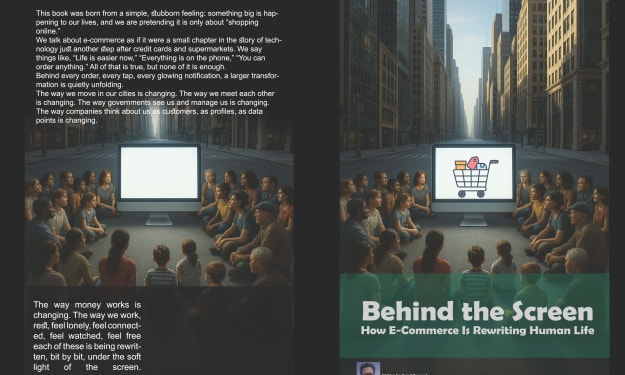
Behind the Screen: How E-Commerce Is Rewriting Human Life
You probably didn't even notice it. Maybe it was just another night. You were tired, half-asleep, your phone in hand. You opened an app without thinking, browsed through a few products, read some suspiciously similar reviews, tapped "Buy Now," and went back to what you were doing. Somewhere in the distance, a warehouse light came on, you scanned a barcode, and a package arrived. A few days later, a small box arrived at your door, and the moment was complete.
By Sayed Zewayed2 months ago in Psyche
Bruce Lee and The God of War: Kuan Ti
It starts with love.. The Power to the God Of War and Wealth Walk into a Chinese restaurant (even in Oklahoma, USA), a Chinese police station, a kung fu martial arts studio or even a Chinese temple and you often see a red faced warrior holding a heavy quan-do (spear like weapon).
By WILD WAYNE : The Dragon King5 days ago in Chapters
How Can Hobbies Make Life Better
As we live our lives and do hobbies throughout it, what comes of life through the hobbies that we do? Have you ever thought about that? Do we ever ask ourselves how hobbies can make our life better by doing them? I ask myself this question all the time. The reason for this is because hobbies are what gives life variety as we all know, and it also gives life some spice in the form of something fun. The more we put hobbies into life the more our lives get better. Life is meant to have hobbies in it, this is because the more we put into our lives in a form of relaxing the better our lives are. Doing the things that bring us joy in the form of hobbies is what makes life better. This can include any hobby that you enjoy and the most that you get out of the hobbies that you do. Doing the hobbies that you enjoy make your life better because you give the hobbies you do the most you can.
By Louise Barraco2 days ago in Chapters


Comments
There are no comments for this story
Be the first to respond and start the conversation.