
The Library of Alexandria
The Ancient World's Beacon of Knowledge

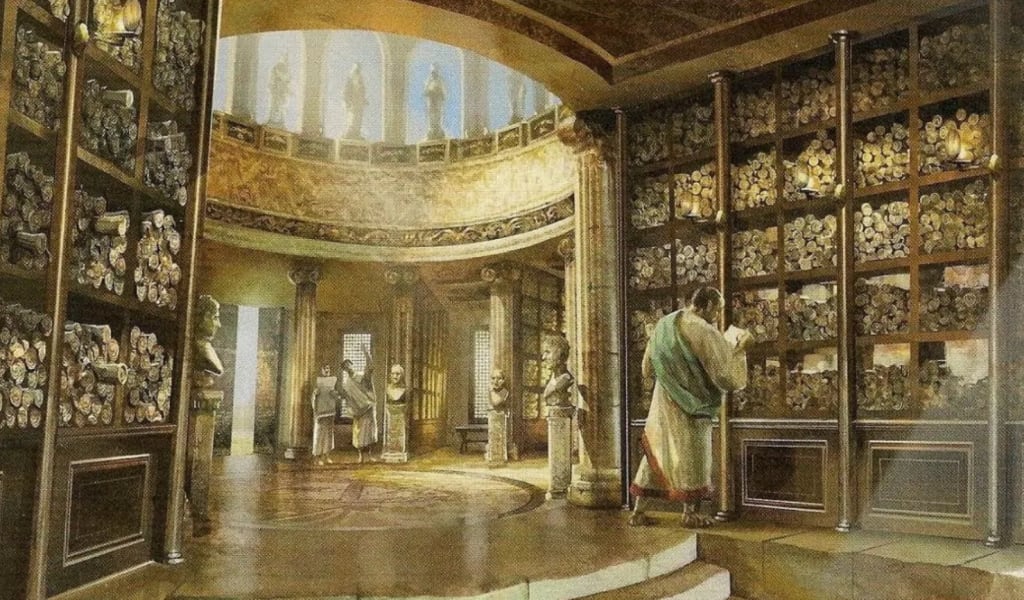
The Library of Alexandria, one of the most renowned and significant institutions of the ancient world, was a beacon of knowledge, learning, and culture. Established in the city of Alexandria, Egypt, during the reign of Ptolemy I Soter in the 3rd century BCE, the library became the intellectual heart of the ancient Mediterranean. It was not only a repository of scrolls and books but also a center for scholarly activity, attracting the greatest minds of the time. This article delves into the history, achievements, and eventual decline of the Library of Alexandria, exploring its lasting impact on human knowledge and culture.
The Founding of the Library
The establishment of the Library of Alexandria was closely tied to the founding of the city of Alexandria itself by Alexander the Great in 331 BCE. Following Alexander’s death, his general Ptolemy I Soter took control of Egypt and sought to make Alexandria the cultural and intellectual capital of the Greek world.
Ptolemy I Soter and the Vision for a Universal Library
A Repository of Knowledge: Ptolemy I envisioned a library that would gather all the knowledge of the world, reflecting the diverse cultures within his empire. To this end, he began amassing a vast collection of texts, from Greek literature and philosophy to the works of other ancient civilizations, including Egyptian, Persian, and Indian texts.
Construction and Design: The library was part of a larger complex known as the Mouseion (Temple of the Muses), dedicated to the nine Muses, the goddesses of the arts and sciences. The Mouseion served as a research institution, where scholars lived and worked, and it included lecture halls, meeting rooms, gardens, and the famous library.
Demetrius of Phalerum: One of the key figures in the library’s early development was Demetrius of Phalerum, a former student of Aristotle and an Athenian statesman. Demetrius is often credited with advising Ptolemy I on the creation of the library and helping to establish its early collection and organizational structure.
The Collection and Scholars
The Library of Alexandria aimed to collect every written work in existence, making it the most comprehensive library of the ancient world. The library’s collection grew rapidly through various means, including acquisition, copying, and translation.
Methods of Collection
Acquisition of Scrolls: The Ptolemaic rulers sent agents across the Mediterranean to acquire books and scrolls. Ships docking in Alexandria were required to surrender their books for copying, with the originals often kept in the library and copies returned to the owners.
Translation and Copying: The library became a center for translating works into Greek, the lingua franca of the Hellenistic world. Texts from various cultures, including Hebrew scriptures, were translated into Greek, contributing to the library’s universal collection. The library also employed a large number of scribes to copy texts, ensuring the preservation and dissemination of knowledge.
Notable Scholars and Achievements
Euclid and Mathematics: Euclid, often referred to as the “father of geometry,” worked at the Library of Alexandria during the 3rd century BCE. His work Elements became one of the most influential mathematical texts of all time, laying the foundation for geometry.
Eratosthenes and Geography: Eratosthenes, another prominent scholar at the library, made remarkable contributions to geography and astronomy. He is best known for calculating the Earth’s circumference with remarkable accuracy using simple geometric principles, a feat that demonstrated the library’s role in advancing scientific knowledge.
Archimedes and Engineering: Although Archimedes spent most of his life in Syracuse, his works were preserved and studied at the Library of Alexandria. His contributions to mathematics, physics, and engineering, including the principle of buoyancy and the invention of war machines, were crucial to the scientific knowledge stored in the library.
Callimachus and the Pinakes: Callimachus, a poet and scholar at the library, created the Pinakes, a massive catalog of the library’s holdings. The Pinakes organized texts by author and subject, making it one of the earliest known library catalogs and a testament to the library’s advanced organizational system.
The Decline and Destruction of the Library
The decline of the Library of Alexandria is shrouded in mystery, with various accounts and theories about its destruction. What is clear, however, is that the library faced several challenges and suffered multiple setbacks over the centuries.
Theories of Destruction
Caesar’s Fire (48 BCE): One of the most famous accounts of the library’s destruction comes from the Roman historian Plutarch, who wrote that a portion of the library was accidentally burned when Julius Caesar set fire to his ships during his siege of Alexandria. The fire reportedly spread to parts of the city, damaging the library.
Christian and Muslim Conquests: Other accounts suggest that the library suffered during the Christianization of the Roman Empire, when many pagan texts were destroyed. Later, during the Muslim conquest of Alexandria in 642 CE, there are reports that the library’s remaining scrolls were destroyed, although the historical accuracy of this account is debated.
Gradual Decline: Some historians argue that the library’s decline was gradual, caused by a combination of neglect, economic difficulties, and the loss of patronage. Over time, the library may have simply fallen into disrepair, with its vast collection dispersed or lost.
Impact of the Library’s Loss
Cultural and Intellectual Void: The destruction of the Library of Alexandria is often seen as a tragic loss for human knowledge and culture. Many works housed in the library were lost forever, and with them, the accumulated wisdom of ancient civilizations.
Myth and Legacy: Despite its tragic end, the Library of Alexandria remains a powerful symbol of the pursuit of knowledge and the fragility of human achievement. Its legacy has inspired countless scholars, writers, and thinkers throughout history, and it continues to be a subject of fascination and reverence in popular culture.
The Legacy of the Library of Alexandria
The Library of Alexandria left an enduring legacy that has shaped the course of intellectual history.
Influence on Later Libraries and Scholarship
Model for Future Libraries: The concept of a universal library, as exemplified by the Library of Alexandria, influenced the development of later libraries, including those in the Islamic Golden Age and the Renaissance. The idea of collecting, preserving, and disseminating knowledge became a cornerstone of academic institutions.
Inspiration for the Renaissance: The rediscovery of ancient texts, some of which had been preserved by scholars influenced by the Alexandrian tradition, played a crucial role in the Renaissance. The revival of classical knowledge and the humanist movement can be traced back to the intellectual ideals that the Library of Alexandria embodied.
Modern Resurgence: The Bibliotheca Alexandrina
Rebirth of an Icon: In 2002, the Bibliotheca Alexandrina was inaugurated in Alexandria, Egypt, as a tribute to the ancient library. This modern library and cultural center aims to recapture the spirit of its predecessor by serving as a hub for learning, research, and dialogue. It stands as a symbol of the enduring human quest for knowledge and understanding.
The Library of Alexandria was not just a physical repository of scrolls and books; it was a symbol of the intellectual curiosity and cultural exchange that characterized the Hellenistic world. Although its destruction remains one of the great tragedies of history, the library’s influence has endured, shaping the development of libraries, scholarship, and the preservation of knowledge throughout the centuries. The legacy of the Library of Alexandria continues to inspire our modern pursuit of learning, reminding us of the importance of safeguarding and nurturing the knowledge that defines our civilization.
About the Creator
Keep reading
More stories from Gus Woltmann and writers in Chapters and other communities.
The Gambino Crime Family
The Gambino crime family is one of the most infamous and powerful Mafia organizations in the history of the United States. As one of the “Five Families” that dominate organized crime in New York City, the Gambinos have played a central role in the American Mafia’s rise to power. This article explores the history, key figures, criminal activities, and eventual decline of the Gambino crime family, shedding light on the complex world of organized crime.
By Gus Woltmann6 months ago in Chapters
Hobbies Can Be Anywhere and Everywhere
As you do the hobbies that you enjoy in life you can do it anywhere and hobbies can be found everywhere. Hobbies that are the most enjoyable can be found anywhere and everywhere because if we look for them and give how we live our lives our all hobbies are wherever we are. The more we put our hobbies and life together we can find our hobbies anywhere because anything that we do everywhere that we are either can become a hobby or was formed from a hobby that we did prior to what we are doing now. Being at your house hobbies are everywhere, because you have ways to relax and with that you do the things that you enjoy. Being outside hobbies can be found being with friends, hobbies can be found, hobbies can be anywhere that you look, just live your life and do the things that you enjoy. The more you live the life that you want to live by doing it anywhere and everywhere that you are, the more you are doing the hobbies that you want to do in your life.
By Louise Barraco6 days ago in Chapters



Comments