
The Justice of the Desert: The Story of Hazrat Umar ibn Al-Khattab (RA)
How a Leader's Simplicity and Fear of God Redefined Power and Justice

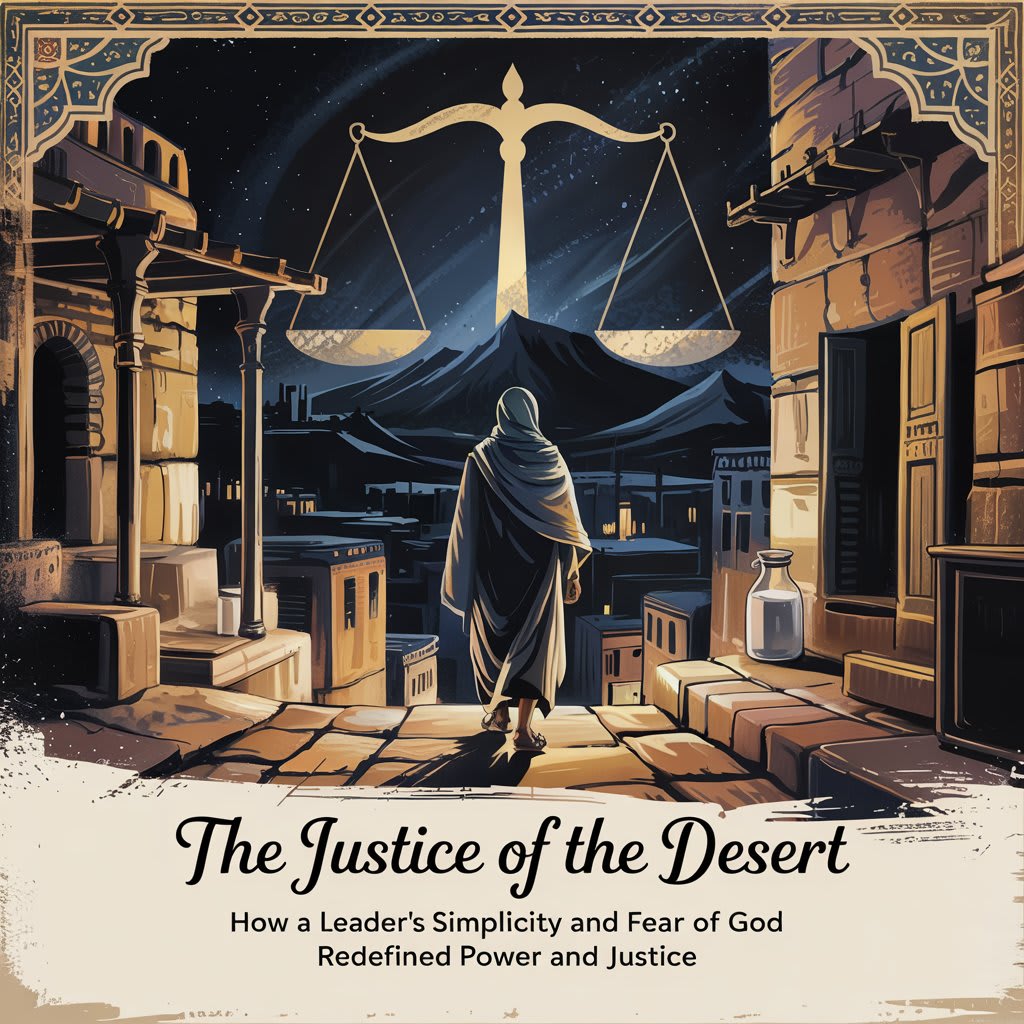
In the golden sands of the Arabian Peninsula, where power was once defined by lineage, wealth, and the sharpness of the sword, arose a man whose leadership would etch itself into history not by tyranny, but by justice, simplicity, and fear of God. He was Umar ibn Al-Khattab (RA), the second Caliph of Islam—a towering figure in stature, intellect, and righteousness.
This is not merely a tale of political leadership. It is the story of how a man’s deep-rooted faith and moral compass transformed the very meaning of justice for an empire stretching from the deserts of Arabia to the gates of Persia and Byzantium.
A Harsh Beginning, a Merciful Heart
Before accepting Islam, Umar (RA) was known for his strong personality, quick temper, and staunch opposition to the message of the Prophet Muhammad (SAW). But his conversion marked a turning point—not just for himself, but for the entire Muslim Ummah. Upon accepting Islam, Umar’s courage, intellect, and leadership became one of the greatest assets of the Muslim community.
Though once stern, Islam softened his heart. What remained was a man of unshakable principles, burning with the desire to uphold the truth, and unwavering in his accountability to Allah (SWT). His humility and justice were born from this fear of divine judgment—not from a need to be revered by men.
The Caliph Without a Crown
When Hazrat Abu Bakr (RA) passed away, the mantle of leadership fell upon Umar. But he did not walk into power with pomp or titles. He did not build palaces or place guards at his door. He was known simply as Amir al-Mu’minin—Commander of the Faithful. And yet, he lived more like a servant than a ruler.
Umar (RA) would walk the streets of Madinah at night, alone and disguised, to see with his own eyes the condition of his people. Power, to him, was not a throne to sit upon but a burden to carry. It meant sleepless nights, tearful prayers, and personal accountability for every hungry stomach in his dominion.
Justice That Knew No Favor
One of the most extraordinary qualities of Umar (RA) was his absolute commitment to justice. His decisions were grounded in the Qur’an and the Sunnah, but above all, in his intense fear of standing before Allah (SWT) on the Day of Judgment.
There was no favoritism. No special treatment. Not even for his own family.
Once, his son Abdullah (RA) bought camels and grazed them in the government pasture. When the camels returned plump and healthy, Umar (RA) noticed.
"Whose camels are these?" he asked.
"They belong to your son, O Commander of the Faithful," someone replied.
Fearing that his son had taken advantage of his position, Umar ordered the camels to be sold and the profits returned to the state treasury. To him, leadership meant sacrifice—not privilege.
The Cry of the Woman and the Caliph’s Tears
One night, during his usual rounds through Madinah, Umar (RA) heard the faint sound of children crying from within a tent. As he approached, he found a woman trying to soothe them while cooking something over a fire.
Curious and concerned, he asked her what was wrong.
“My children are hungry,” she replied. “I’m boiling water to calm them, hoping they’ll fall asleep thinking food is coming.”
She had no idea she was speaking to the Caliph himself. Tears welled in Umar’s eyes.
He rushed back to the treasury, carried a sack of flour, oil, and other provisions on his own back, and returned to the woman’s tent. His servant offered to carry the load, but Umar refused.
“Will you carry my burden on the Day of Judgment?” he said.
He cooked the food himself, served the family, and watched as the children smiled and fell asleep.
That night, the leader of a vast empire stood under the stars with flour on his beard and tears in his eyes—not for the greatness of his deeds, but for the weight of his responsibility.
The Just Caliph and the Qadi’s Judgment
In one incident, a Christian man brought a complaint against one of Umar’s governors. The man claimed that Amr ibn Al-As, governor of Egypt, had wronged his son.
Umar summoned both the governor and his son to Madinah. Upon confirming the wrongdoing, he handed the whip to the Christian and told him to strike the son of the governor as he had been struck.
Then, turning to Amr ibn Al-As, Umar said:
"Since when do you enslave the people when their mothers gave birth to them free?"
In Umar’s court, there was no privilege—not for the Muslim, nor for the elite. Justice was not an ideal; it was a living reality.
Austerity in a Time of Wealth
During Umar’s rule, the Islamic state expanded immensely. Treasures from Persia, Egypt, and beyond began pouring into the treasury. Yet Umar’s lifestyle remained unchanged.
His clothes were patched, his food was simple—often just bread and oil—and his home had no luxury. Once, an envoy from Byzantium arrived in Madinah, seeking the mighty Caliph.
He was shocked to find Umar sleeping under a tree, alone, with no guards. The envoy whispered, “You ruled, you were just, so you slept in peace.”
Plague, Famine, and His Own Hunger
During the great famine in Arabia, Umar (RA) declared that he would not eat meat or ghee until every hungry person in Madinah had enough. His face became pale, his body weak, but he did not waver.
He said, “How can I be concerned about the people if I do not feel their pain?”
This was not political theatre—it was his fear of Allah (SWT) that made him live the hardships of his people.
An Empire of Conscience
Under Umar’s leadership, Islam spread far and wide. The Islamic empire extended to Persia, the Levant, Egypt, and more. But conquest was never about dominance. It was about spreading justice, removing tyranny, and establishing the worship of Allah (SWT) alone.
He introduced systems still admired today: a public treasury, regular census, stipends for the needy, a judicial system independent of executive power, and protection of non-Muslims’ rights under Islamic governance.
He would write to his governors, saying:
“The most beloved of your affairs to you should be the most just of them, and the most hated should be the most oppressive... For people will only be good if you make them so, and they will only go astray if you do.”
The Final Chapter
Umar’s journey ended as dramatically as his leadership had been. While leading Fajr prayer in the mosque, he was stabbed by a Persian slave. As his life faded, his only concern was not his legacy, not his victories—but whether his Lord was pleased with him.
As he lay in pain, he asked his son to place his head on the ground.
“Perhaps Allah will look upon me with mercy,” he whispered.
He asked to be buried beside his beloved Prophet Muhammad (SAW) and his predecessor, Abu Bakr (RA). With permission granted by Aisha (RA), he was laid to rest in the company of those he loved, leaving behind a legacy that echoed across the centuries.
Legacy of the Just
Hazrat Umar ibn Al-Khattab (RA) redefined power. In his world, leadership was not a pursuit of glory, but a test of character. Authority was not for control, but for service. And justice was not a tool for the privileged, but a shield for the oppressed.
His simplicity was his strength. His fear of Allah was his guide.
Today, as leaders rise and fall, as power tempts and corrupts, the memory of Umar (RA) stands like a pillar in the desert—a reminder that true greatness lies not in wealth or command, but in humility, sincerity, and unwavering justice.
He once said:
“If a mule were to stumble in Iraq, I would fear that Allah would ask me, ‘Why did you not pave the road for it, O Umar?’”
Such was the justice of the desert. The justice of Umar.
About the Creator
Reader insights
Outstanding
Excellent work. Looking forward to reading more!
Top insights
Compelling and original writing
Creative use of language & vocab
Easy to read and follow
Well-structured & engaging content
Excellent storytelling
Original narrative & well developed characters
Expert insights and opinions
Arguments were carefully researched and presented
Eye opening
Niche topic & fresh perspectives
Heartfelt and relatable
The story invoked strong personal emotions
On-point and relevant
Writing reflected the title & theme
Keep reading
More stories from Zain Ul Abedin Khan and writers in Chapters and other communities.
Search for a Sister, Chapter Two
4-H-N heard not a word about her secret mission around Headquarters over the following days, so had to conclude either Mini-Flash Phytolith hadn’t been listening in after all, or she’d misjudged him. She hoped it was the latter, as she wanted the pair of them to get on, even if he wasn’t going out of his way to make it easy for her.
By Doc Sherwood19 days ago in Chapters



Comments
There are no comments for this story
Be the first to respond and start the conversation.