
The Empty Lunchroom
A Teenager’s Glimpse into America’s Uncertain Days

Ella Martinez glanced at the cafeteria door. Across the hall, row after row of lunch-trays sat untouched, the usual hustle of midday replaced by quiet chairs and muted whispers. At 14, she was used to seeing the hustle of high school life at Lincoln High School in Phoenix, but something felt off today.
Earlier this week, her friend Jordan had explained the reason: the federal food-aid programme called SNAP (which helps so many families) faced uncertainty because the government was shut down. Courts had ordered payments to continue, yet in many schools the ripple effects were already being felt.
The Guardian
+2
CBS News
+2
Ella’s mother, Rosa, worked two jobs and counted on SNAP benefits to keep enough groceries in the house. Last night, Rosa had come home late, tired and worried. “I don’t know how we’ll stretch it if this keeps up,” she’d whispered.
At lunch, Ella walked to the line. She picked up a tray, slid it along the counter, chose the salad and some fruit. She sat down next to Jordan. He didn’t pick up a tray. Instead he stared at the empty-looking line of trays in front of him and said quietly: “It’s weird, right? We’re in the richest country in the world … and still this.”
Ella nodded. “I heard the judge ruled that citizens don’t have to prove citizenship on the voter-form.” Jordan shrugged. “Which sounds fair to me — but then there’s so many other rules changing, about who can vote, what counts… it’s messy.” He was referring to a recent decision by a federal judge blocking a requirement for documentary proof of citizenship on the federal voter registration form.
The Guardian
+1
They sat in silence for a moment, the hum of the cafeteria overhead soft. Ella fidgeted with her tray. She thought of her little brother, Miguel, five years old, waiting for her to pick him up after school. She thought of Rosa’s worry. She thought of Jordan, whose mother worked at a non-profit that was cutting back hours because of the funding freeze.
Finally, Ella asked: “Do you think it’s okay to live like this? I mean — uncertain, waiting for something someone else in Washington decides?”
Jordan’s eyes flicked to the window. Outside the sun was bright, but the sky held a kind of haze, like the future felt. “I don’t know,” he said. “But I do know I want to change it someday. For us. For my mom. For you too.”
Ella smiled and reached out, placing a hand on his shoulder. “Me too.”
Later, after school, Ella stopped by the food bank near the school. Volunteers were handing out extra boxes of food — a backup because so many families were worried. Inside, the volunteers talked quietly about “what if” the shutdown lasts longer, “what if” benefits are delayed. In that moment, Ella realise something: it wasn’t just about politics or rules. It was about real people, real lives.
That night, at the dinner table, the three of them sat around a small meal. Rosa politely asked about Ella’s day. Ella told her about the empty trays, about the news she and Jordan talked about. Rosa sighed. “We’ll make it through. We always do. But it’s harder when you feel no one in charge cares.”
Ella looked at her mother and thought: even if the system feels broken, even if Washington is messy and uncertain, people still show up. Help each other. Try. And maybe that’s enough
About the Creator
Keep reading
More stories from Md Sabbir Hossen and writers in Chapters and other communities.
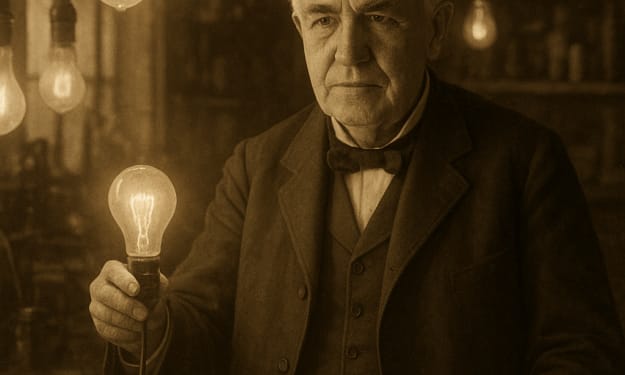
The Light of Determination
Thomas Alva Edison, one of America’s most famous inventors, was not a genius by birth — he was a man of relentless determination. Born in 1847 in Ohio, Edison had very little formal education. His teachers once called him “too slow to learn.” But his mother believed in him, and that belief changed the course of history.
By Md Sabbir Hossen4 months ago in Chapters
A Powerful, Personal Review of Kikoff
👉👉👉FOR MORE INFROMATION CLICK HERE Building credit today isn’t just about improving a number—it's about reshaping your financial future, increasing your independence, and opening doors that were once closed. Many people want better credit but don’t know where to begin, and traditional systems are often designed to make the process confusing, slow, or expensive. That’s where Kikoff comes in, and why I personally believe it stands out as one of the most effective, accessible, and stress‑free credit‑building solutions available.
By Organic Products 3 days ago in Chapters


Comments (1)
AI generated... Yet, the plot is interesting and up to date.