
''The Diamond Planet''
A World of Wealth, Wonder, and Warnings
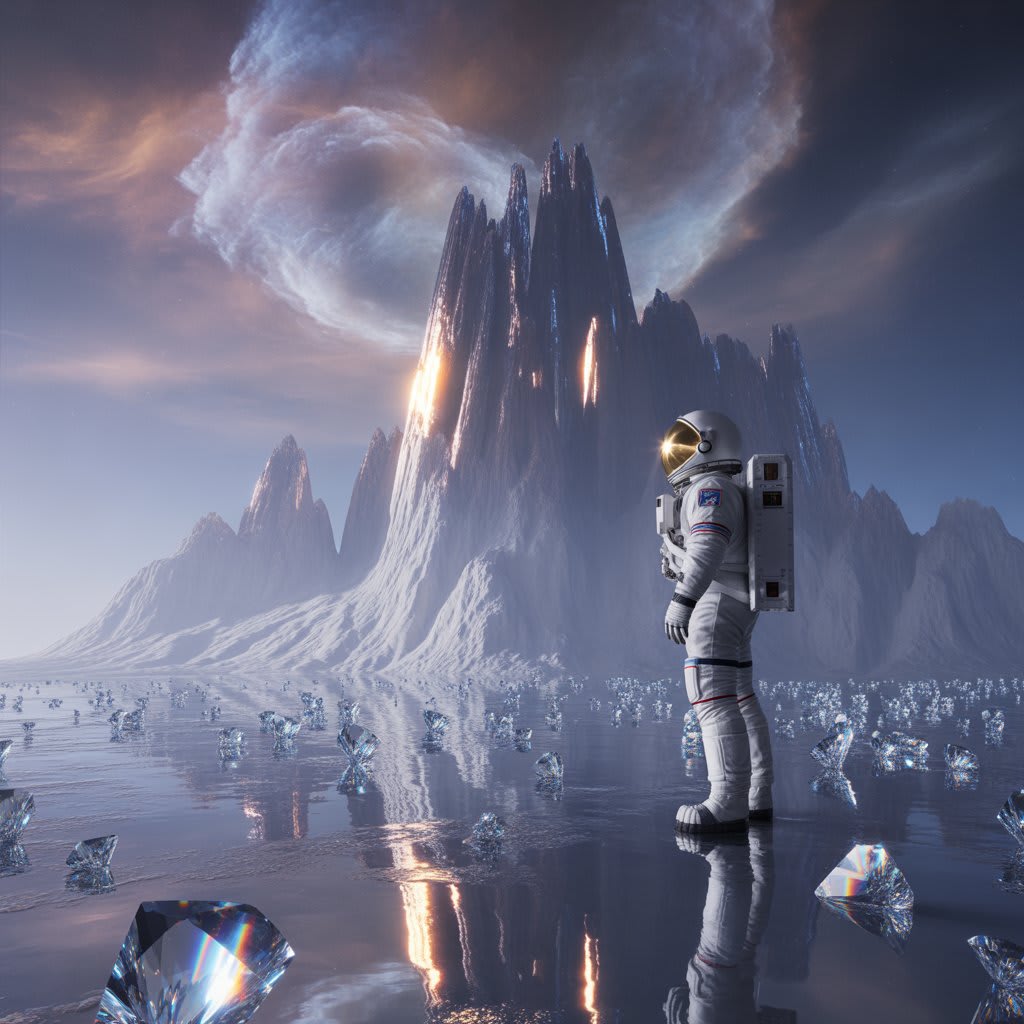
They found it beyond the Kuiper Belt, just outside Neptune’s orbit—a planet that glittered like a star but moved like a ghost. At first, astronomers thought it was a sensor glitch. No planet should shine like that, and certainly not reflect light like a faceted gemstone.
They called it Eretheon, but to the media and eventually the world, it became known as "The Diamond in the Cosmos."
Dr. Nyla Reed, a young astrophysicist working with the International Deep Space Observation Program (IDSOP), was the first to propose what others dismissed: that the planet was made largely of carbon and, under immense pressure and temperature, had formed a crystalline surface—one massive diamond, bigger than Earth.
In 2083, Earth was fractured. Climate wars, water shortages, and economic collapse had drained its spirit. But the Diamond Planet? It offered something else: hope. Resources. Escape. And for the greedy—untold wealth.
A mission was launched: Odyssey-X.
Six astronauts. One ship. A destination 40 light-minutes from Earth.
CHAPTER ONE: THE SHIP AND THE SILENCE
Nyla was chosen to go, not because she was the best pilot or the most trained astronaut, but because she understood Eretheon better than anyone. Her presence aboard the Odyssey-X was the result of relentless papers, interviews, simulations—and a quiet obsession.
She remembered the first time she saw the image of Eretheon. Not just the shimmer, but the symmetry. The lines etched in its surface, like natural facets. It looked… unnatural. Designed.
By who? By what?
Odyssey-X reached Eretheon after two years in cryo-sleep. The planet grew from a speck to a blinding presence as the ship entered orbit.
It was breathtaking.
The surface looked like it had been carved by a god. Prismatic reflections scattered across the black void. No clouds. No atmosphere. Just crystal plains, geometric ridges, and canyons lined with glittering veins.
Nyla whispered over the comms, “It’s not just carbon. It's structured.”
CHAPTER TWO: THE ENTRY
Commander Hale ordered a descent. They deployed The Prism Rover, a small AI-controlled lander equipped with laser drills, scanners, and atmospheric pods.
As the rover touched down, its sensors went haywire.
“Temperature stable,” said Hale, “but... this can’t be right. There’s vibration. Low frequency. Not tectonic. Rhythmic.”
“Almost like... a signal,” Nyla said.
The rover began drilling. The surface wasn’t just solid—it was layered. Each stratum denser, clearer, and arranged with mathematical precision.
Then it happened.
As the drill hit the sixth layer, a pulse surged through the crystal. The rover was flung upward like a pebble, destroyed in a second. The planet reacted—as if protecting something.
Eretheon wasn't just made of diamond.
It was alive.
CHAPTER THREE: THE HEART
Debate broke out onboard. Commander Hale wanted to pull back. But Nyla—obsessed, determined—pleaded for one more attempt. She theorized that Eretheon wasn’t reacting to destruction, but to intention. It responded to aggression.
“What if it’s a defense mechanism?” she asked. “What if Eretheon was created to protect something—buried beneath?”
They voted.
Mission Specialist Tomás Reyes and Nyla suited up for EVA.
The landing was smooth. The gravity was light, the air nonexistent. But what stood out was the sound—or lack thereof. Total, oppressive silence. Even radio signals became fuzzy. And yet… something deeper hummed through their boots. A frequency below hearing, but felt in their bones.
They followed a series of crystalline ridges that led to a deep fissure—not a natural one. It looked cut. Engineered.
Inside, the crystals changed color—from diamond-clear to violet-blue. And at the bottom of the fissure, they found it:
A massive, smooth orb, buried halfway in the crystal ground. It shimmered like the planet’s surface, but smoother—too perfect.
And then it lit up.
CHAPTER FOUR: THE MESSAGE
Nyla’s helmet buzzed with static. Her HUD flickered. Suddenly, symbols flashed—glowing runes not made by any human hand.
“Reyes,” she whispered, “are you seeing this?”
Before he could answer, their minds were inundated.
Not in language, but in emotion.
They saw visions of a dying star. Of an alien civilization—tall beings of light and glass—sacrificing their world to preserve knowledge. They encoded their consciousness into this planet, crystallizing their history, memory, and identity in diamond—a data storage medium on a planetary scale.
The orb pulsed.
A message, finally understood: "Do not take. Learn. Become."
The diamonds were not treasure.
They were memory.
CHAPTER FIVE: CHOICES
Back aboard the Odyssey-X, arguments exploded. The corporations funding the mission demanded extraction. Earth needed solutions—resources. But Nyla stood firm.
“You don’t extract a mind. You don’t carve up a library. You listen.”
Commander Hale was torn. “We need proof.”
So Nyla went back down. Alone.
She placed her gloved hand on the orb and whispered, “I want to learn.”
This time, the fissure opened. Beneath the orb lay chambers of light—crystalline archives, glowing with knowledge older than Earth. She saw technology that could purify water, repair ecosystems, and heal atmospheres.
The gift was never wealth.
It was wisdom.
CHAPTER SIX: RETURN
Nyla returned to Earth a year later, carrying a single shard encoded with alien knowledge. No one believed her until the shard was activated. Within weeks, breakthroughs in energy and environmental repair began.
Eretheon was declared a Cosmic Preserve, guarded, not mined.
And Nyla?
She became Earth’s first true ambassador to an ancient intelligence among the stars.
EPILOGUE
Long after Nyla’s passing, Earth entered a new era—a renaissance led by the knowledge of Eretheon. Humanity no longer looked to the stars with greed, but with humility.
Because somewhere out there, glinting in the void, still spinning in silence, was the Diamond in the Cosmos—a reminder that the greatest treasures are not always what we take, but what we choose to understand.
About the Creator
Reader insights
Nice work
Very well written. Keep up the good work!
Top insight
Expert insights and opinions
Arguments were carefully researched and presented
Keep reading
More stories from farooq shah and writers in Chapters and other communities.
''Whispers of the Wild''
The forest had always been a place of secrets. To the villagers of Elmswood, it was simply known as the Greenwood. Towering oaks, ash, and birch stood like sentinels over winding paths lost to time. Few dared to venture far beyond the edge. Strange sounds—low murmurs, soft rustles that didn’t belong to wind or wildlife—kept them away.
By farooq shah8 months ago in Earth
Kia Ford: The Hammer Girl's English Premiere Production
Wearing an immaculate beige ensemble, highlighting innocent marketable features, Kia Ford continued surveying the courtyard, debating the open space future, “I have the two tickets here, are you prepared to head over to Anfield’s afternoon delight music festival series?”
By Marc OBrien4 days ago in Chapters
Flower Bloom 369
FLOWER Bloom 2/25/26 Wednesday By Mariann Carroll Karen had been with Tony for 7 years. Tony started acting strangely after her surgery. He would mow the lawn in the rain and be on his cellphone. He started pushing Karen away. Tony came clean about seeing someone. Karen moved out two months later. Karen moved in with a friend. She felt betrayed.
By Mariann Carroll7 days ago in Fiction


Comments
There are no comments for this story
Be the first to respond and start the conversation.