
The Craziest Live Show: Over a Million Viewers Watch Him Steal, and Everyone Calls Him a Hero
Part 1
The flames of war burn in the desert, fueled by flesh, blood, and civilization, sweeping across the winds.
In January 2013, the war, which had been raging for a year, reached its most critical point. Rebel forces had seized cities along the border between northern and southern Mali, and were preparing to march southward, ready to consume the entire country.
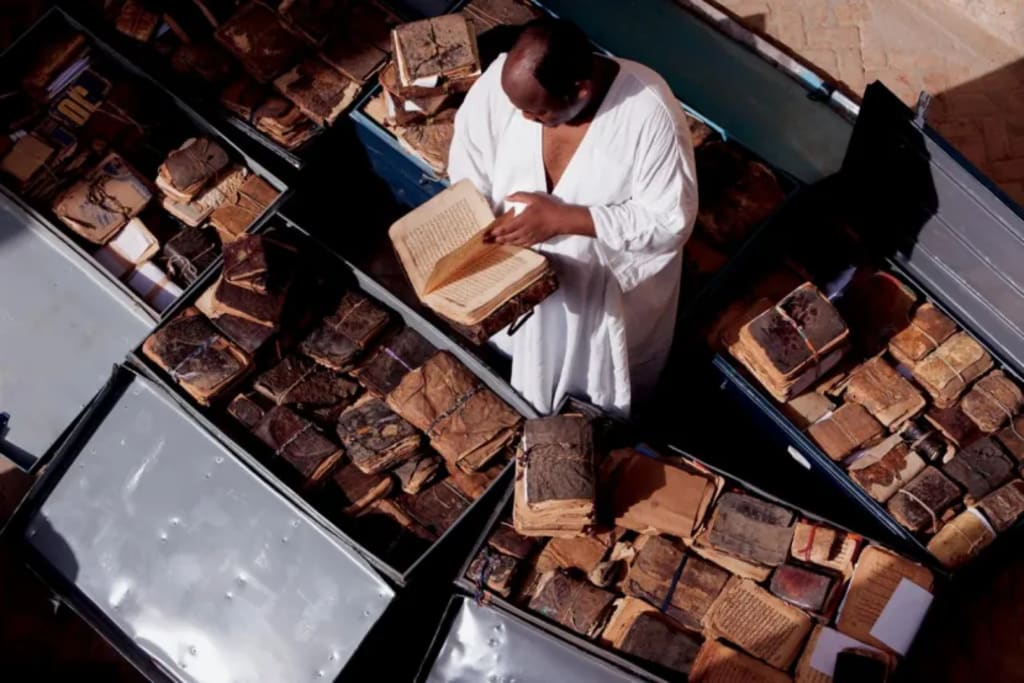
As the situation grew more unstable, 20 dilapidated flat-bottomed wooden boats quietly set sail from a desolate harbor, lining up to enter the rushing river. The boats moved slowly, and along the way, villagers could be seen carrying large metal boxes. Each box, measuring over half a meter in height and more than a meter in length, with nearly 300 in total, was carefully loaded onto the boats. Inside, precious ancient texts, some dating back to the 15th and 16th centuries, were safely stored.
The organizer of the fleet was named Abdoulaye Kader Haidara, a librarian who had devoted his life to collecting, preserving, and restoring ancient manuscripts.
At first, the war claimed lives, but soon it began to turn civilization into ashes. Haidara wanted to move these invaluable books as quickly as possible, hoping to smuggle them out of the war zone before terrorists could lay their hands on them. Haidara ordered that no boat carry more than 15 boxes to minimize the risk of the boats being intercepted or sinking. Each boat was assigned two carriers and two captains to ensure the fleet sailed day and night without rest.
This was no ordinary fleet, but a group of librarians and captains, driven by a deep hatred for the terrorists and a mission to preserve the flame of civilization. They embarked on a daring mission to save these ancient texts. As the last of the books were loaded onto the boats, the fleet began to pick up speed, sailing upstream against the current. The desert winds howled fiercely as the river swelled, threatening to capsize the fragile boats at any moment.
After the fleet managed to escape the arid desert, palm trees and low shrubs came into view. Ahead, a massive lake appeared—or rather, an ocean of water plants. The fleet seemed to glide across the grasslands, offering some respite from the violence, though it was also a prime hunting ground for bandits. A dozen men wrapped in turbans emerged from the thick water plants, brandishing AK-47 assault rifles and ordering the fleet to stop. The metal boxes were forcibly opened, and the bandits ran their fingers over the fragile pages of the ancient manuscripts. The crew offered their cheap Casio watches, silver bracelets, rings, and necklaces, pleading with the bandits to spare the books.
The bandits were unmoved, declaring that the manuscripts would be kept. Someone called Haidara, who promised the bandits a hefty ransom: "Trust me, we will deliver the money to you." The bandits debated what to do, while the crew nervously guarded the metal boxes. Eventually, the bandits understood Haidara’s dilemma—he couldn’t afford to lose the books, especially since thousands more awaited transport from the war zone. The fleet and the books were released.
Four days later, Haidara kept his promise and sent an agent to deliver the ransom. During this period, Haidara, in the capital city of Bamako, worked 15-hour days, managing eight phones, each receiving an update every 15 minutes. Haidara kept a watchful eye on the large brown kraft paper taped to the wall, listing the names of each carrier, the latest contact time, the number of boxes they were transporting, their locations, and the conditions along the route. He followed the operation's progress in real time.
For over half a year, Haidara and many volunteers faced the perils of war, countless checkpoints, and the ever-present danger of police, soldiers, bandits, and terrorists lurking in every corner. They made frequent trips back and forth from the ancient city of Timbuktu to the capital, Bamako, smuggling civilization along a perilous 1,000-kilometer route.
About the Creator
Bruce Lee and The God of War: Kuan Ti
It starts with love.. The Power to the God Of War and Wealth Walk into a Chinese restaurant (even in Oklahoma, USA), a Chinese police station, a kung fu martial arts studio or even a Chinese temple and you often see a red faced warrior holding a heavy quan-do (spear like weapon).
By WILD WAYNE : The Dragon King12 days ago in Chapters
The Ritual of Demand, Chapter Two
The subsequent phases of the solar cycle saw a tremendous change in Flashpower. He was a happier and more confident Mini-Flash all round. He lost his wan distracted look and his cheeks flushed with colour, the freckles on his snub nose standing out boldly. In class he could concentrate again, and his grades began to improve. Even his Flashball picked up a little, and when someone got the better of him he started taking it as any boy would, instead of getting his knickers in a twist. The adult Flashes all agreed Flashpower was finally getting the hang of being the age he was.
By Doc Sherwood6 days ago in Chapters




Comments
There are no comments for this story
Be the first to respond and start the conversation.