
The Casket on Canal Street
Part 3: The Belle Orleans

The Casket on Canal Street – Part 3: The Belle Orleans
A Mimi Delboise Mystery
Aboard a steamboat bound for Natchez, Mimi finds the man she’s been hunting—and a terrible truth about the woman who hired her.
***
On the other hand, twenty thousand dollars in stolen money and forty ruined families demanded justice, even if it required taking risks.
"How would one arrange passage on a boat that's already departed?" she asked.
Marie smiled. "Leave that to me. I know exactly the person to ask."
Two hours later, Mimi found herself aboard a fast packet boat bound for Natchez, having paid an exorbitant fee for emergency passage to "attend a dying relative." The boat was small and fast, designed for urgent travel rather than comfort, and its captain assured her they would overtake the slower Belle Orleans by evening.
As the New Orleans riverfront fell away behind them, Mimi reviewed what she knew about Marcus Trevino. According to the city directory, he was forty-two years old, originally from Mobile, unmarried. His business address on Camp Street had indeed been legitimate for the past three years, though the building's owner confirmed that Trevino had paid his rent in cash and avoided signing any long-term leases. He was described as charming, well-educated, and meticulous in his record-keeping—exactly the sort of man who would inspire confidence in potential insurance clients.
He was also, apparently, the sort of man who would steal the life savings of forty families without a moment's remorse.
They caught up with the Belle Orleans just as the sun was setting, painting the muddy Mississippi red and gold. The larger boat was magnificent even by New Orleans standards, with three decks of passenger accommodations and twin smokestacks that rose like cathedral spires above the churning paddle wheel. As their packet boat pulled alongside, Mimi could hear music and laughter from the main salon, where passengers were gathering for the evening's entertainment.
The transfer proved more complicated than she had anticipated. The Belle Orleans' captain was initially reluctant to take on an unexpected passenger, especially one traveling without proper arrangements. It took twenty minutes of negotiation, the production of extra payment for "emergency boarding," and a carefully crafted story about a dying relative in Natchez before he agreed to the transfer.
"Most irregular," he muttered as Mimi climbed aboard with her small traveling bag. "We're not a river taxi, you understand. This vessel operates on a schedule."
"I understand completely, Captain," Mimi replied, pressing an additional five dollars into his hand. "I'm grateful for your accommodation in these tragic circumstances."
She watched her original transport disappear into the gathering dusk, acutely aware that she was now alone on a riverboat with a dangerous confidence man who would not hesitate to kill her if he discovered her true identity.
"Welcome aboard the Belle Orleans, ma'am," said a uniformed crewman. "If you'll follow me, I'll show you to the passenger services desk so we can arrange your accommodations."
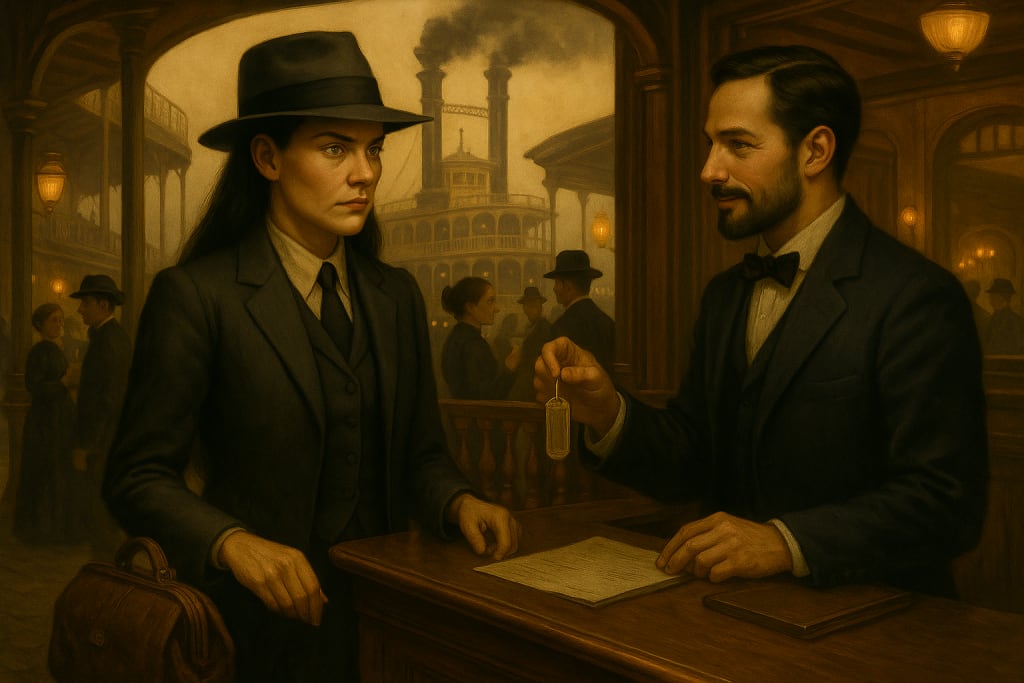
The passenger services desk was located on the main deck, near the grand salon where elegantly dressed travelers were enjoying pre-dinner cocktails. Behind the mahogany counter stood a man of medium height with carefully groomed dark hair and the kind of smooth confidence that marked a successful salesman. He was exactly as Mrs. Fortier had described Marcus Trevino, though he now sported a neat beard that altered his appearance considerably.
"Good evening, madam," he said with a practiced smile. "I'm Jean-Baptiste Moreau, passenger services. How may I assist you?"
"I need passage to Natchez," Mimi said, studying his face carefully. "I was told you might have accommodations available."
"Certainly. We have several staterooms still available, ranging from our economy cabins at twelve dollars to our luxury suites at thirty-five." His voice carried the cultured tones of an educated man, with just a hint of French accent that was probably calculated to charm female passengers.
"The economy cabin will be fine," Mimi said, placing fifteen dollars on the counter. "Though I should mention—I'm traveling on urgent family business. My cousin in Natchez is very ill, and I'm hoping to reach him before... well, before it's too late."
"I'm sorry to hear that, madam. We should reach Natchez by noon tomorrow, God willing." Trevino—she was certain it was him now—made careful notes in his ledger. "May I have your name for our passenger manifest?"
"Margaret Smith," Mimi lied smoothly. "From New Orleans."
As Trevino prepared her cabin assignment, Mimi noticed several things that confirmed her suspicions. His handwriting was identical to the signatures on the forged insurance documents. He handled the cash with the automatic efficiency of someone accustomed to large amounts of money. Most tellingly, when he thought she wasn't looking, she caught him studying the other passengers with the calculating gaze of a predator selecting his next victim.
More concerning was the small notebook he kept partially hidden beneath his ledger—filled with passenger names, cabin numbers, and what appeared to be assessments of their wealth and vulnerability. She glimpsed notations like "widow, traveling alone, expensive jewelry" and "elderly gentleman, mentions investments frequently."
"Here's your cabin key, Mrs. Smith," he said, handing her a brass key attached to a wooden fob. "Cabin twelve, just down the corridor from here. Dinner is served until nine o'clock if you're interested."
"Thank you, Mr. Moreau. Tell me, have you been working riverboats long? You seem very knowledgeable about the arrangements."
For just an instant, his practiced smile wavered. "Several years, ma'am. Started on smaller boats, worked my way up to vessels like the Belle Orleans. It's honest work, and I enjoy helping passengers with their travel needs."
The irony of a man who had stolen twenty thousand dollars talking about "honest work" was almost too much for Mimi to bear silently. But she simply nodded and made her way to her cabin, already planning her next move.
Her cabin was small but comfortable, with a narrow berth, a washstand, and a porthole that looked out over the dark water. She spent an hour listening to the sounds of the boat—footsteps in the corridors, voices from neighboring cabins, the steady rhythm of the paddle wheel. Gradually, the passenger areas grew quieter as people retired for the night.
At eleven o'clock, she heard Trevino's voice in the corridor, speaking with what sounded like another crew member about passenger arrangements for the next day. By midnight, the sounds had diminished to the essential operations of a riverboat at night—the engine room crew, the pilot house watch, and the occasional footsteps of security personnel making their rounds.
She waited until well past midnight, when most of the passengers had retired and the boat's crew was reduced to essential personnel. Then she made her way quietly back to the passenger services area, where a single oil lamp provided just enough light for late arrivals or passenger emergencies.
The desk was unattended, but unlocked—exactly what she had hoped for. Working quickly, she examined Trevino's passenger ledger and cash drawer. The ledger showed evidence of systematic overcharging, with passengers being billed for services that didn't exist and cabin upgrades that were never provided. The cash drawer contained nearly three hundred dollars, far more than would be normal for a legitimate clerk's daily receipts.
But it was the small leather portfolio hidden beneath the counter that provided the most damning evidence. Inside, she found blank insurance policy forms, a corporate seal for "Mississippi Valley Mutual Insurance," and several sheets of letterhead for a company that didn't exist. More disturbing were detailed notes about passengers—their apparent wealth, travel patterns, and personal circumstances. Trevino had been systematically evaluating potential victims for his next round of insurance fraud.
In the margin of one page, she found a name that made her blood run cold: "A. Fortier—special arrangement complete. Final payment received. Disposal of evidence required."
"Looking for something, Mrs. Smith?"
Mimi turned to find Trevino standing in the doorway, no longer bothering to maintain his pleasant demeanor. In the lamplight, his face looked harder, more calculating—the face of a man who had spent years lying to people who trusted him.
"Just admiring your business methods, Mr. Trevino," she said calmly, though her heart was racing. "Or should I call you Mr. Moreau? It's difficult to keep track of your various identities."
His hand moved toward something beneath the counter—probably a weapon of some kind. "I don't know what you're talking about, ma'am. I'm afraid you're confused."
"Am I? Then perhaps you can explain why you have blank insurance forms for a company that doesn't exist hidden in your desk. Or why your handwriting matches the signatures on fraudulent policies sold to families in New Orleans." Mimi kept her voice level, despite the damning notation she had just discovered. "Twenty thousand dollars, Marcus. That's what you stole from forty families who trusted you to protect their futures."
"Forty families who were stupid enough to believe in promises they couldn't afford," Trevino said, his mask of civility finally slipping completely. "Though I notice you didn't mention the forty-first family, Mrs. Smith. The one that got exactly what they paid for."
"What do you mean?"
"I mean Mrs. Adelaide Fortier, who hired you to track me down. Tell me, did she mention that her insurance policy with me was somewhat... different from the others?"
Mimi felt the pieces beginning to shift into a new and horrible pattern. "Different how?"
"Mrs. Fortier didn't want protection for her family, Mrs. Smith. She wanted protection for herself. She came to me six months ago with a very specific request—an insurance policy that would pay out quickly and quietly when her husband died, with minimal investigation and no uncomfortable questions about the cause of death."
"Not twenty thousand dollars worth."
"Says someone who's never had to scrape and claw for every penny, never had to smile and bow and pretend to respect people who wouldn't spit on you if you were burning." Trevino's voice carried years of resentment and bitterness. "Those families got exactly what they paid for—the illusion of security. The reality is that security doesn't exist for people like them, and it never did."
"So you decided to steal their money instead."
"I decided to take what I could get from a world that never gave me anything I didn't take myself." His hand was definitely moving toward a weapon now. "The question is what happens to someone who's learned too much about my business."
Mimi had been hoping to avoid violence, but Trevino's posture made it clear that he wasn't planning to come quietly. "What happens is that you surrender peacefully and return what you've stolen. There are people depending on that money, Marcus. Widows and orphans who have nothing left but the policies you sold them."
"Touching. But I'm afraid that money has already been invested in my future." Trevino produced a small pistol from beneath the counter. "As for you, Mrs. Smith—or whoever you really are—you've made a serious mistake coming aboard this boat."
"Have I? Because I'm fairly certain the boat's captain would be very interested to learn that his passenger services clerk is wanted for insurance fraud in New Orleans. Not to mention what he might think about the money you've been stealing from his passengers."
"The captain is in his cabin, sleeping off a bottle of whiskey. The crew is busy with their duties. And accidents happen on riverboats all the time—passengers fall overboard, especially passengers who've been drinking and wander onto the deck alone at night."
Mimi calculated distances and angles, trying to determine whether she could reach her own derringer before Trevino could fire. The chances weren't encouraging.
"Before you make any irreversible decisions," she said, "you should know that I'm not traveling alone. I have colleagues who know exactly where I am and what I'm investigating. If something happens to me, they'll make sure the authorities know everything about Marcus Trevino and his various business ventures."
It was a bluff, but a reasonable one. Trevino studied her face, clearly trying to determine whether she was lying.
"You're working for someone," he said finally. "One of my former clients, I assume. Which one?"
"Mrs. Adelaide Fortier. Her husband died last month, and she discovered that the insurance policy you sold them was worthless."
Trevino's expression shifted slightly. "Adelaide Fortier. Now there's an interesting woman. Did she tell you about her previous husband, Mrs...?"
"Smith. And yes, she mentioned Charles Dupuis."
"Did she mention that Charles Dupuis didn't die in a riverboat accident? He was murdered—poisoned with arsenic and pushed overboard to make it look like an accident." Trevino's smile was genuinely unpleasant now. "Adelaide Fortier is a very wealthy widow, Mrs. Smith. Wealthy enough to afford my premium rates for specialized insurance services."
"What are you talking about?"
"I'm talking about insurance policies that pay out even when the death isn't entirely natural. Adelaide came to me not because she wanted protection for her family, but because she wanted protection for herself. She was planning to kill Theodore Fortier, and she needed an insurance policy that would pay out quickly and quietly, without uncomfortable questions from investigators."
Mimi felt her world shifting. Mimi felt the pieces clicking into place with horrible clarity. "She thought she was buying real insurance."
"Exactly. Mrs. Fortier researched insurance companies, compared policies, did everything a careful customer should do. Then she came to me asking for a policy with very specific terms—immediate payout, minimal investigation, absolute discretion about the circumstances of death." Trevino's eyes gleamed with malicious satisfaction. "She never asked if the company actually existed. She just assumed that someone willing to sell such an unusual policy must be legitimate, if expensive."
"And when Theodore died..."
"She filed her claim and discovered there was no company to file with. No corporate headquarters, no claims adjusters, no payout procedures. Just empty offices and disconnected telephone numbers." Trevino shook his head in mock sympathy. "Imagine her frustration—she'd done everything perfectly, eliminated her inconvenient husband with careful planning and flawless execution, only to discover that her insurance policy was completely worthless."
"So she hired me to track you down and recover her money."
"Oh, it's much more personal than simple financial recovery, Mrs. Smith. Mrs. Fortier is furious. She committed murder based on the promise of a substantial insurance payout, and instead, she got nothing but worthless paper. She's not just seeking financial compensation—she wants revenge against the man who made her a murderer for no profit."
The irony was staggering. Adelaide Fortier had indeed murdered her husband, exactly as Trevino claimed. But instead of being the calculating criminal who hired Mimi to eliminate a witness, she was genuinely a victim of insurance fraud—a murderer who had been cheated out of her blood money.
"She really is seeking justice," Mimi said slowly. "Twisted justice, but justice nonetheless."
"The most dangerous kind. A woman who has already killed once and discovered that murder without reward is simply waste." Trevino raised the pistol slightly. "She hired you to find me and bring me back to New Orleans to face charges. But I suspect she's hoping I'll resist arrest in some way that proves permanently fatal."
"So you disappeared."
"So I disappeared. But apparently Adelaide decided to pursue the matter with professional help." Trevino's smile grew colder. "I have to admit, I'm impressed with her cleverness. Hiring a detective to track down the insurance fraud is a perfect cover story for eliminating an inconvenient witness to murder."
"She's not paying me to kill you."
"Isn't she? What exactly did she hire you to do, Mrs. Smith? Find me and recover her money? Bring me back to New Orleans to face justice?" Trevino shook his head. "Adelaide Fortier doesn't want justice. She wants me dead, and she's using you to accomplish that goal."
Mimi realized with growing horror that Trevino's version of events made perfect sense. Mrs. Fortier's strange behavior during their interview, her excessive concern about the fake insurance company, her willingness to pay Mimi's fee without negotiation—all of it pointed to hidden motives that had nothing to do with seeking justice for fraud victims.
"Even if you're telling the truth about Mrs. Fortier," she said, "that doesn't excuse what you did to forty other families."
"Doesn't it? Those families got what they deserved for being stupid enough to trust a stranger with their money. Adelaide Fortier got exactly what she paid for—a dead husband and a profitable insurance claim. The only person who got cheated in this whole business was me, and I'm not planning to let that stand."
Trevino was moving around the counter now, but more cautiously than before, clearly aware that their conversation might be overheard. The boat's evening activities were winding down, but the corridors weren't entirely empty yet.
"Even if you're telling the truth about Mrs. Fortier," she said, "that doesn't excuse what you did to forty other families."
"Doesn't it? Those families got what they deserved for being naive enough to trust a stranger with their money. At least Mrs. Fortier got something for her investment—she eliminated an inconvenient husband, even if she didn't get the financial reward she expected." His voice carried years of resentment. "I provided exactly the service she requested—a policy that would avoid uncomfortable questions about her husband's death. It's not my fault she didn't verify the company's legitimacy before committing murder."
"You deliberately sold her a worthless policy."
"I sold all my clients worthless policies. Mrs. Fortier's situation was only different in that she had more immediate plans for using hers." Trevino glanced toward the corridor. "The irony is that she actually got better value than most of my customers. They paid for protection they would never need. She paid for a service she used immediately—even if it didn't work out as planned."
"What's your escape plan?" she asked, stalling for time while her mind raced through possibilities.
"Simple enough. I have documents establishing Jean-Baptiste Moreau as a legitimate passenger services clerk. When we reach Natchez, I'll disappear into the river traffic heading north. New identity, new territory, same basic business model." Trevino's expression hardened. "The only complication is you, Mrs. Smith. Mrs. Fortier is paying you to bring me back to New Orleans, but I suspect she's hoping the process proves... permanently unsuccessful."
"You think she wants me to kill you."
"I think Mrs. Fortier has discovered that murder is easier than she expected, and she's willing to arrange for others to do her killing. She can't risk me testifying about her husband's death, but she also can't risk being connected to my disappearance." Trevino smiled coldly. "Hiring a detective to pursue a dangerous criminal who dies resisting capture is the perfect solution. She gets her revenge, eliminates a witness, and appears to be seeking justice."
Before Mimi could ask what he meant, footsteps echoed in the corridor outside, followed by voices and the sound of several men approaching. Heavy footsteps, moving with purpose rather than the casual pace of passengers returning to their cabins.
"Mr. Moreau?" a voice called. "Captain Murdoch wants to see you immediately. There are some irregularities in the passenger accounts that need explaining."
Trevino's face went pale. "Stay quiet," he whispered, pressing the pistol against Mimi's ribs. "One word and you're dead."
Three men entered the passenger services area—the boat's captain and two crewmen who looked like they had been roused from sleep for an emergency. The captain was a weathered man in his fifties, with the kind of steady authority that came from years of commanding river vessels.
"Mr. Moreau," he said, "we've had some disturbing reports about irregularities in the passenger accounts. Several travelers have complained about being overcharged for services, and there seems to be a significant discrepancy between the passenger fees collected and the amounts recorded in the ship's ledgers."
"I'm sure there's been some misunderstanding, Captain," Trevino said, trying to maintain his pleasant demeanor while keeping the pistol hidden behind the counter. "Perhaps we could discuss this in the morning, when I've had a chance to review the accounts?"
"I'm afraid not. We need to examine your records immediately." The captain's gaze moved to Mimi. "And we need to understand why you're conducting business with passengers in the middle of the night."
"Mrs. Smith had an urgent question about her accommodations," Trevino said. "I was simply trying to help her resolve the matter."
"Is that true, ma'am?" the captain asked, studying Mimi's face carefully.
Mimi realized that this was her chance—possibly her only chance—to expose Trevino without getting herself killed in the process. But she also understood that revealing his identity would force her to confront the uncomfortable truth about Mrs. Fortier's real motives.
"Actually, Captain," she said carefully, "I think you should know that the man you've hired as Jean-Baptiste Moreau is actually Marcus Trevino, a confidence man wanted for insurance fraud in New Orleans. He's been stealing money from your passengers, and he was just threatening to kill me to keep me quiet about it."
The captain's expression hardened. "Is this true?"
Trevino's hand tightened on the concealed pistol, but with three men watching him and nowhere to run, his options were severely limited. "The woman is obviously delusional, Captain. Perhaps she's been drinking?"
"Check his desk," Mimi said. "You'll find blank insurance forms, a corporate seal for a fake company, and evidence that he's been systematically overcharging passengers and pocketing the difference."
One of the crewmen moved to examine the desk while the captain kept his attention fixed on Trevino. When the sailor produced the leather portfolio with its incriminating contents, Trevino's shoulders sagged in defeat.
"Well, Mr. Trevino," the captain said grimly, "it seems you've been running quite an operation aboard my vessel. Johnson, relieve him of any weapons and secure him in the cargo hold. We'll turn him over to the authorities in Natchez."
The crewman found Trevino's pistol and several hundred dollars in cash that clearly didn't belong to him. As they led him away, Trevino looked back at Mimi with an expression of pure malice.
"Give my regards to Mrs. Fortier," he called. "Tell her that some problems don't disappear just because you hire someone else to solve them."
***
Part 4 brings justice—and deeper questions. Don’t miss the conclusion of The Casket on Canal Street as Mimi learns that not all villains go to jail, and not all clients are what they seem.
About the Creator
Gio Marron
Gio, a writer and Navy vet, served as a Naval Aircrewman, then a programmer, and later a usability analyst. Earned a B.S. and Master's. Lived in Iran, Japan, Saudi Arabia; traveled to Israel, Dubai, more. Now in Nashville.
Keep reading
More stories from Gio Marron and writers in Chapters and other communities.
If the Strait of Hormuz is closed for a long time, it will benefit Russia.
A war involving the United States and Israel with Iran carries the risk that the Strait of Hormuz could remain closed for a prolonged period. This is a crucial route in the global economy through which 20% of the world’s oil and liquefied natural gas is supplied from the countries of the Persian Gulf.
By Real content7 days ago in Chapters



Comments (1)
What a story and it seems like a Murder, She Wrote mystery in a way. By the way are you a Louisianian.