
St. Kilda in His Bones
Elias felt a homesickness for a place he knew only from faded ink and brittle paper, a wild island outpost called St. Kilda.
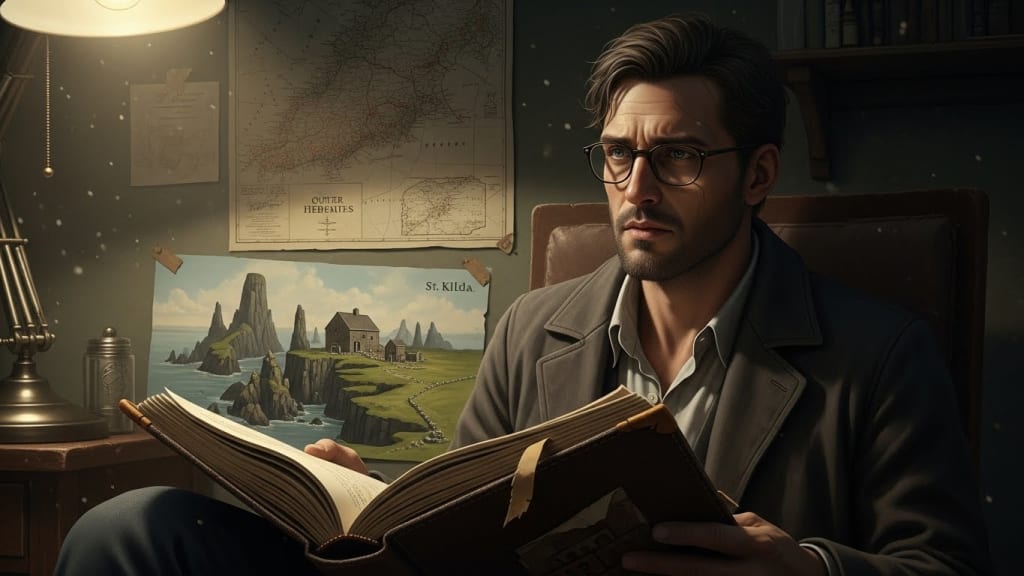
Elias Thorne wasn't much for 'living.' He existed. Six days a week, he cataloged the forgotten lives of others in the city archives, his fingers stained with the dust of centuries. His flat, a single room overlooking a grimy alley, held only what was necessary: a cot, a chipped mug, a stack of worn books. He didn't crave adventure, not truly. He just wanted a quiet corner. And then, the St. Kilda Box arrived.
It was a collection donated by some defunct historical society, packed carelessly into a cardboard carton marked 'Miscellaneous Isles.' Most of it was ephemera, tourist pamphlets from the 1960s, a few blurry postcards of Arran and Skye. But at the bottom, beneath a dog-eared guide to Highland distilleries, lay a leather-bound journal. No title, no author on the spine, just the year 1903 embossed in tarnished gold. It was heavy, its pages thick, textured like old linen. A faint scent, something earthy and salty, clung to it.
He opened it with the care he afforded all ancient things. The handwriting, elegant yet hurried, detailed a journey to St. Kilda, a remote archipelago far out in the North Atlantic. The words painted a world: blackhouses huddled against relentless gales, the shriek of gannets, the precarious life of men harvesting seabirds from sheer cliffs. The author, a botanist named Alistair MacLeod, wrote of the isolation, the stark beauty, the strange, almost alien culture of the islanders. Elias had never heard of St. Kilda. He found it on a map, a speck of land, west of the Hebrides, a tiny cluster of dots swallowed by the vast blue.
But as he read, day after day, during his lunch breaks, then late into the night under the weak glow of his bedside lamp, it wasn't just a story. It was a memory. Not his memory, not logically. But something deep down, a current beneath his ribs, pulled taut, a constant thrumming. He'd find himself tracing the rough sketches MacLeod had drawn: a fula, a primitive stone storehouse; the jagged profile of Conachair cliff; the tiny, resilient figures of men scaling its face. His breath would catch. He'd feel a peculiar ache, a longing so specific it was disorienting.
He started researching. St. Kilda, he learned, had been evacuated in 1930. The last 36 inhabitants, succumbing to the harsh realities of modern life and the loss of their young to the mainland, had left their ancestral home forever. The island was now a ghost, a nature reserve, uninhabited by humans for nearly a century. This knowledge didn't diminish the ache; it deepened it. He wasn't longing for a vibrant community; he was longing for a spectral one, a way of life that had been painstakingly eked out and then, abruptly, surrendered.
He tried to explain it once, to old Mrs. Henderson, who manned the front desk at the archive. 'It's like... I know this place,' he'd stammered, holding up a faded photograph of a St. Kildan family standing outside a blackhouse, faces weather-beaten and serious. 'The wind, the smell of the sea, the way the light hits the stone.' Mrs. Henderson, her spectacles perched on her nose, had just blinked at him. 'Never been to Scotland, have you, dearie?' she'd asked, then returned to her crossword. He hadn't. He'd barely left the city limits.
The longing became a constant companion. He sought out books on Gaelic culture, though he couldn't speak a word. He listened to mournful folk music, the drone of bagpipes and the lilt of ancient songs filling his small room, conjuring images of grey skies and crashing waves. He even tried to find 'seabird oil' in some obscure international market, wanting to understand the very sustenance of those people, but gave up. It felt silly, indulging in such fantasies.
Sometimes, when the city was particularly loud, or the archive particularly silent, he'd close his eyes. He'd see the cliffs of St. Kilda, stark against a bruised sky, hear the cry of the fulmars, feel the spray of the Atlantic on his face. He'd taste the peat smoke, thick and earthy, clinging to the rough wool of an imagined tunic. It was so real, so vivid, he'd almost forget where he was. The weight of the journal, the smell of old paper and sea salt, became more familiar to him than his own apartment.
One evening, staring at a map tacked above his cot, his finger tracing the tiny outline of Hirta, the main island, he saw an advertisement for a specialist tour company. 'Visit St. Kilda: Journey to the Edge of the World.' A boat trip. Eight hours from Skye, weather permitting. He stared at the phone number for a long time. His hand hovered over the receiver. The idea of actually *going* there, seeing it with his own eyes, felt both like a desperate need and a terrifying prospect. What if it wasn't real? What if the feeling, so profound and deeply rooted, vanished when confronted with the physical reality? He pulled his hand back.
He picked up MacLeod's journal instead, turning to the last entry, dated August 1903. 'Leaving the islands now. The silence, after the cries of the birds and the constant roar of the sea, will be deafening. I carry a part of St. Kilda within me, a wild, untamed thing.' Elias ran his thumb over the words, the ink a dark ghost on the yellowed page. The wind outside his window picked up, rattling the pane, a sound that, for a moment, carried the chill and vastness of the Atlantic. He just sat there, listening, feeling the wild, untamed thing settle deeper into his bones.
About the Creator
HAADI
Dark Side Of Our Society
Valentine's Dates Over the Years
Colin grinned as Brooklyn slipped into the living room. “Is it all set?” he asked. The twenty-one year old grinned. She was in her last year of college and Colin knew that Lincoln was proud of her. Although she had been away at college, she’d eagerly helped Colin plan his surprise for Lincoln. “I’m so glad you’re finally doing this,” she said.
By Reb Kreyling17 days ago in Chapters
Albert Einstein: The Genius Who Changed the Universe
Albert Einstein (14 March 1879 – 18 April 1955) was a German-born theoretical physicist whose ideas transformed our understanding of the universe. Best known for the theory of relativity and his mass–energy equivalence formula E = mc², Einstein’s work laid the foundation for modern physics. He also made groundbreaking contributions to quantum theory, statistical mechanics, and cosmology. In 1921, he received the Nobel Prize in Physics for his explanation of the photoelectric effect, a discovery that would pave the way for quantum mechanics.
By Haroon Pasha4 days ago in Chapters



Comments
There are no comments for this story
Be the first to respond and start the conversation.