
Speed, Lasers, and the Risk of the First Mistake
Why faster AI-driven defenses may make global security more fragile, not safer

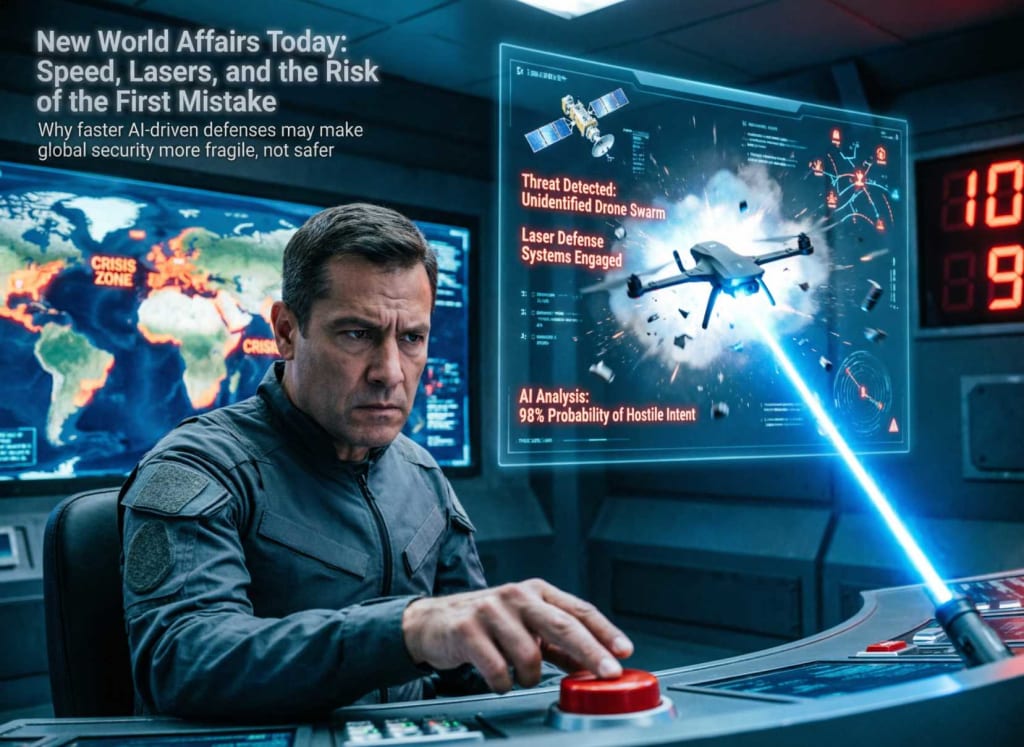
New World Affairs Today: Speed, Lasers, and the Risk of the First Mistake
Today’s world affairs are no longer shaped only by armies, borders, or even nuclear weapons. They are increasingly shaped by speed. In modern conflict, the side that reacts first often gains the advantage—and this reality is quietly transforming global security in dangerous ways.
In the past, wars unfolded over days, weeks, or months. Diplomacy had time to intervene. Human judgment slowed decisions. But in today’s environment, artificial intelligence, automated surveillance, and directed-energy weapons like defensive lasers are compressing decision-making into seconds. This shift is changing how power works—and raising the risk of catastrophic mistakes.
Why Faster Systems Favor First Reactions
Modern military doctrine increasingly rewards preemption. AI-powered systems are designed to detect threats earlier, analyze data faster, and respond instantly. On paper, this sounds like safety. In reality, it creates pressure.
When one country deploys rapid-response AI systems, rivals feel forced to do the same. If your opponent can detect and strike in seconds, waiting even a minute could mean losing command centers, satellites, or defensive shields. As a result, nations begin to design systems that act first rather than verify first.
This is where danger begins.
AI does not understand political context, intent, or deception the way humans do. It identifies patterns, anomalies, and probabilities. A radar glitch, cyber interference, or unusual military exercise could be misread as an attack. In a world where speed equals survival, hesitation becomes a liability—and escalation becomes automatic.
Defensive Lasers: Protection or Provocation?
Directed-energy weapons, especially laser defense systems, are often described as purely defensive. They intercept drones, missiles, or aircraft without explosions, collateral damage, or debris. Many countries see them as stabilizing tools.
But there is a hidden strategic effect.
When lasers neutralize incoming threats quickly and cheaply, they can undermine traditional deterrence. If a state believes it can block retaliation, it may feel safer taking aggressive actions. At the same time, adversaries may feel pressured to strike earlier, faster, or more massively to overwhelm defenses.
This creates a paradox:
- But they encourage speed-based escalation
In such an environment, AI-controlled defense systems may be authorized to respond automatically, because human reaction is considered too slow. Once machines are trusted to decide when a threat is “real,” the margin for error shrinks dramatically.
AI, Surveillance, and the Compression of Time
Global surveillance has reached an unprecedented level. Satellites, cyber intelligence, facial recognition, signal interception, and battlefield sensors now feed AI systems around the clock. These systems are designed to see everything—and react instantly.
The problem is not surveillance itself.
The problem is what happens when surveillance is linked directly to weapons.
When detection, analysis, and response are merged into a single automated loop, human oversight becomes symbolic rather than real. Commanders may only have seconds to approve or override machine recommendations. In crisis scenarios, that time may not exist at all.
History shows that many near-war incidents were avoided because humans hesitated, questioned data, or chose restraint. AI does not hesitate. It optimizes.
The Miscalculation Trap
The greatest danger of this new era is not intentional war—it is accidental war.
Faster systems create environments where:
- False alarms escalate rapidly
- Cyber manipulation can trigger real-world responses
- Defensive actions look offensive to opponents
- Machines react before diplomacy can function
Defensive lasers firing automatically, AI interpreting threat patterns, and surveillance systems flooding command centers with alerts can create a chain reaction no one intended to start.
Once escalation begins, reversing it becomes extremely difficult.
A Fragile Balance
New world affairs today are defined by a contradiction: technology meant to prevent war may actually make it more likely. Speed replaces patience. Automation replaces judgment. Defense blurs into offense.
The real challenge facing global powers is not who has the strongest AI or the brightest laser—but who can slow down decisions when it matters most.
In an age where machines are ready to react instantly, the survival of humanity may depend on the one thing technology cannot replicate: restraint.
About the Creator
Wings of Time
I'm Wings of Time—a storyteller from Swat, Pakistan. I write immersive, researched tales of war, aviation, and history that bring the past roaring back to life
Keep reading
More stories from Wings of Time and writers in Chapters and other communities.
AI, Surveillance, and the Fragile Line Between Deterrence and Disaster
AI, Surveillance, and the Fragile Line Between Deterrence and Disaster The next great danger in global conflict is not only missiles or soldiers, but machines that think faster than humans. As artificial intelligence (AI) becomes deeply embedded in military planning, surveillance, and nuclear command systems, the risk of accidental war is growing quietly but dangerously. What once depended on human judgment is now increasingly shaped by algorithms, sensors, and automated decision-making. In this new environment, a single error, misreading, or cyber manipulation could push the world toward catastrophe.
By Wings of Time 4 days ago in Chapters
The Cave Part 6
If you have ever heard a tale about yourself that you cannot remember and doubtless think is made up, you will know how I felt when Tharkin related all that the eagle had seen of me before my memories were scattered. Of far distances and traveling companions that I did not recall, camping out under the stars and making our way to the mountains with deliberate purpose. The great bird had lost contact with my party once we entered the forests, and the seven other members were not seen again by him or his brethren since.
By Jamye Sharpa day ago in Chapters



Comments
There are no comments for this story
Be the first to respond and start the conversation.