
Salt-Stained Ghosts
He saw their lives, a forgotten world, in faded sepia and felt a longing for a past that was never his.
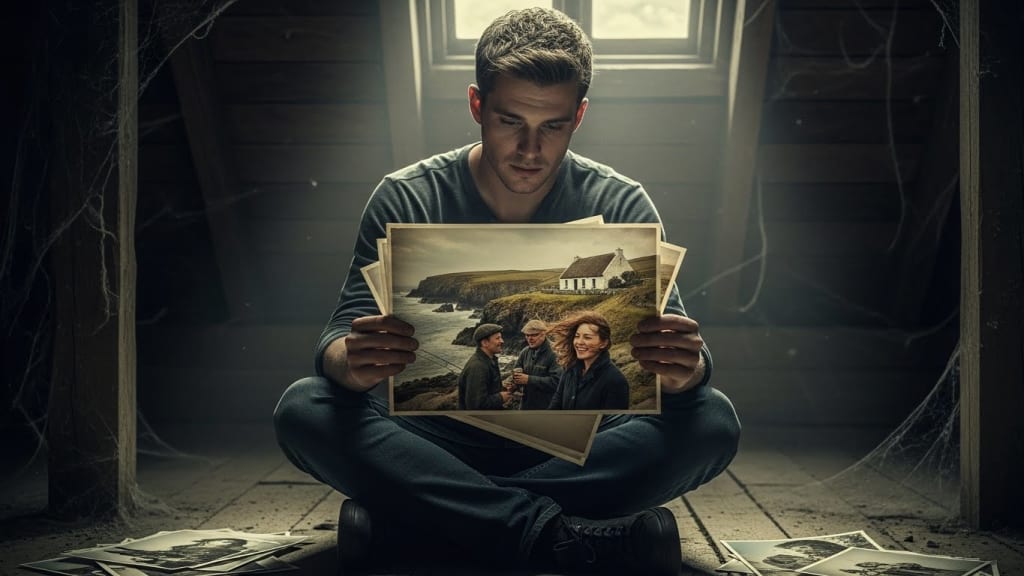
Leo existed in a quiet hum, a low-level buzz of dissatisfaction that had become his default. Mornings melted into afternoons, afternoons into indistinguishable evenings, each day a new tile in a mosaic of grey. He worked a job that paid the rent, ate food that filled him, slept enough to get by. Nothing hurt, exactly, but nothing sang either. It was a dull ache, a pressure behind the eyes, the feeling of a story unwritten, a life unlived. He often wondered if this was all there was, this flat, even road, stretching out with no discernible end.
His grandmother Maeve had been gone six months when the task of clearing her attic finally fell to him. His mother, bless her practical heart, had deemed it a job for 'the young ones, with their good backs and stronger stomachs for dust.' Leo didn't mind. Maeve had always been a quiet presence, a woman of few words who communicated mostly through the smell of baking bread and the fierce grip of her hugs. He figured he'd find some old crockery, maybe a moth-eaten quilt, nothing too surprising. But tucked away behind a stack of National Geographics from the 70s, under a sagging canvas tarp, sat a sturdy, iron-bound wooden chest. It wasn't like anything else in her meticulous, suburban house.
The lock was rusted solid, but the hinges gave way with a groan that seemed to echo through the silence of the attic. Inside, not crockery, not quilts. Just layers of rough linen, smelling faintly of peat smoke and something else, something wild and salty. Beneath it all, a stack of photographs, brittle with age, curled at the edges, and a small, leather-bound journal, its pages thin and crackling. He pulled out the photos first, carefully, like handling dried leaves. They weren’t the studio portraits his grandmother usually displayed. These were candid, grainy, sepia-toned glimpses into another world, a forgotten time.
The images showed craggy coastlines, white-capped waves crashing against unforgiving rock. Stone cottages with thatched roofs huddled together, smoke curling from their chimneys into a perpetually bruised sky. Faces stared out at him, weathered by wind and sun, eyes bright and shrewd. Men in heavy woolen sweaters hauled nets onto rocky shores, their hands calloused, their expressions stoic, yet there was a deep current of life, a fierce energy in their stance. Women, scarves tied tight against the elements, carried baskets, their backs straight, their gaze direct. There was Maeve, a slip of a girl, no older than fifteen, standing by a whitewashed cottage door, her hair wild in the wind, a laugh caught on her face, almost audible. Beside her, a man, a fisherman likely, his arm a strong, protective curve around her small shoulders. His grandfather, maybe? A ghost he'd never known, glimpsed only in this silent film reel.
He sat cross-legged on the dusty floor, lost in them. He could almost smell the salt on the air, feel the bite of the wind off the sea. The damp chill of the stone walls, the heat from a peat fire, the distant cry of gulls. He imagined the taste of fresh-caught fish, the sting of cold water on bare feet, the sound of Irish spoken in quick, clipped tones. It was all so vivid, so terribly real, and yet, he had never been there. Maeve had left that world behind when she was young, came to America, married, raised a family. She’d rarely spoken of it, not really. Just fragments, whispers, like stones skipped across water. But these photos, this chest, they weren’t fragments. They were a whole, living, breathing place. And a part of him, a deep, hollow part, ached for it.
His own apartment, with its sterile white walls and engineered wood floors, felt colder, emptier than usual when he finally returned, the chest cradled in his arms. The muted thrum of city traffic outside his window, the distant blare of a horn, seemed so distant, so meaningless compared to the imagined roar of the Atlantic, the specific clang of a bell buoy in a fog. His daily grind, the spreadsheets, the polite conversations, it all felt like a costume he wore, while his true self, the one he was discovering now, wanted to be out there, wrestling with nets, feeling the spray on his face, earning his keep with the grit of his hands.
He kept returning to that picture of young Maeve by the cottage door, her bright, untamed face. He traced the lines of the weathered stone, the faint shadow of a cat curled on the step. He felt a profound sense of recognition, a pull, as if he’d been there before, stood in that exact spot, breathed that same bracing air. It wasn't just a sentimental attachment to a lost past; it was a physical ache, a phantom limb sensation for a life he knew belonged to his blood, a life that had simply bypassed him.
He spent weeks, then months, poring over the journal. Maeve’s spidery script, mostly in English, but peppered with Gaelic words he had to look up. Tales of harvests and storms, of small joys and crushing losses, of a community bound tight by the harshness of their shared existence. He learned the name of the village: Ballynahown. A small dot on the wild west coast. He pulled up satellite images, Google Maps. The cottages were gone, replaced by a few modern holiday homes, a small pier for tourists. The crags, though, they remained. The relentless ocean still hammered the shore.
The world in the photographs, that vibrant, unforgiving, beautiful world, was no more. It was a ghost, a whisper, preserved only in Maeve’s belongings, and now, strangely, in him. He held the photo up, the one of young Maeve laughing, her eyes sparkling with a fierce vitality. He felt a lump in his throat, a tightness in his chest. It wasn't sadness, not exactly. It was something deeper, more complex. A belonging he’d never known he craved, a memory he’d never lived, a home he’d never seen, but could feel, deep down, in his very bones. He looked out his window at the dull glow of streetlights, the anonymous apartment buildings across the way, and pressed the cold, brittle photograph against his cheek.
About the Creator
HAADI
Dark Side Of Our Society
Valentine's Dates Over the Years
Colin grinned as Brooklyn slipped into the living room. “Is it all set?” he asked. The twenty-one year old grinned. She was in her last year of college and Colin knew that Lincoln was proud of her. Although she had been away at college, she’d eagerly helped Colin plan his surprise for Lincoln. “I’m so glad you’re finally doing this,” she said.
By Reb Kreyling16 days ago in Chapters




Comments
There are no comments for this story
Be the first to respond and start the conversation.