
RMG Rail Mounted VS RTG Rubber Tyred Container Gantry Cranes:4 Key Differences for Efficient Yard Operations
RMG vs RTG
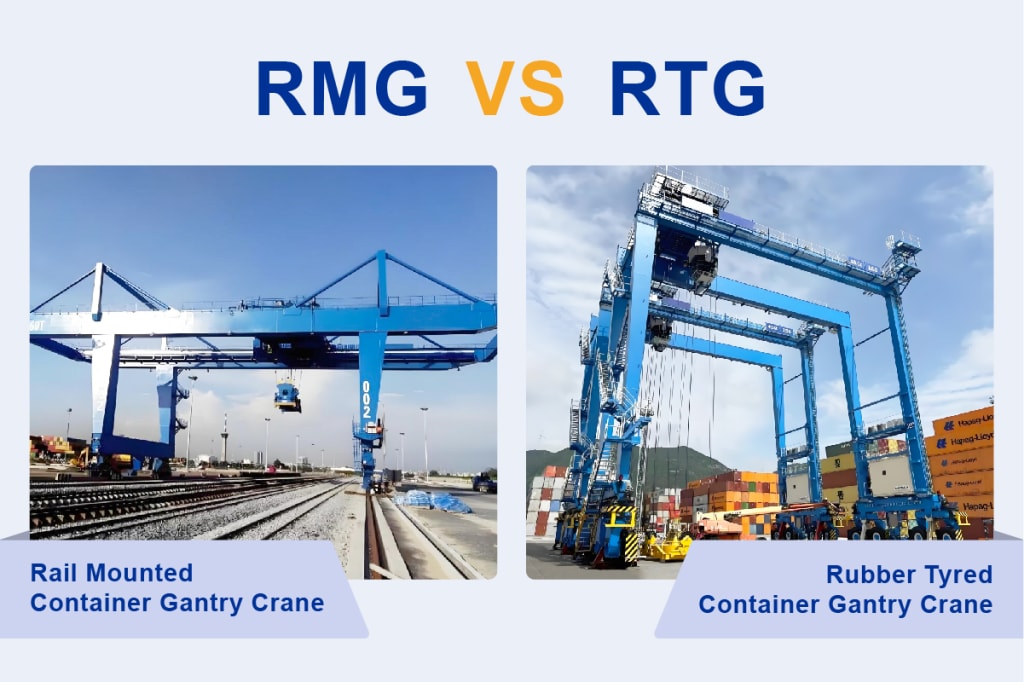
Currently, the commonly used lifting equipment for yard operations at container terminals in major ports worldwide includes Rubber Tyred Container Gantry Cranes (RTG) and Rail Mounted Container Gantry Cranes (RMG). These cranes are employed in port terminals, rail yards, road transfer stations and logistics parks for container loading, unloading, transfer, and stacking operations.
Both RTGs and RMGs are easy-to-operate devices. Although these two types of cranes have similar functions, they differ in various aspects such as technical performance, loading and unloading performance, mobility performance, economic performance and automation performance.
Application Comparison

RTGs were developed in the 1980s and are still widely used today in container yards at docks, roads, and railway freight stations. After trailers transport containers to the yard, RTGs move laterally and longitudinally within the yard to complete loading, unloading, and stacking operations.
The main advantages of RTGs are their mobility, versatility, and relatively low yard construction costs. They can move forward and backward and are equipped with a tire steering mechanism. A trolley carrying a container spreader travels along the main beam track to perform container handling and stacking operations. The rubber-tired travel mechanism allows the crane to move across the yard.
By rotating the tires 90 degrees, the RTG can transfer from one yard (Yard A) to another (Yard B), making operations convenient and flexible, even in smaller yard spaces.
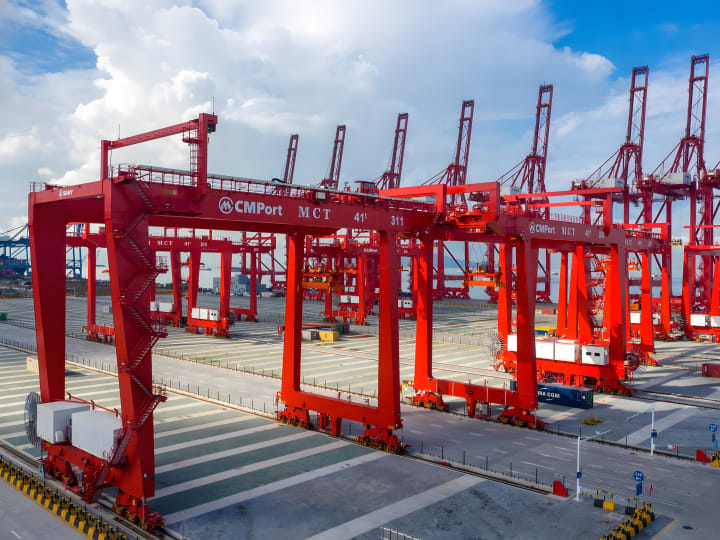
RMGs, which were developed later than RTGs, are suitable for more structured, dedicated container yards, with different spans and effective cantilevers corresponding to different yard layouts.
Their advantages include a high degree of single-machine automatic control, making it easier to achieve automated operations.
In recent years, with continuous technological advancements, the market share of RMGs has steadily increased, and their performance has improved, leading them to become a standardized equipment type in national crane standards.
Main structural components of container gantry cranes
RTG and RMG steel structures generally adopt box structure, in order to reduce the overall quality of the machine, can also be used truss structure, but due to the complexity of the process, the production cost is high, and the use of less in the container yard. RTG and RMG steel structures generally adopt box structures, in order to reduce the overall quality of the machine, which can also be used for truss structure, but due to the complexity of the process, the production cost is high, and the use of less in the container yard.
- Rubber Tyred Container Gantry Cranes
The RTG is supported by eight rubber tires and is typically powered by a diesel engine driving a generator, allowing it to operate without the need for power cables or other external power sources. This enables the RTG to move freely within the yard. RTGs usually adopt a self-propelled trolley design with a telescopic spreader suspended underneath, which is used for container handling and transfer operations.
The main components of an RTG include the steel structure, hoisting mechanism, gantry travel mechanism, trolley travel mechanism, operator cabin, power transmission system, and spreader. The various components are connected through welding or flange connections.
- Rail Mounted Container Gantry Cranes
The RMG is supported by steel wheels and primarily consists of a gantry steel structure, hoisting mechanism, trolley travel mechanism, gantry travel mechanism, electrical system, operator cabin, and spreader.
Additionally, the span and cantilever length of the RMG can be customized, with three configurations available: single cantilever, double cantilever, and no cantilever, to meet the operational requirements of different yards.
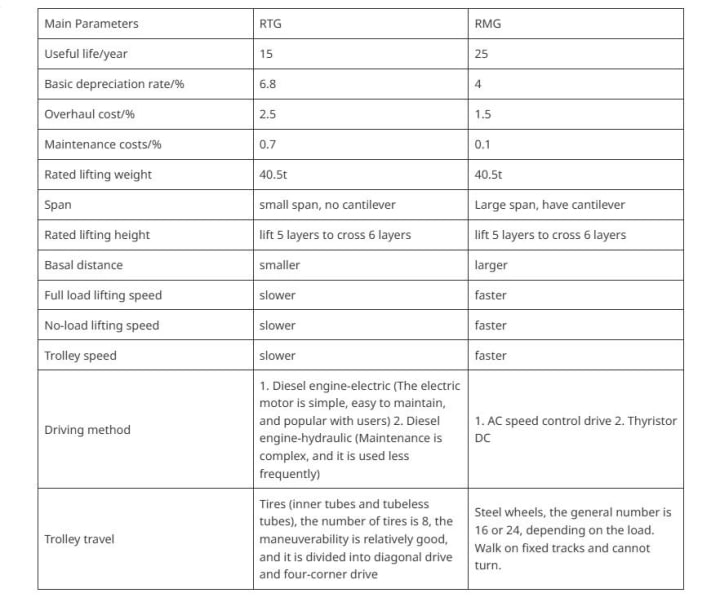
Technical Parameters Comparison
Performance Comparisons
- Mobility
Rubber tired gantry cranes (RTGs) are equipped with tires, allowing them to move across various surfaces, sites, and work locations, offering high mobility. This enables them to easily transport containers between different yards. In contrast, Rail-Mounted Gantry Cranes (RMGs) operate on tracks, and their mobility is restricted to these fixed tracks, limiting them to linear movement and preventing yard transfers.
- Economic Performance
RTGs generally have lower acquisition costs, and their mobility allows them to adapt to various work environments, increasing the utilization of the equipment. Although RMGs may require a higher initial investment, their efficiency, and stability in operations make them more cost-effective in the long term.
- Applicable Scenarios
RTGs are suitable for lifting operations between different yards, meeting the needs of various locations. On the other hand, RMGs are better suited for high-intensity, high-efficiency operations in fixed work areas, such as port terminals and railway yards.
In conclusion, both RTG and RMG cranes are essential components of container handling equipment in the shipping industry. They both have their strengths and abilities that make them ideal for specific types of operations. Whether it's the flexibility of the RTG or the precision of the RMG, choosing the right type of equipment for the job ensures a highly efficient and streamlined operation that can move goods quickly and reliably.
About the Creator
Holler Hobby Living
When you holler through your hobbies does your throat hurt? Or do you get more out of your hobbies when you scream about them? Or do you holler about your hobbies and go after them all at the same time? What holler hobby living can mean to you, is it finding the things that you enjoy doing and that relax you holler about them and get them to where you want them in your life. The more you holler when doing your hobbies you get further with them because you push yourself to go after the hobbies that you want. The more you do this the more you will get out of life. Now some people might say that hollering about hobbies doesn’t get them anywhere but if you really want your hobbies and life to work for yourself then hollering while doing them and pushing yourself to do them is a great thing. The more you put your hobbies and life together and go after them, the more you do this the more you get out of your life. Hobby living is all around us. We just have to holler and go after them in the way that works for you.
By Louise Barraco4 days ago in Chapters
Review of 'Man on the Run'
My wife and I saw Man on the Run, a nearly 2-hour documentary on Amazon Prime, about Wings, Paul McCartney's group that flew around the world from shortly after The Beatles broke up in early 1970 to shortly after John Lennon was murdered at the end of 1980, making a Beatles reunion forever impossible.
By Paul Levinson6 days ago in Beat


Comments
There are no comments for this story
Be the first to respond and start the conversation.