
Power and Repression: The Saddam Hussein Era.
A ruthless journey through power, war, and the fall of Iraq’s most feared ruler.
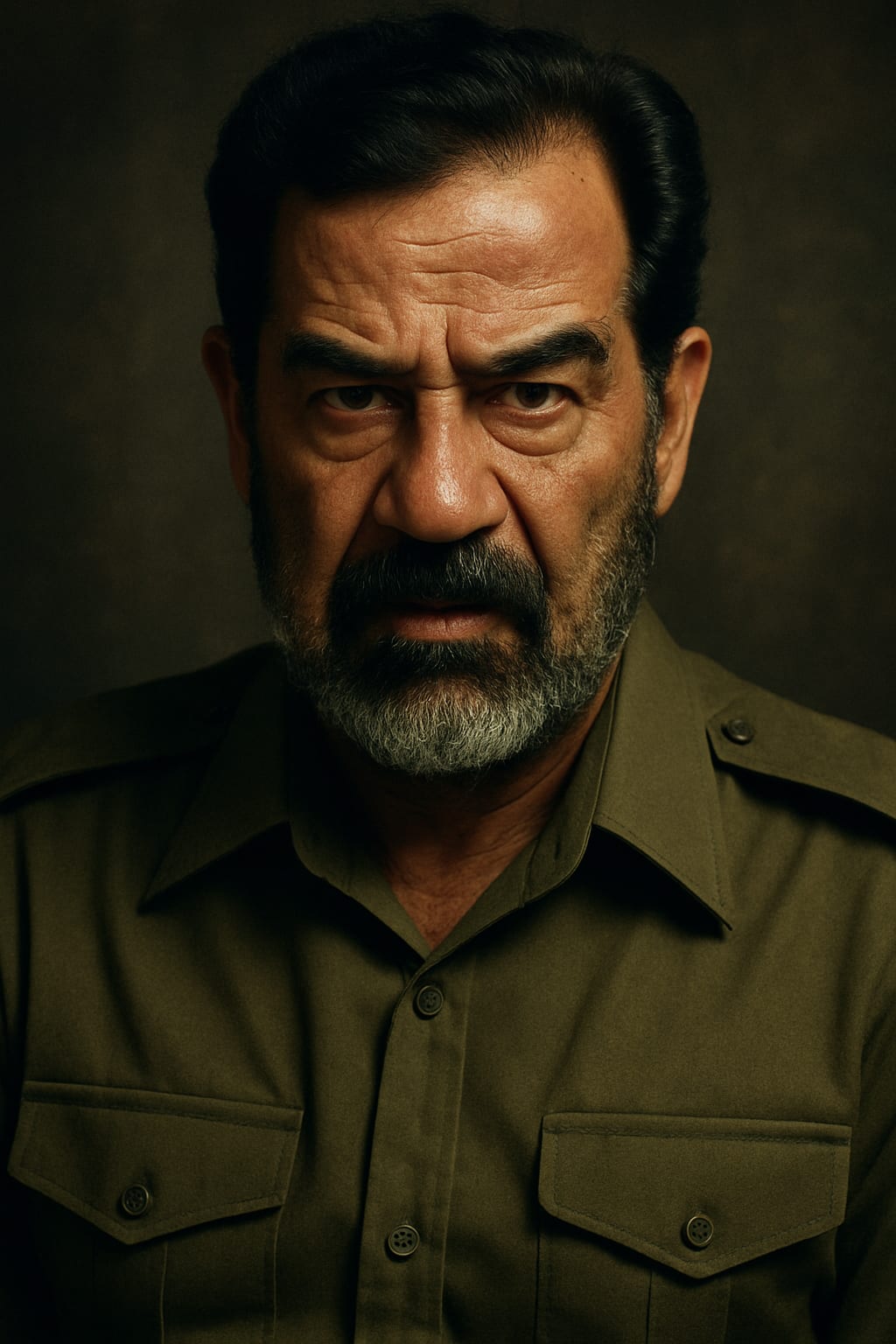
SADDAM HUSSAIN HISTORY
Saddam Hussein: A Controversial Legacy of Power and Repression
Saddam Hussein, the former president of Iraq, remains one of the most controversial and polarizing figures of the late 20th and early 21st centuries. Known for his authoritarian rule, wars, and brutal tactics, Saddam shaped the political landscape of Iraq and the broader Middle East for decades. His life and leadership were marked by ambition, violence, and an unrelenting grip on power.
Early Life and Rise to Power
Saddam Hussein was born on April 28, 1937, in the village of Al-Awja near Tikrit, Iraq. Coming from a poor and difficult background, Saddam was raised in a turbulent environment. His father disappeared before he was born, and his stepfather was reportedly abusive. Despite these early challenges, Saddam pursued education and eventually moved to Baghdad.
As a young man, Saddam joined the Arab nationalist Ba'ath Party, which aimed to unify the Arab world under a single socialist and secular government. In 1959, he participated in a failed assassination attempt on then-Iraqi Prime Minister Abd al-Karim Qasim, which forced him to flee the country. He spent time in exile in Syria and Egypt, where he further developed his political ideas and connections.
After the Ba'ath Party seized power in a 1968 coup, Saddam quickly rose through the ranks. By the early 1970s, he was Iraq’s de facto leader, even before formally assuming the presidency. In 1979, following the resignation of President Ahmed Hassan al-Bakr, Saddam officially took over as President of Iraq.
Authoritarian Rule and Repression
Once in power, Saddam Hussein established a highly centralized and authoritarian regime. He maintained control through a combination of fear, propaganda, and patronage. His government employed widespread surveillance, secret police, and brutal punishments to crush dissent. Political opponents were often imprisoned, tortured, or executed.
One of the most infamous acts of Saddam’s repression was the Anfal Campaign in the late 1980s, during which tens of thousands of Kurdish civilians were killed, and entire villages were destroyed. This campaign included the 1988 chemical attack on the town of Halabja, where thousands died from poison gas—an act widely condemned as a war crime.
Saddam also engaged in violent purges within his own party to eliminate any perceived threats. His personality cult portrayed him as a heroic and fatherly figure, omnipresent in Iraqi life through portraits, statues, and state-controlled media.
Economic and Social Policies
Despite his repressive regime, Saddam implemented several significant economic and social reforms, especially in the early years of his rule. He nationalized Iraq’s oil industry, which allowed the state to fund infrastructure projects, health care, and education. Literacy rates improved, and Iraq’s economy saw periods of growth during the 1970s.
However, these gains were undermined by corruption, mismanagement, and a series of devastating conflicts. Over time, Saddam’s regime prioritized military spending and internal security over economic development and public welfare.
The Iran-Iraq War and Gulf War
One of the defining events of Saddam Hussein’s presidency was the Iran-Iraq War, which lasted from 1980 to 1988. Initiated by Saddam, the war was driven by territorial disputes and ideological rivalry with Iran’s Islamic Revolution. The conflict became a brutal stalemate, with massive casualties on both sides—estimates suggest over a million lives were lost.
In 1990, Saddam invaded neighboring Kuwait, claiming it was historically part of Iraq and accusing it of economic sabotage. The international response was swift and severe. A U.S.-led coalition launched Operation Desert Storm in 1991, forcing Iraqi troops out of Kuwait within weeks. The defeat led to a weakened Iraq, internal uprisings, and severe economic sanctions.
Sanctions, Resistance, and Survival
Throughout the 1990s, Iraq was subjected to harsh United Nations sanctions that crippled the economy and contributed to widespread suffering among ordinary Iraqis. Nevertheless, Saddam managed to retain power, using the sanctions as a propaganda tool to rally nationalistic support and blame external enemies for the country's hardships.
During this period, Saddam's government continued to suppress dissent brutally. He also played a complex game with the international community regarding weapons inspections, at times allowing and at times obstructing efforts to investigate alleged weapons of mass destruction (WMDs).
The 2003 Invasion and Downfall
In the aftermath of the 9/11 attacks, the U.S. government under President George W. Bush intensified its focus on Iraq. Accusing Saddam of possessing WMDs and having ties to terrorist groups—claims that were later discredited—the United States led an invasion of Iraq in March 2003.
The invasion quickly toppled Saddam’s regime, and he went into hiding. After several months, he was captured by U.S. forces on December 13, 2003, near his hometown of Tikrit. His capture marked the end of an era, but it also ushered in years of chaos and violence in Iraq.
Trial and Execution
Saddam was tried by the Iraqi Special Tribunal for crimes against humanity, particularly for the 1982 killing of 148 Shi’a men and boys in the town of Dujail. The trial was highly publicized and polarizing, seen by some as justice and by others as victor’s retribution.
On December 30, 2006, Saddam Hussein was executed by hanging. His death brought closure to some but also deepened divisions in Iraq. His legacy remains contested—some Iraqis view him as a tyrant responsible for immense suffering, while others remember him as a strong leader who kept the country unified and resisted foreign influence.
Legacy
Saddam Hussein’s legacy is one of brutality, war, and authoritarianism, but also of ambition and the complex politics of the Middle East. His rise from a poor village to the presidency of a major Arab country, and his dramatic fall, illustrate both the dangers of unchecked power and the unpredictable currents of history. Iraq continues to grapple with the consequences of his rule and the power vacuum that followed his demise.
Don't Forget To Give Me A Like For Motivation 😉 😉 .
Thank You ❤️ ❤️



Comments
There are no comments for this story
Be the first to respond and start the conversation.