
“Postcards From the Afterlife”
Genre: Speculative / Emotional Fiction Concept: A grieving daughter begins receiving postcards from her deceased mother, each mailed from a different “memory destination” — “The Café Where You First Cried,” “The City Where I Let Go.” The final postcard asks her to stop waiting for more. Themes: Grief, memory, closure, healing.

Postcards From the Afterlife
Genre: Speculative / Emotional Fiction
Theme: Grief, memory, closure, healing
The first postcard arrived on a Wednesday.
There was no return address, no name, just a picture of a quiet seaside café at dusk. The back carried her mother’s looping handwriting — elegant, steady, unmistakable.
“From: The Café Where You First Cried.”
“It wasn’t your fault, you know. Babies feel storms before they see them. I remember thinking — maybe she already knows how to grieve.”
Mara read those words a dozen times, tracing each curve of ink like a scar she both hated and needed. Her mother had been gone for seven months. Seven months of silence, until now — a whisper wrapped in a postcard.
She flipped it over again. The café looked vaguely familiar — or maybe all cafés by the sea did. The waves were calm, and a single cup of tea sat on a table with two empty chairs.
When she checked the postmark, it was smudged, but there was one clear word: Yesterday.
The second card came two weeks later.
“From: The City Where I Let Go.”
“You were nine. We were at the train station, and I watched you run down the platform, your ponytail swinging. You wanted to go with your father that summer, and I said yes even though every cell of me wanted to say no. Love is the quiet act of letting someone leave without making them feel guilty for it.”
On the front was a picture of an empty train car bathed in golden light.
Mara sat on the floor of her apartment, reading it again and again. Her hands trembled. Her mother’s handwriting had never been digital; she refused email, said screens couldn’t hold warmth.
The next morning, Mara took the postcard to the post office. “Is this a joke?” she asked the clerk.
The woman squinted at the postmark. “Not one of ours,” she said. “Looks foreign. Old.”
“Old?”
“As in — decades old. Like someone’s printing from vintage stock.”
Mara left the post office with a strange chill in her chest, as if the world had tilted slightly out of alignment.
The third arrived a month later.
“From: The Bridge You Almost Jumped From.”
“I was there that night, though you couldn’t see me. I wanted to tell you the pain wouldn’t last, that grief is a tide — cruel, but temporary. But you stepped back on your own, my brave girl. I wept every drop of that rain with you.”
Mara dropped the postcard when she read it. Her knees buckled. She hadn’t told anyone about that night. Not her therapist. Not even her best friend.
She picked it up, heart hammering. The image showed a long bridge fading into mist, a single lamppost glowing in the middle.
“Is this you?” she whispered to the card, voice breaking. “Are you really—?”
No answer, of course. Only the stillness of her kitchen, the hum of the refrigerator, the pulse of her grief awakening again.
Over the next three months, four more postcards arrived.
Each one from a “memory destination”:
“The Garden Where You Learned Patience.”
“The Hospital Where I Pretended Not to Be Scared.”
“The Street Where We Forgot to Say Goodbye.”
Each written in her mother’s hand, each describing memories so intimate no one else could have known them.
Mara began collecting them on her wall, pinning them beside photos, old letters, fragments of her mother’s life. Her apartment became a museum of love and haunting.
For the first time since the funeral, she started waking early — making tea the way her mother did, talking to the postcards as if they could hear her.
“I’m doing better,” she would say. “I started painting again.”
Or,
“I walked past that old café today. The sky looked like your handwriting.”
She didn’t expect answers anymore. The silence between postcards felt sacred — like the pause between heartbeats.
The final one came on her mother’s birthday.
It was smaller than the others, worn around the edges, as if it had traveled farther. The picture was of an open field dotted with white flowers.
No title on the front. Just a simple sentence on the back:
“From: The Place Where Waiting Ends.”
“My darling girl, this is the last one. I never meant for you to live in the postcards. They were only meant to guide you back to the living. I’ve watched you remember, forgive, and breathe again. Don’t wait for me at the mailbox anymore. Look for me in the wind, in laughter, in the scent of rain. That’s where I am now — scattered, free, and always near.”
Her mother’s name was signed at the bottom — the ink slightly smudged, as if touched by tears.
Mara pressed the card to her chest. For the first time, she didn’t cry. She stepped outside, barefoot, into the gentle rain that had begun to fall.
The city shimmered with wet light. Somewhere, distant thunder rumbled like a heartbeat.
She looked up at the gray sky and whispered, “Okay, Mom. I’ll stop waiting.”
Then she walked toward the horizon, the postcards left behind on her windowsill — a gallery of love letters from the other side of goodbye.
About the Creator
The Cave Part 6
If you have ever heard a tale about yourself that you cannot remember and doubtless think is made up, you will know how I felt when Tharkin related all that the eagle had seen of me before my memories were scattered. Of far distances and traveling companions that I did not recall, camping out under the stars and making our way to the mountains with deliberate purpose. The great bird had lost contact with my party once we entered the forests, and the seven other members were not seen again by him or his brethren since.
By Jamye Sharp16 days ago in Chapters
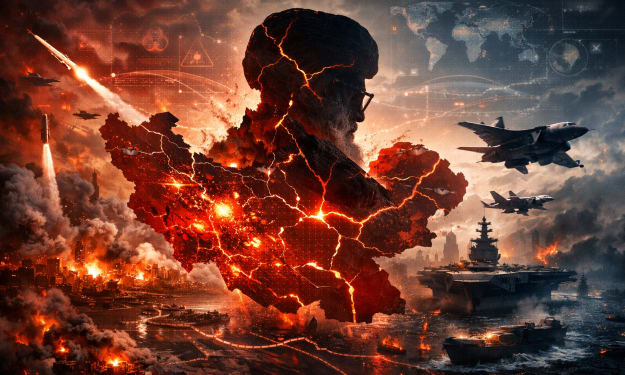
After Khamenei: How the Middle East Crisis Could Redraw Global Politics
After Khamenei: How the Middle East Crisis Could Redraw Global Politics The confirmed death of Ayatollah Ali Khamenei after joint strikes by the United States and Israel has sharply intensified the ongoing conflict in the Middle East—turning what was a dangerous regional crisis into a moment with global implications. Khamenei, who led Iran for nearly four decades and wielded extraordinary political and military influence, was killed when missiles and airstrikes hit Tehran in the opening phase of a major military operation targeting Iranian leadership and strategic infrastructure. The impact of his death is already reverberating across the region and the world in ways that may last for years.
By Wings of Time a day ago in Chapters



Comments
There are no comments for this story
Be the first to respond and start the conversation.